
Says limits on travel by beggars, illegal migrants; The NA Committee orders the promulgation of clear SOP
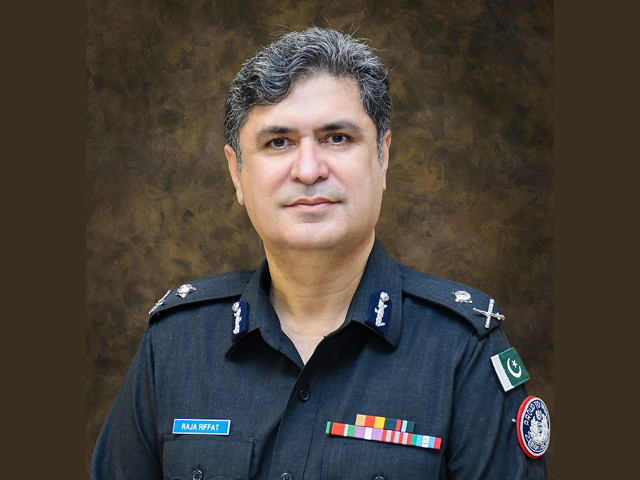
Inspector General of Police Sindh Riffat Mukhtar. PHOTO: FILE
ISLAMABAD:
The Federal Investigation Agency (FIA) has revealed to a parliamentary panel that it offloaded 66,154 passengers this year to curb organized gangs of beggars and illegal immigrants from traveling abroad.
“The rise in readings is multifaceted,” FIA Director General Riffat Mukhtar told the National Assembly’s Standing Committee on Overseas Pakistanis and Human Resource Development, chaired by Syed Rafiullah, on Wednesday.
The meeting was convened to examine the growing phenomenon of passengers being prevented from boarding flights as well as the role and performance of the Community Welfare Attaché (CWA) network in protecting Pakistanis abroad.
During the meeting, DG FIA briefed the committee on the operational realities in ports of departure.
The FIA director general clarified that 51,000 of these people were stopped due to questionable validity of their travel documents, which fall under three main categories: work visas, tourist visas and Umrah visas.
He highlighted that illegal migration and begging are seriously damaging Pakistan’s international image. He reported that 56,000 beggars were deported from Saudi Arabia, while the United Arab Emirates (UAE) had also imposed visa restrictions in light of the phenomenon.
Mukhtar said illegal migration trends had been observed towards Africa and even on tourist visas to countries such as Cambodia and Thailand. The FIA official defended the stringent measures needed to curb human trafficking and protect Pakistan’s international standing.
Noting that the increase in relief is a countermeasure against fraudulent migration rings, he revealed that 56,000 people involved in organized begging were recently deported from Saudi Arabia.
He pointed to growing restrictions from the United Arab Emirates and new illegal migration routes towards Africa and Europe as drivers of the increased vigilance.
The committee members welcomed the enforcement work, but stressed that enforcement must be paired with an available redress channel so that genuine travelers who are wrongly offloaded can obtain quick relief.
It directed the FIA and the Ministry of Home Affairs to finalize, publicize and operationalize a clear SOP for unloading and an airport visible grievance mechanism.
The panel was told that a risk analysis unit has been set up and an “IMMI” mobile application is being developed to improve pre-departure screening and real-time monitoring of immigration counters.
Members called for immediate interoperability between FIA systems and the Protectorate/E-Protector platform so that verification and ‘ok-to-board’ checks are carried out before passengers reach the airport counter.
The chairman emphasized that the public must be informed of how a passenger can challenge an off-loading decision and that contact details and an online complaint form be displayed at all airports.
Community Welfare Attaché (CWA)
The ministry presented the CWA network’s briefing.
Members were fully briefed on the legal basis of CWAs, the merit-based selection process, KPIs and the ministry’s expansion plan to restore and add CWA wings at priority stations.
The committee noted in detail the return from the Gulf region: CWAs reported that they collectively handled over 55,000 welfare cases by 2025, including more than 30,000 assisted repatriations/ETDs, 3,400+ death-related interventions and thousands of prison visits and legal aid interventions.
The committee welcomed these results, but also noted persistent operational limitations – employers’ confiscation of passports, employer resistance to dues recovery, host country legal restrictions, language barriers and weak outreach to remote labor camps.
It stressed that these limitations must be addressed through bilateral engagement and enhanced capacity in the mission.
In terms of the Gulf region’s achievements, members highlighted notable achievements – rapid issuance of emergency travel documents, targeted repatriations and coordinated legal support – while pushing for better prevention (pre-departure orientation and contract validation), improved employer engagement and a dedicated legal aid panel in mission posts to expedite legal aid.
The committee directed the Department to provide full station-by-station performance returns for each CWA in the Gulf, including case-level summaries, personnel lists and resource requests, and to provide a prioritized plan for the next ten new stations envisioned in the presentation.


