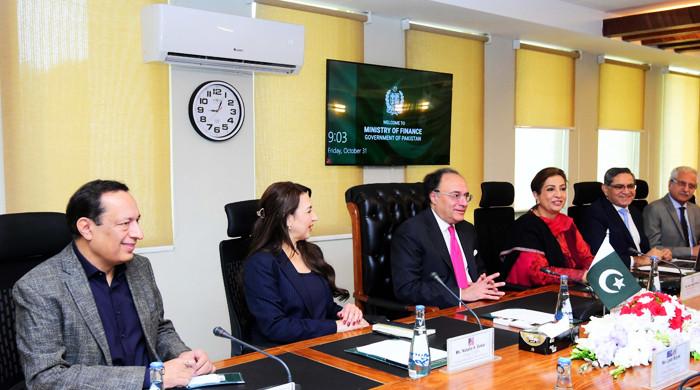
ISLAMABAD: In a bid to deepen bilateral cooperation in Pakistan’s fast-growing mineral sector, Critical Minerals Forum (US) President Robert Louis Strayer II and US Chargé d’affaires Natalie Baker met Finance and Revenue Minister Senator Muhammad Aurangzeb on Friday.
Discussions focused on improving cooperation in critical minerals exploration, ensuring supply chain security and promoting responsible, sustainable investment to unlock Pakistan’s vast mineral potential.
Both sides expressed commitment to continued engagement and cooperation in the mineral sector, in line with Pakistan’s economic reform agenda and shared goals of sustainable development.
Welcoming the delegation, the minister highlighted Pakistan’s stable economic trajectory, noting improvements across macroeconomic fundamentals and government reforms.
“Our priority is basic fiscal hygiene – building the discipline where capital flows in, stays invested and is secured through sound policies,” he said.
“This foundation is now translating into improved sentiment and positive signals from international rating agencies.”
The minister said Pakistan had embarked on deep-rooted structural reforms, including restructuring of the power sector, tax administration reforms, widening the tax base and a roadmap for fiscal sustainability.
He noted that the government separated tax policy and administrative functions by establishing a dedicated tax policy unit in the Ministry of Finance to ensure improved governance and efficiency.
“The 24 state-owned enterprises have been referred to the Privatization Commission as part of the government’s commitment to improve service delivery and increase fiscal discipline,” he said.
The minister also emphasized Pakistan’s strengthened geopolitical and economic partnerships and said that Pakistan today stands at a constructive intersection of global relations, renewed momentum in the Pakistan-US bond, proven ties with China and forward-looking strategic cooperation with the Kingdom of Saudi Arabia.
He said Pakistan’s mineral and mining sector represented a transformational opportunity.
“This provides Pakistan with a path to shift from consumption-driven cycles to export-led growth. A strong mineral policy framework will help Pakistan break the cycle of periodic balance of payments pressures and reduce future dependence on multilateral support.”
Strayer shared that the Critical Minerals Forum, funded by the US government, works globally to support secure and transparent mineral supply chains for US industry, particularly in emerging markets.
He said the forum focused on rare and niche metals, including copper and antimony, and aimed to de-risk investments from both financial and security perspectives.
He reiterated the forum’s commitment to supporting technology transfer, IP protection and US private sector investor confidence.
The US delegation noted that the US viewed Pakistan’s science, engineering and mathematics talent as a competitive strength and recognized Pakistan’s potential to become a future hub for critical mineral development.
The chargé d’affaires noted the embassy’s support for US commercial engagement in Pakistan and stressed the importance of ensuring strong investor confidence and enabling regulatory frameworks in the minerals sector.
The minister said Pakistan was working on important legal and regulatory reforms and would welcome structured proposals from the Critical Minerals Forum.
“We urge you to come back with a detailed framework for cooperation. Pakistan will evaluate it with a view to facilitating responsible investment and ensuring mutual benefit,” he said.