
Experts emphasize the prevalence of mental health problems during pregnancy at the AKUH seminar, stress knowledge gap
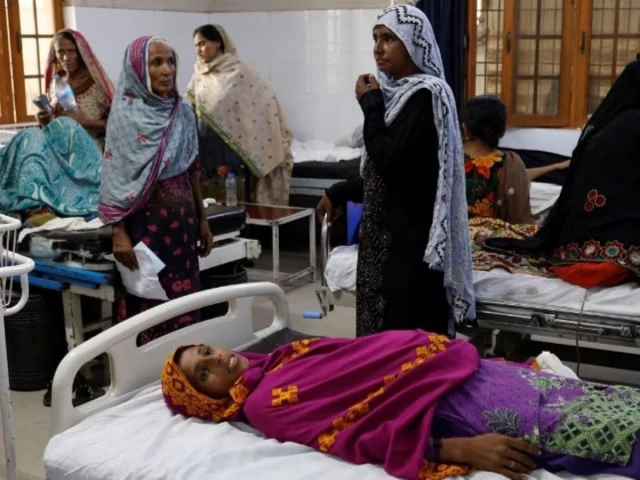
A pregnant woman lies on a hospital bed. Source: Reuters
“It’s a mystery why a woman’s womb contracts early. Is it the baby saying I’ve had enough? Is it the mother telling it to come out?”
This is how the dean of the School of Midwifery and Nursing (SONAM) at Aga Khan University (AKU), Dr. Salimah Walani, the session on Thursday. “Mostly research [on maternal health] is about how to save babies,” but we don’t know enough about how a mother’s mental health affects her unborn child.
According to Professor and Sally Smith Chair in Nursing at Queen’s University in Canada, Dr. Shahirose Sadrudin Premji, research shows that when a pregnant woman’s emotional well-being suffers, it increases the likelihood of premature births. She said that in 2020, Pakistan had a rate of premature births between 15.8% to 21.6%, with just over 61 infant deaths per year. 1000 on average and 154 maternal deaths per 100,000 live births (over a period of 42 days).
The dissemination seminar at AKU on Maternal Mental Health During Pregnancy: Impact on Generations to Come detailed the results of seven years of work on a project on maternal mental health. Out of 190 million pregnancies in low- and middle-income countries each year, 63 million women face mental health problems during pregnancy, Dr. Premji.
They enrolled 1,404 healthy, pregnant Pakistani women from different areas and across different socioeconomic brackets, excluding those who were users of mood-altering drugs, victims of terrorism, those suffering from pregnancy-related illnesses or HIV/AIDS. Those factors would have skewed the data, she said. On average, participants were in their late 20s and early 30s with varying educational backgrounds.
Read: Brain and mind: Experts push for multi-layered solutions for mental health, not just tertiary care
“The main objective of the project was to understand the pathways linking psychosocial distress and preterm birth… We have 14 peer-reviewed publications that have resulted from this effort.”
A publication, presented by assistant professor at AKU-SONAM, Dr. Sharifa Lalani, addressed whether psychosocial distress during pregnancy could predict preterm births (PTB). She said that all available data on this topic was collected from high-income countries and this was a misrepresentation of Pakistani women.
“Six million Pakistani women become pregnant a year… and 20%, 720,000, report suicidal and self-harming thoughts,” she said. “The economic burden of mental health has risen to $16.6 billion.”
In her paper, she said, her team focused on pregnancy-related anxiety (PRA) and whether this was an indicator of PTB, as well as the additional effect of chronic stress on PTB. They found that pregnant women who were anxious about their pregnancies were also more likely to have premature births. There were many factors, from the effects of socioeconomic status to family planning: the women who had not planned to become pregnant were four times more likely to have a preterm birth than those who had planned a pregnancy due to PRA.
She emphasized the need to identify stress and depression early in pregnancy and target psychosocial interventions to reduce the risk of PTB.
Vice-chairman and associate professor at the department of obstetrics and gynecology and head of medical services at AKU’s Kharadar campus, Dr. Sidrah Nausheen, shared some counterintuitive findings from her paper seeking to understand the social factors that might modify the effects of PRA, general anxiety and depression during pregnancy.
She found that women who had very little support from their families, even though it increased their anxiety, actually reduced the chances of PTBs by almost a quarter, and for women who received familial support, they could see an “increase in PTB” despite not having chronic anxiety due to a hostile family environment.
Read more: One in three Pakistanis suffer from mental disorders
When asked about this, she reasoned that it was possible that “since the woman is used to it [hostile home environment]she may not feel the effects of this as much”.
Women with less education were found to have less anxiety about pregnancy as a whole, leading to a lower risk of PTB. “As a doctor, if I get sick, I’m going to worry myself to death with every little symptom. Obviously, not knowing what you’re going through will leave you less worried,” she said.
Assistant professor in obstetrics and gynaecology, Dr. Neelofur Babar, spoke about the need to understand how allostatic stress—the “wear and tear” on the body from chronic stress—affects PTBs in her paper. “In normal pregnancies, the body becomes less responsive to stress to protect the baby and the mother,” she said, questioning whether there were ways to biologically predict (such as through a blood cholesterol test) PTB.
She found that allostatic load directly leads to premature births (which makes sense), but maternal mental health, like feelings of anxiety and depression, did not directly contribute to PTBs.
That’s not to say that mental health doesn’t matter here; on the contrary, because of its effect on the “wear and tear” of the body, it is essential to grasp and keep in check.


