
The party’s three-day annual congregation begins at Lahore’s historic Minar-e-Pakistan
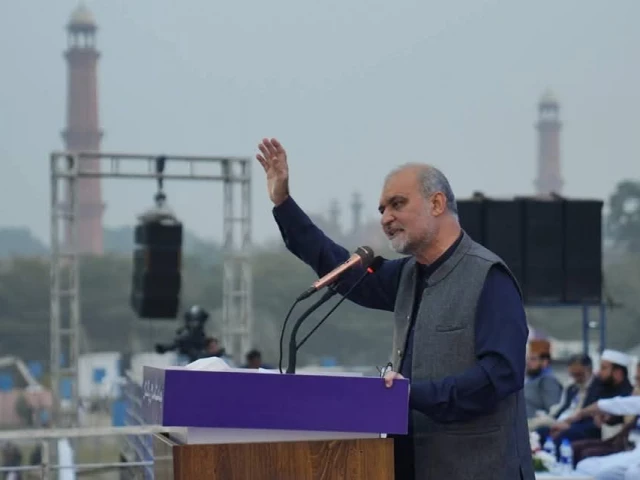
JI chief Hafiz Naeemur Rehman addresses the inaugural meeting of the party’s three-day congregation beginning at the historic Minar-e-Pakistan in Lahore. Photo: X
Jamaat-e-Islami chief Hafiz Naeemur Rehman said that the prevailing political and constitutional turmoil regarding the 27th series of constitutional amendments had heightened public concern and created new challenges to the fundamental rights of citizens and the structure of government. He added that his party did not seek power through conspiracies and would not participate in any opaque election process.
Addressing the inaugural meeting of the party’s three-day annual congregation at Lahore’s historic Minar-e-Pakistan, he said Pakistan at this critical juncture required clear direction and unwavering constitutional supremacy so that every citizen could feel part of a just and fair system.
Naeem described the gathering at Greater Iqbal Park as a symbol of unity, noting that thousands of participants from across the country had transformed it into a disciplined congregation unparalleled in scale. He argued that the organizational standards demonstrated at the site reflected the tireless work of thousands of volunteers who ensured facilities for all participants, including women, and created an administrative model that he believed no political party or government could replicate.
Referring to JI’s ideological and historical foundations, he said the movement initiated by Syed Abul Al’la Maududi had evolved into a broad-based effort dedicated to the establishment of a just social order. He emphasized that JI should not be seen simply as a political party driven by personal interests or controlled by influential families or institutions, but rather as a religious and social movement committed to service across sectarian and communal divides.
Read: Factory blast in Faisalabad kills 20 with manager, staff arrested as owner flees
Commenting on global politics, Naeem criticized the concentration of economic power in the hands of a small global elite and pointed to what he described as destabilizing American politics.
He said prolonged wars and unwavering support for Israel had exacerbated humanitarian crises in several regions, while the use of veto powers at the international level had obstructed justice for oppressed communities. He argued that no unjust system could sustain itself indefinitely and called on the Muslim world, including Pakistan, to play a more active role in shaping a more just global order.
Talking about Kashmir and Palestine, the JI chief said Pakistan must continue to uphold its principled stand while maintaining that JI had always supported the state in difficult times – even when the party disagreed with the establishment. He added that Kashmir could not be compromised and that the Palestinian issue had long been central to the political discourse in the subcontinent.
In terms of domestic governance, Naeem argued that for decades Pakistan’s system had remained in the grip of entrenched power structures that limited citizens’ rights. He said the combined influence of landlords, capitalists and bureaucracy had deprived the common people of education, employment, justice and inheritance rights.
Also read: KP CM slams Punjab over ill-treatment of Imran Khan’s sisters
According to him, deep-rooted class divisions had adversely affected children’s education and women’s rights, slowing down national progress. The JI chief criticized the state’s neglect of regions such as Balochistan, Khyber-Pakhtunkhwa and Sindh, linking persistent local grievances to long-standing administrative failures.
He added that JI will continue to advocate for farmers, workers and young people on all platforms. He also pointed to the recurring agrarian crisis in Punjab and what he called the malign role of various mafias.
Pakistan, he noted, did not belong to a single individual but to the millions who sacrificed for independence. To steer the nation out of despair, he said a comprehensive political and social roadmap would be announced on the third day of the congregation and the movement would then continue nationwide.
He concluded that Pakistan could not progress without a just system and that no power could hinder a united public once it chose to assert its rights. The session was also addressed by Jamaat-e-Islami Deputy Chief Liaquat Baloch, Dr. Osama Razi, Secretary General Ameer ul Azeem and others. Thousands of participants, including women and children, have traveled from all over the country to attend the congregation, which concludes on Sunday afternoon.


