
HAL has struggled to meet production targets, delaying the induction of operational aircraft
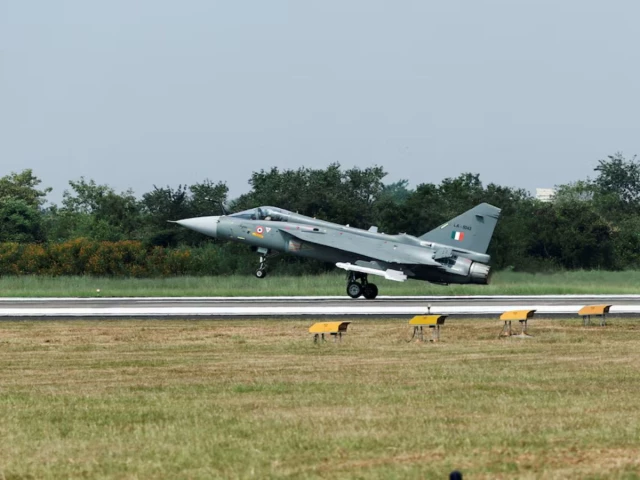
Hindustan Aeronautics Limited (HAL) Tejas Mark 1A, a light combat aircraft takes off ahead of its maiden flight at HAL Nashik, India, October 17, 2025. PHOTO: Retuers
ISLAMABAD:
The crash of the Tejas lightweight indigenous fighter, developed by India’s Hindustan Aeronautics Limited (HAL) and the Defense Research and Development Organization (DRDO), has raised serious concerns about the fighter’s operational readiness, safety standards and lingering technical difficulties.
The crash, which occurred during a public aerobatic performance at the Dubai Air Show, has prompted aviation experts and military analysts to weigh in on the series of systemic flaws that have plagued the Tejas program for decades. Although the exact cause is still under investigation, experts suggest that a combination of technical failures, systemic problems during development and operational pressures may have played a decisive role in the crash.
Aviation experts point to a history of development delays, chronic quality control issues, engine integration difficulties and a general dissatisfaction by the Indian Air Force (IAF) with the aircraft’s performance. These problems have over time resulted in a warplane that has struggled to meet both internal expectations and external demands.
The Tejas program, which started in the 1980s, was touted as India’s flagship indigenous fighter, a symbol of the country’s confidence in combat aviation. However, almost four decades of development have been marked by delays and technical setbacks. The aircraft only became operational in the past decade, and even then it has been fraught with problems.
The latest in a series of worrying incidents was the crash of a Tejas warplane near Jaisalmer in the Indian state of Rajasthan on March 12, 2024, following an engine failure caused by an oil pump failure. Preliminary investigations pointed to this error as a critical error rather than pilot error.
The crash highlighted the vulnerability of the Tejas, a single-engine aircraft, to catastrophic failure when its propulsion system fails. It served as an early warning that the aircraft’s engine remained unreliable despite years of development.
According to aeronautics and aviation experts, the ongoing issues with the Tejas engine are compounded by procurement and supply chain issues. Despite HAL’s efforts to integrate local systems, the aircraft has been dependent on imported GE F404/F414 engines, which have suffered from delayed deliveries and occasional shortages of gearboxes and accessories.
These delays have forced the IAF and HAL to shift production timelines, delay deliveries and scramble for temporary solutions – all of which have compressed test schedules and created operational risks. All these concerns were confirmed by the Dubai plane crash, prompting aviation experts to draw links between the failure at Jaisalmer and the more recent crash.
The Tejas was originally envisioned as a multi-role fighter to replace the aging fleet of Russian MiG-21s in the IAF. However, the program’s development course has been far from smooth. The timeline, spanning 40 years, has been plagued by unstable design requirements, technology gaps and an inability to freeze a final configuration for the aircraft.
Despite these problems, the Tejas continued to be showcased at international air shows as a symbol of India’s growing defense capabilities. However, the aircraft’s ability to meet the IAF’s stringent operational requirements is still in doubt as major issues remain with radar integration, defensive systems and combat survivability.
Another major contributor to Tejas’ operational woes is the state of HAL’s manufacturing processes. Over the years, HAL has faced recurring quality control issues which have compromised the safety and reliability of the Tejas fleet.
HAL has struggled to meet production targets, delaying the induction of operational aircraft. Despite huge investments, HAL’s production capacity has been insufficient to meet the demand for Tejas jets within the IAF.
Reports of fluid leaks, panel misalignment, premature seal wear and grounding issues have plagued the Tejas fleet. These defects indicate lapses in HAL’s quality control processes and failure to ensure that the aircraft meets basic operational standards before delivery.
Meanwhile, HAL’s reliance on manual procedures instead of automated controls has contributed to human error during assembly and maintenance. The lack of automation in quality control has made it difficult to maintain high production standards, which is critical for military aircraft.
The Dubai crash exposed these deficiencies as visible fluid leaks and other mechanical defects were visible before the flight. These defects should have been corrected during pre-flight inspections, but the hasty nature of the demonstration, combined with ongoing maintenance and quality control issues, led to a catastrophic mid-flight failure.
The Tejas was originally designed to be powered by the original Kaveri engine. However, the failure of the Kaveri engine project forced HAL to rely on foreign engines – GE F404/F414 – which were not optimally suited to the aircraft’s airframe. This mismatch has resulted in numerous performance problems, including thrust limitations, aerodynamic disturbances, and increased maintenance complexity.
These performance limitations were particularly evident during the aerobatics at the Dubai Air Show, where the Tejas was pushed to its limits, exacerbating any underlying problems with the engine or flight systems.
The Tejas uses a digital fly-by-wire system, a modern feature that should provide greater control and precision during flight. However, the system has faced significant instability problems since its introduction, including excessive sensitivity, software fixes, and pilot-autopilot discrepancies.
Given the sensitivity of the Tejas’ flight control system and the unresolved software issues, it is likely that the crash in Dubai was partly caused by the combination of these factors, making it more difficult for the pilot to regain control during the high-stress aerobatic routine.
According to defense analysts, political pressure has also played a major role in the trajectory of the Tejas programme. As part of India’s “Aatmanirbhar Bharat” (Self-reliant India) and “Make in India” initiatives, the Tejas has become a symbol of national pride. However, this political pressure has often overshadowed technical concerns, leading to the aircraft being showcased at international air shows despite ongoing problems with its design and performance.
They believe that the desire to project strength and technological prowess on the global stage has led to a situation where the aircraft was pushed into demonstrations before it was fully operational, downplaying its technical shortcomings in favor of national optics. This approach, while boosting India’s image, has clearly compromised the safety and performance of the Tejas.
Analysts say the Dubai crash is a reminder of the deep-rooted problems in India’s military-industrial complex. It emphasizes the importance of prioritizing technical readiness, quality control and safety over political considerations in defense development.
The Tejas program, supposed to be a symbol of India’s self-reliance, has instead become a case study in how repeated technical failures, compounded by political pressure and systemic inefficiency, can lead to catastrophic outcomes.


