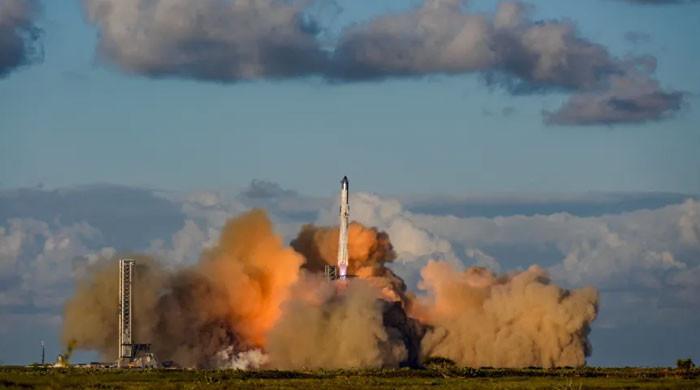
A towering first-stage booster for an upgraded version of SpaceX’s Starship rocket suffered a test failure in Texas on Friday, potentially complicating the company’s efforts to prove the rocket’s lunar landing capabilities to NASA, according to observers who caught it on video.
Elon Musk’s SpaceX had rolled out the upgraded stainless steel Super Heavy booster to a test pad on Thursday at the company’s Starbase rocket facility, saying it intended to test its redesigned propellant systems and structural strength.
During a test on the pillow around 04 a.m. CT Friday, a zoomed-in live video feed, a new tab from SpaceX watchdog LabPadre, showed the booster suddenly tensing up and releasing a cloud of gas from its sides, indicating an explosion had blown up its exterior.
SpaceX acknowledged in a statement what it called an “anomaly during pressure testing of the gas system” and said there were no injuries. The mishap, SpaceX said, happened before it was supposed to test the booster’s structural strength.
“The teams need time to investigate before we are sure of the cause,” the company said.
SpaceX had hoped to fly the booster, as well as its Starship upper stage, which was not involved in Friday’s test, early next year for the company’s 12th Starship flight demonstration since 2023. Friday’s mishap is likely to hit that goal.
Spaceship central in the race to the moon
The company has faced pressure from NASA to advance its whirlwind Starship development program into a new phase of testing involving features related to the rocket’s future lunar landings, a multibillion-dollar mission for the US space agency that would put the first humans on the moon’s surface since 1972.
The mission has made Starship a key component of the U.S. lunar program, which is under increasing pressure to achieve a landing before China does by around 2030. NASA’s current and future leadership camps have discussed how best to return humans to the moon as China’s space program advances.
The booster that crashed Friday was the first of the Starship V3, an iteration of the rocket that SpaceX has said includes a number of new designs and features related to the lunar program.
SpaceX is known for rapid production of multiple booster iterations as part of its capital-heavy trial-to-error ethos of rocket development. But it was unclear whether it readily had another V3 booster it could resume testing with, or how many months the mishap might set back the Starship program.
Of the five Starship flight tests this year, the first three suffered complex and explosive setbacks before SpaceX resumed steady progress in August, making it a bumpy year. Starship’s last flight in October was the last test before SpaceX moved to build the V3 version, which it hoped to fly in February 2026.
Starbase, the sprawling SpaceX Starship facilities in South Texas, has had several test explosions in the past. A Starship booster exploded in a giant fireball on its test pad in June, sending debris across the US-Mexico border two miles (3.22 km) away and sparking political tension with the country’s president.