
- Russia is forming a national AI task force to ensure technological and national sovereignty
- President Putin insists that only Russian-designed AI systems will serve national security purposes
- Sberbank and Yandex are developing homegrown LLMs such as Gigachat and Yandex GPT
President Vladimir Putin has confirmed that Russia will create a national task force to coordinate the development and deployment of domestically produced artificial intelligence.
The initiative aims to strengthen Russian technological sovereignty and reduce dependence on foreign systems as other nations lead the way in AI development.
The task force will focus on building new data centers and securing reliable energy sources, including small nuclear power plants, to sustain AI infrastructure.
Putin is at the center of things
Putin claimed that AI-powered technologies are expected to contribute over 11 trillion rubles to the country’s gross domestic product by 2030.
He called for a national AI implementation plan with the task force, urging both government institutions and private companies to integrate AI more fully into operations.
“For Russia, it is a matter of national, technological and value-based sovereignty. Therefore, our country must possess a comprehensive set of its own technologies and products in the field of generative AI,” Putin said at the AI Journey, an AI event in the country.
Despite being far behind the US and China, some Russian firms claim to have developed models in major languages, including Gigachat and Yandex GPT, through Sberbank and Yandex.
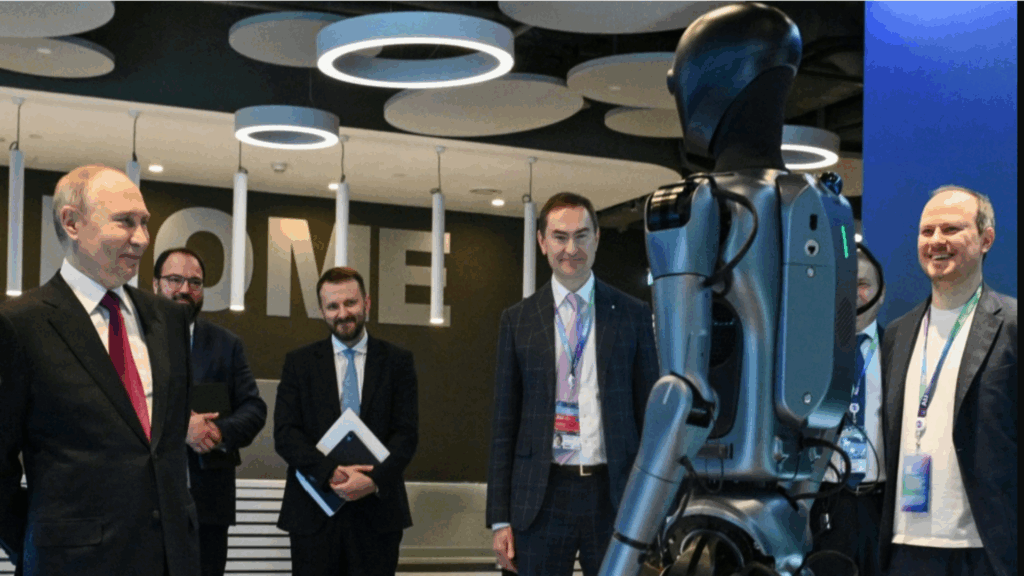
Sberbank, in particular, says it has evolved from a traditional bank into a technology-focused company, demonstrating humanoid robots for health-scanning machines at the event.
Putin emphasized that reliance on foreign LLMs is unacceptable, saying that only Russian-designed AI systems should be used for national security and intelligence gathering.
Russian authorities are reportedly working on autonomous drones capable of operating in swarms and hitting targets at distances of up to 100 kilometers (62 miles).
Ukrainian drone experts have highlighted this development as potentially transformative for military operations, especially with AI-enhanced targeting and coordination.
Putin also said excessive regulation should not hinder AI progress, and military or civilian applications will be developed within the national framework.
Western sanctions, which limit hardware imports, including microchips, have limited Russia’s ability to expand its computing capacity and develop AI tools on a large scale.
The national task force plans to mitigate these problems by focusing on domestic production of necessary components and ensuring a continuous energy supply.
Via Cybernews
Follow TechRadar on Google News and add us as a preferred source to get our expert news, reviews and opinions in your feeds. Be sure to click the Follow button!
And of course you can too follow TechRadar on TikTok for news, reviews, video unboxings, and get regular updates from us on WhatsApp also.


