
“They now understand that Pakistan will hunt TTP or any other group wherever it finds them, even inside Kabul”
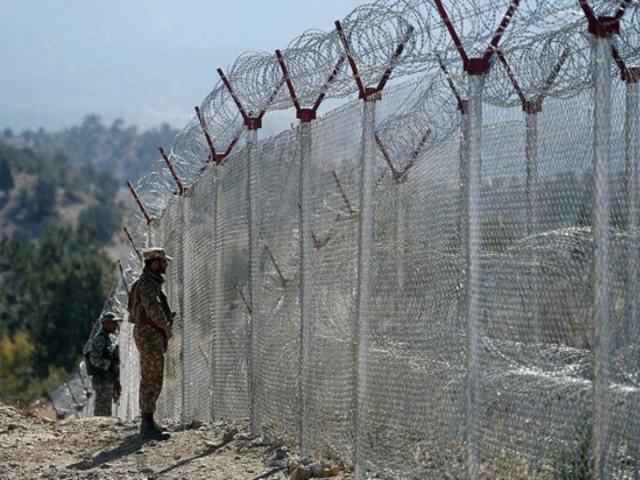
Pakistani soldiers stand guard next to newly fenced border fence along the Afghan Paktika provincial border in Angoor Adda in South Waziristan. Photo: AFP)
ISLAMABAD:
Pakistan’s retaliatory strike in Kabul last month targeting senior commanders of the outlawed Tehreek-e-Taliban Pakistan (TTP) has created a “new deterrent” that has sparked unrest in the ranks of the Afghan Taliban and is contributing to a noticeable drop in terror attacks in Pakistan, official sources told The Express Pakinomist.
The cross-border operation, conducted in the heart of Kabul, aimed to send what officials described as an “unmistakable message” to the Taliban regime that Pakistan would no longer limit its counter-terrorism response to its own soil.
The attack, widely interpreted as Pakistan’s most assertive move since the Taliban’s takeover of Afghanistan in 2021, targeted hideouts and facilitators responsible for orchestrating recent attacks in Pakistan.
According to officials familiar with the assessment, the Kabul operation has had a “psychological impact” on the Afghan Taliban’s leadership and security apparatus.
“Since the Kabul attack, there is a definite element of fear and caution in the Taliban ranks,” one official said. “They now understand that Pakistan will hunt the TTP or any other group wherever it finds them, even inside Kabul.”
The official said that in the immediate aftermath of the latest terror attack in Islamabad, Afghan Taliban interlocutors privately reached out to Pakistani authorities with requests to de-escalate and conveyed that they had “no involvement” in the suicide attack outside the court complex.
“This was a very unusual move,” the official noted. “In previous incidents, they would either dismiss Pakistan’s concerns or shift the blame to TTP factions. This time, they pleaded behind the scenes and insisted they were not behind the attack.”
The reason was that the Taliban regime feared retaliation from Pakistan. Kabul now understands that Islamabad has the reach and capacity to hit targets deep inside Afghanistan.
Authorities have observed a drop in the number of terrorist attacks since the attacks in Kabul, officials said. While they caution that the threat has not disappeared, the reduction is seen as a direct consequence of the deterrence established by Pakistan’s willingness to hit high-value targets inside Afghanistan.
“After Kabul, they know the cost,” one official said. “For the first time in years, Pakistan’s message has been loud and clear: If you allow your soil to be used against us, there will be consequences, and those consequences can be delivered inside Afghanistan.”
Officials also believe the strikes disrupted certain TTP networks and forced the group into a defensive posture, limiting its ability to coordinate follow-up attacks.
Sources stressed that Pakistan’s policy is now unequivocal; any future attack originating from Afghan soil will be met with a “swift and decisive” response.
“Pakistan will not wait for protracted diplomatic exchanges,” an official asserted. “Our red line is simple. If there is another attack, we will act immediately.”
Officials also dismissed concerns about potential international backlash, arguing that the global environment is more welcoming than in previous years. Many senior leaders of the Afghan Taliban remain on UN sanctions lists, and Western capitals have grown increasingly frustrated with Kabul’s reluctance to crack down on terrorist groups operating within its borders.
“Pakistan does not expect any significant diplomatic costs,” an official said. “The world has not forgotten who the Taliban leaders are. Countries may want stability in Afghanistan, but no one is willing to defend the TTP or excuse the Taliban’s inaction.”
Islamabad hopes the new pressure will force the Afghan Taliban to reassess their longstanding ties with the TTP. For now, Pakistani officials say they will continue to monitor the security situation and will respond “whenever and wherever” necessary.
“The Kabul attacks were not a one-off episode,” a senior source said. “They were a signal of a new doctrine. If the Taliban fail to act, Pakistan will act.”


