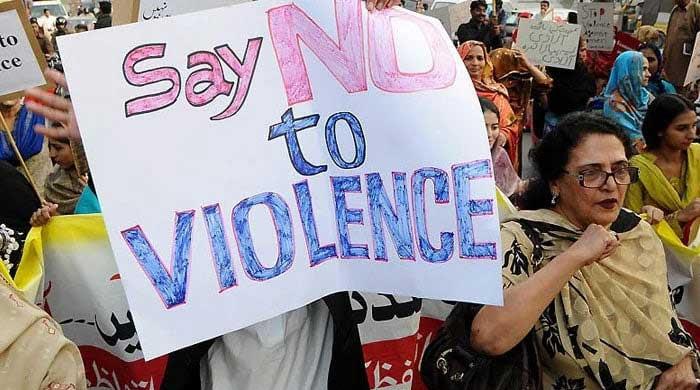
Every year, the International Day for the Elimination of Violence against Women forces us to confront a painful truth: violence against women in Pakistan is neither rare nor remote.
It plays out in ordinary homes, in the homes of people we know, among friends who smile through their pain and insist they are fine, and in the lives of women who continue to move through each day with strength and grace while enduring far more than they ever reveal.
Many carry emotional and physical wounds quietly because speaking up often brings disbelief, judgment or shame. And for those seeking justice, the process can be as painful as the violence itself, forcing them to relive their trauma in front of strangers.
According to police data, more than 32,000 cases of violence against women were reported in 2024. Over 5,000 women and girls were raped, more than 24,000 were abducted, and 547 were killed in the name of honor. These figures are disturbing, but they also show that more families are reporting crimes rather than remaining silent.
The Pakistan Demographic and Health Survey shows that almost one in three married women have experienced physical, emotional or sexual violence from a spouse. The conviction rate remains low and women are often humiliated during the process. Many survivors describe the legal system as another ordeal.
Our response must be firm, compassionate and rooted in the values we claim as a society. Islam emphasizes dignity, compassion and justice in the family, guided by the Qur’anic instruction to live with spouses in kindness. A home built on fear or cruelty is contrary to this principle. Protecting vulnerable members of a household is both an Islamic and a Pakistani responsibility.
It is within this moral and social context that the Prevention and Protection of Domestic Violence Bill 2025 was drafted and passed by the National Assembly. The bill recognizes that domestic violence is not limited to physical harm. Emotional intimidation, psychological manipulation, verbal degradation and financial coercion are equally harmful forms of abuse that erode a person’s dignity and well-being.
As the author of this bill, I carried the voices of women who never made it into the system. I fought for this law because their silence was never a choice.
Each clause reflects a journey of resistance, perseverance and the belief that legislation should serve those who cannot fight for themselves. From its drafting to its passage in the National Assembly, this has been one of the most challenging and deeply personal legislative journeys of my public life.
To make protection meaningful, the bill establishes protection committees across Islamabad to monitor cases and coordinate services. protection officers will help survivors file complaints, obtain medical examinations, access shelters, secure emergency protection orders and understand their rights. For the first time, the burden shifts from the bereaved to the state.
The bill empowers courts to issue immediate and emergency protective orders to prevent escalation and protect women and children. It requires hospitals, police and social services to coordinate their efforts so that survivors are not sent from one office to another.
Recognizing that many remain in precarious environments due to economic dependency, the bill introduces monetary relief and compensation for medical treatment, loss of income, relocation and urgent needs.
This legislation is not limited to women. It extends protection to men, children, transgender people, the elderly, people with disabilities and all vulnerable individuals living in a household. Domestic violence can affect anyone and every person deserves safety and dignity in their own home.
The bill also strengthens Pakistan’s constitutional responsibility to uphold the right to life, dignity and equality of all citizens. It fulfills obligations Pakistan has already undertaken under CEDAW, the Convention on the Rights of the Child, the ICCPR, the Universal Declaration of Human Rights and the Sustainable Development Goals.
These are commitments that Pakistan voluntarily and proudly accepted. Leading this bill through the National Assembly has been one of the most meaningful tasks of my public life. It reflects the courage of the women of Pakistan and the vision of Shaheed Mohtarma Benazir Bhutto, who believed that the dignity of women is inseparable from the dignity of the nation.
The Senate now bears responsibility for completing this reform. This bill is not about conflict between the sexes, but about fairness, justice and the fundamental promise that every individual deserves safety in their own home.
Implementation is where this law will stand or fall. Even the strongest legislation is meaningless without enforcement. Pakistan cannot afford a gap between what is written and what is delivered.
Any delay in appointing protection officers, activating protection committees, notifying regulations or training frontline responders leaves survivors vulnerable and unprotected. Implementation is the dividing line between safety and harm, between justice realized and justice denied.
This is a story of courage, responsibility and a Pakistan that chooses a safer and more dignified path for all. If we commit to enforcing this law with the seriousness it requires, thousands of women, children, transgender, elderly and vulnerable people will finally have a state that stands with them, not against them. The journey does not end here.
This is where it really begins.
The writer is a member of the National Assembly. She has a Ph.D. in Law and serves on the National Assembly’s Special Committee on Kashmir.
Disclaimer: The views expressed in this piece are the author’s own and do not necessarily reflect Pakinomist.tv’s editorial policy.
Originally published in The News