
Says it does not conduct covert operation; Pakistan never attacks civilians; Highlighting the threat posed by US-made weapons
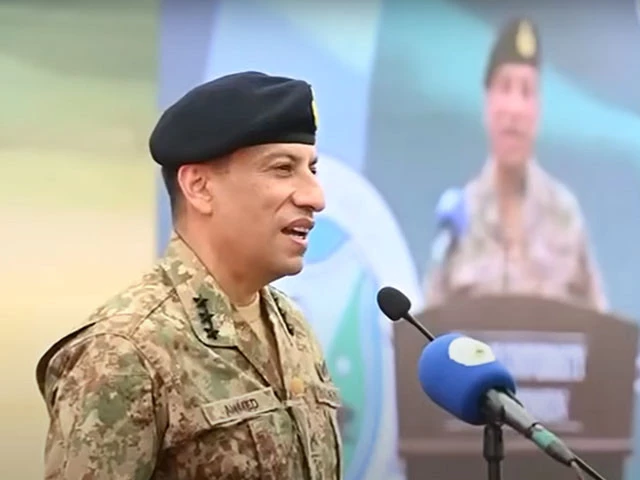
Director General of Inter-Services Public Relations (ISPR), Lt. Gen. Ahmed Sharif Chaudhry, addresses students at Jinnah University for Women in Karachi on June 17. Photo: ISPR video screen grab
ISLAMABAD:
Pakistan’s army on Tuesday strongly rejected Kabul’s claims that Islamabad carried out airstrikes on Afghan territory, insisting that Islamabad neither conducts covert cross-border operations nor targets civilians.
Speaking to reporters in Rawalpindi, Inter-Services Public Relations (ISPR) Director General Lt. Gen. Ahmed Sharif Chaudhry said the allegations by the Afghan Taliban that Pakistan “bombed” Khost and carried out attacks in Kunar and Paktika were “baseless and factually incorrect.”
“When we conduct an operation, we announce it openly. In October, when we struck inside Afghanistan, we informed everyone,” he said.
“Pakistan never attacks civilians. Our problem is not with the Afghan people but with terrorism. Blood and trade cannot continue together, it cannot happen that we face attacks and still carry on as usual.”
Earlier, the Afghan regime’s spokesman claimed that Pakistan carried out airstrikes in three provinces, killing civilians.
The allegations and counter-allegations came amid strained ties between Pakistan and the Taliban regime. Pakistan has said its patience has finally run out as Kabul failed to rein in terror groups, including the outlawed Tehreek-e-Taliban Pakistan (TTP).
On border management, DG ISPR said the Army and Border Corps were effectively securing the border. He referred to talks in Doha and Istanbul, where Afghan interlocutors had at times threatened to allow “6,000 TTP terrorists to enter Pakistan.” He accused Afghan authorities and militants of pushing anti-Pakistan narratives, including talk of a so-called “Greater Pashtunistan”, and warned that senior Afghan officials themselves had issued statements signaling intentions to attack Pakistan.
DG ISPR highlighted the growing threat posed by US-made weapons left behind after the US withdrawal from Afghanistan.
“American weapons were found even in the Mianwali terror attack,” he said. “These missiles and weapons have become a threat to the whole world.”
He said militants were using American weapons and bulletproof vehicles bought through drug money, and such weapons had been used in 29 terrorist incidents in Pakistan.
Giving an overview of counter-terrorism operations, Lt Gen Chaudhry said 67,000 operations had been conducted since January, 1,387 in Khyber-Pakhtunkhwa and 3,485 in Balochistan. While Balochistan remained the most active front, Punjab and KP also saw sustained action.
These operations resulted in 210 militants killed, but came with heavy losses for Pakistan.
“This year, 607 security personnel have been martyred,” he said. “In November alone, 4,910 operations were conducted during which 57 Army and FC soldiers embraced martyrdom, including 22 from the Army.”
Civilian casualties included 14 people, while 11 of the martyrs were from the Frontier Corps.
The Directorate General of ISPR said Pakistan had tightened border controls and curbed smuggling even for those who previously had permits. He noted that the army and Balochistan government had sharply reduced diesel smuggling from Iran, cutting it by Rs 20.2 billion.
“Stopping smuggling is primarily the responsibility of the provincial government, but we fully support them,” he added. Reiterating Islamabad’s resolve, he said Pakistan would continue to fight terrorism with national unity.
“The war against terrorism must be won by the army and the people of Pakistan. Regardless of the nature of this war, Pakistan will prevail.”
Separately, Federal Information Minister Attaullah Tarar revealed that the suicide bomber who attacked Islamabad’s District Courts in Sector G-11 on November 11 was an Afghan national. He said the attack was planned in Afghanistan under the supervision of TTP chief Noor Wali Mehsud.
Addressing a press conference, Tarar said the bomber had been identified as Usman Shinwari, a resident of Nangarhar, Afghanistan.
According to the minister, militants had planned major attacks in Rawalpindi and Islamabad, but the bomber did not reach any high-security area and targeted the first available location on the outskirts of the city.
He said that within 48 hours, the Intelligence Bureau and the Counter Terrorism Department arrested four suspects involved in the plot – Sajidullah alias Sheena, Kamran Khan, Muhammad Zali and Shah Munir.
An alleged confessional statement by Sajidullah alias Sheena – declared the key handler – was also shown during the briefing.
Tarar said Sajidullah had joined the Afghan Taliban in 2015 and received training in several camps inside Afghanistan. He allegedly transported the bomber and the suicide jacket.
The minister claimed that the entire operation was planned in Afghanistan by TTP emir Noor Wali Mehsud acting through his commander Dadullah who is also present in Afghanistan.


