
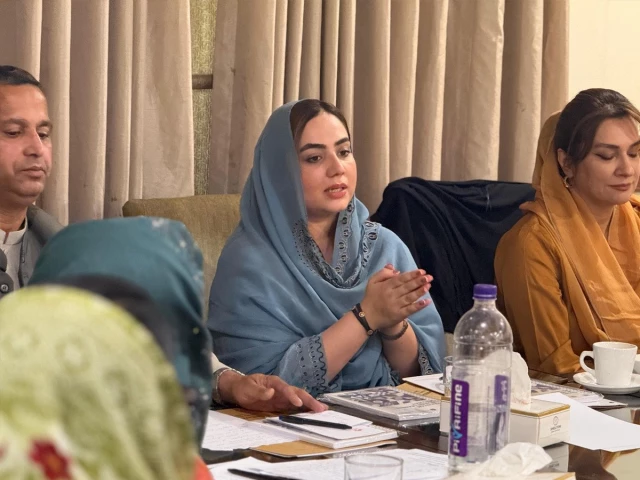
Commission Chair Sumira Shams emphasizes the importance of accurate, timely documentation for effective policymaking
Dr. Sumira Shams, Chairperson of the Khyber-Pakhtunkhwa Commission on the Status of Women. Photo: facebook.com/kpcsw.gov.pk/
The Khyber-Pakhtunkhwa Commission on the Status of Women reviewed several laws, policy initiatives and proposed recommendations, including incorporating inheritance rights into policy, ensuring enforcement of existing laws, eliminating dowry practices and integrating certain traditional economic practices into curricula.
A hearing of key stakeholders on the Women’s Empowerment Policy 2026-30 was held in Peshawar on Wednesday under the auspices of the Khyber-Pakhtunkhwa Commission on the Status of Women.
The session gathered Dr. Sumira Shams, President of the Commission; MPA Sobia Shahid; Zainab Qaiser Khan, Head of the UN Women Sub-Office in KP; and representatives from the Information, NADRA, Labor and Welfare Departments as well as other government institutions and civil society organizations.
The workshop reviewed several laws and policy initiatives, including the KP Enforcement of Women Property Rights Act 2019, revisions to the Women Empowerment Policy, gender mainstreaming in the KP Climate Change Policy 2022, gender analysis reports for education and health (2024), strict enforcement of anti-harassment implementation, measures against women’s marriage strategy and funding for women’s marriage policy and funding.
In his speech, Dr. emphasized Sumira that KP’s previous women’s empowerment policy had ended its tenure, making it imperative to draft a new policy that addresses existing gaps. She highlighted the need for support from public representatives and institutions to improve women’s rights, legislation, implementation and participation across different sectors. She also emphasized the importance of accurate and timely documentation for effective policy making.
Gender specialist Syeda Nadrat from the Social Welfare Department provided a detailed briefing on key advances and challenges in women’s empowerment. She noted that despite existing laws, implementation had been delayed due to several factors. She also highlighted a significant literacy gap in the province, with male literacy rates at 64-66 per cent compared to just 37 per cent for females.
The KP Women’s Commission concluded the session by stating that a comprehensive implementation plan for the Women Empowerment Policy 2026-30 will be finalized soon to ensure effective implementation and monitoring.


