
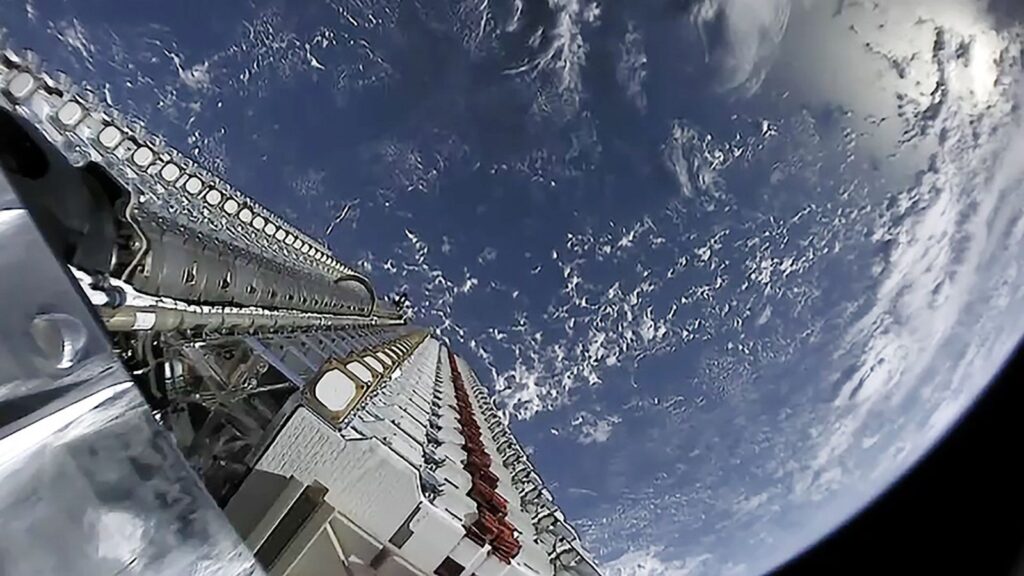
- A Chinese study shows that it is possible to block Starlink over Taiwan
- 1,000 to 2,000 drones with jamming equipment could create an ‘electromagnetic shield’ to do this
- However, it would be far from easy to keep such a drone operation running
Chinese scientists have demonstrated how it is theoretically possible to use a large swarm of drones to jam satellite internet from Taiwan in a ‘large-scale electronic warfare’ simulation.
Tom’s Hardware reports that the study, as highlighted by the South China Morning Post (SCMP), found that it would take around 1,000 or possibly up to 2,000 specially adapted jamming drones to plunge all of Taiwan into internet darkness.
The study was run by Zhejiang University & Beijing Institute of Technology, and as SCMP explains, “Hundreds or thousands of small, synchronized jammers would need to be deployed across the sky – on drones, balloons or aircraft – forming an electromagnetic shield over the battlefield.”
Starlink has become a focus for China since Musk’s Starlink satellites were deployed to help Ukraine, after it was attacked by Russia in 2022, re-establish battlefield communications.
Denying Starlink in such a total way would not be an easy task as you might imagine. Musk’s satellites have smart technology on board, and compared to a typical satellite, their collective ‘mesh network’ nature makes them much harder to jam.
SCMP says the Chinese scientists used real Starlink data to create a simulation of the positioning of Musk’s satellites over a 12-hour time frame. They then devised a grid of jamming drones—using a mix of wide- and narrow-beam electronic noise-generating jammers flying at an altitude of 12 miles (20 km)—so that they successfully jammed the signal to the ground in all areas.
The conclusion was that 935 coordinated drones would have to create the necessary ‘electromagnetic shield’ to completely block Starlink from Taiwan. However, lower-powered (cheaper) drones could be used instead — deploying about 2,000 would work, according to the report.
Analysis: a costly endeavor to realize
Clearly, mobilizing 1,000 or indeed 2,000 drones loaded with specialized jamming equipment will be a headache – for it is not only about the initial deployment in a shield formation, but also about keeping those drones in place. That includes swapping them out for replacements as needed as they need to be refueled in a sustained internet blocking campaign that runs for some time.
It wouldn’t be cheap, and it wouldn’t be easy to manage logistically, but China clearly has the means to accomplish this feat, marking a possible new way to exploit technological warfare. The study relies on some assumptions, including ideal conditions for the drones to operate, while a real-world implementation may end up being far from ideal.
And of course the targeted island creature could take action against these drones. Taiwan has anti-drone equipment, but the jamming drones will be 12 miles in the sky, so bringing down many of them would not be trivial. It may be expensive to set up such a swarm of drones, but it would also be expensive to break this blockade.
In any case, it’s not comforting that China is flexing its technological warfare muscles like this, and when coupled with China’s Internet cable-cutting capabilities, as Tom’s Hardware points out, the furrowed brows of those potentially threatened could be multiplied.
The best computers for all budgets
Follow TechRadar on Google News and add us as a preferred source to get our expert news, reviews and opinions in your feeds. Be sure to click the Follow button!
And of course you can too follow TechRadar on TikTok for news, reviews, video unboxings, and get regular updates from us on WhatsApp also.


