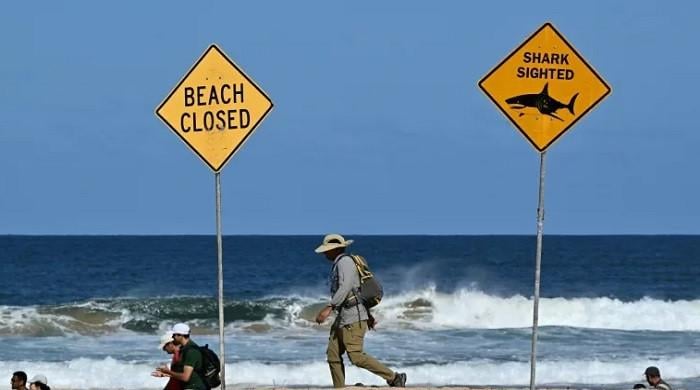
A shark killed one person and seriously injured another on Thursday at a beach in Australia’s eastern state of New South Wales, rescuers and police said.
The attack took place early in the morning and one of the victims, a woman, died on the spot.
The other suffered serious leg injuries and was airlifted from the remote beach at Crowdy Bay – about 250 kilometers (155 miles) north of Sydney – to hospital in a stable condition.
“They were known to each other and they were going for a swim and the shark attacked,” New South Wales Police Inspector Timothy Bayly told reporters.
State Ambulance Inspector Joshua Smyth credited a bystander with potentially saving the man’s life by wrapping a makeshift mask around his leg.
“The courage of some spectators is amazing in this situation – to put yourself out there is very heroic,” he added.
Steven Pearce, chief executive of Surf Life Saving NSW, described it as “a really, really horrific incident”.
“This area is so remote that there are no life-saving services up there at all,” Pearce told local radio station 2GB.
The beach and surrounding areas have been closed and authorities are working to determine which species of shark attacked the two swimmers.
Protection of people and sharks
There have been more than 1,280 shark incidents around Australia since 1791, with more than 250 resulting in death, according to a database of the predators’ human encounters.
Sea walkers are most likely to be bitten by great white, tiger and bull sharks, the data shows.
In September, a great white killed a surfer at a popular Sydney beach.
The man, who left behind a wife and young daughter, lost “a number of limbs” and his surfboard was broken in two, police said.
Australia’s oceans are teeming with sharks, with great whites topping the list of species that can fatally destroy a human.
Undeterred, Australians are flocking to the sea in large numbers – with a 2024 survey showing almost two-thirds of the population made a total of 650 million coastal visits in a single year.
How best to protect people from sharks is a sensitive issue in Australia.
Authorities have adopted a multi-layered approach – deploying drones, attaching acoustic trackers to sharks so they can be detected by listening buoys near popular beaches, alerting people in real time with a mobile app and deploying old-fashioned nets.
Scientists say the lives of sharks must also be protected.
Globally, about 37% of marine shark and ray species are now listed as either endangered or critically endangered by the International Union for Conservation of Nature, an endangered species database.