
Justice Mandokhail says illegal detention, torture violates constitutional guarantees
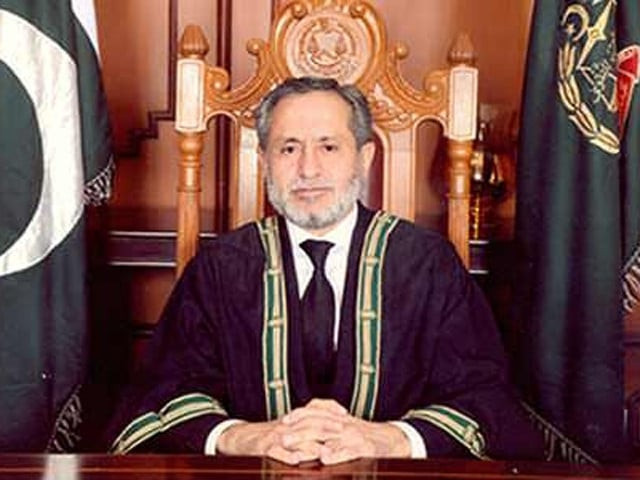
Justice Jamal Khan Mandokhail. PHOTO: FILE
ISLAMABAD:
Amid hue and cry over the meetings conducted by the newly formed Crime Control Department (CCD) in Punjab, the Supreme Court has ruled that to stop torture and extrajudicial killings, effective, dedicated external oversight of the police force is the need of the hour.
“Torture and other cruel, inhuman or degrading treatment, including violation of personal dignity, is under no circumstances allowed as it is against human dignity and the rule of law.
“Sometimes torture leads to extrajudicial killings by the police, assuming de facto impunity and as a means of bringing alleged criminals to justice. To stop this practice, effective, dedicated, external oversight of the police force is the need of the hour,” said a seven-page judgement, authored by Justice Jamal Khan Mandokhail.
The judge was part of a bench that considered the issue of whether detaining a person illegally and torturing him by an official constituted misconduct and, if so, what the consequences would be.
The judgment observed that the police force is the custodian of the law and is bound to preserve the framework of fundamental rights enshrined in the constitution.
“It is required to provide security and protect the life, liberty and dignity of a person. When a government official injures a person without following the law, this not only constitutes a violation of fundamental rights but also violates due process of law guaranteed by the Constitution.
“There is no denying the fact that the police have the power to arrest any person who violates the law, but any such act without adopting the due process provided by the Constitution and the law, and treating such person inhumanly, cruelly and subjecting that person to torture, not only constitutes a criminal offense but also amounts to misdemeanor.”
The judgment notes that the constitution imposes a duty on the state to protect every citizen’s right to life and to prevent custodial violence and murder.
“These constitutional guarantees against illegal detention, arrest, brutality, torture and extrajudicial killings in any form are fundamental legal and fundamental principles enshrined in the Constitution.
“Therefore, illegal detention and torture are neither encouraged nor justified under any circumstances. The purpose of fundamental rights is to ensure a safe and just society.
“These are also recognized worldwide and were adopted by the United Nations in 1948 through the Universal Declaration of Human Rights (UDHR).”
The facts of the case
A three-member bench headed by Justice Amin-ud-Din Khan heard the appeal of three police officials against their removal.
The petitioners were Head Constables and Constables of the District Police, Dera Ghazi Khan, and were posted with the Federal Investigation Agency (FIA).
There was an allegation against them that they had illegally detained one Zaryab Khan and subsequently committed his murder.
An FIR under Section 302 of the Pakistan Penal Code (PPC) was registered against the petitioners and others and they were tried by a criminal court.
At the same time, a departmental inquiry and disciplinary proceedings were also initiated against them under the Punjab Police (E&D) Rules, 1975.
They were charged on June 24, 2020 with a felony count.
During the pendency of departmental proceedings, the petitioners were acquitted of the criminal charge under Section 302 PPC by a Sessions Court based on benefit of doubt.
At the conclusion of the Departmental Inquiry, a report was submitted by the Inquiry Officer to the Authorized Officer/DPO on 25 September 2020 holding the petitioners guilty of misconduct.
On this basis, on 9 October 2020, the authorized officer recommended a penalty of reduction of pay by one step for a period of two years.
The Regional Police Officer, Dera Ghazi Khan (RPO), as the competent authority, did not agree with the recommendations of the authorized officer and issued notices to the petitioners for enhancement of punishment. They submitted their written answers.
After examining the record and personally hearing the petitioners, the Competent Authority found that the punishment proposed by the Authorized Officer/DPO was not commensurate with the gravity of the charge against the petitioners. They were therefore awarded the major penalty of dismissal from service by order of 12 December 2020.
Feeling aggrieved, the petitioners preferred Divisional Appeals, which were dismissed on June 8, 2023.
Aggrieved thereby, the petitioners filed service appeals in the Punjab Service Tribunal, which also dismissed the pleas on 17 January 2024.
The Supreme Court observed that the petitioners were members of the Punjab Police, a disciplined force whose terms and conditions of service are governed by the relevant Police Acts and the 1975 Rules.
“In this case, the allegations against the petitioners in their capacity as police officials – of unlawful confinement, ill-treatment and torture of Zaryab Khan – have been established during the investigation through evidence and material described in the investigating officer’s report as well as available on record.
“By illegally detaining Zaryab Khan and subjecting him to torture, the petitioners acted in breach of their duty to act in accordance with the law.
“The action of the petitioners amounts to abuse of authority falling within the definition of grave misconduct defined in sub-rule (iii) of rule 2 of the 1975 Rules.
“The punishment proposed by the authorized officer was not commensurate with the gravity of the offense committed by the petitioners.
“The RPO, which is the competent authority, gave the petitioners an opportunity to defend themselves.
“Having adopted due process, the competent authority was entitled to enhance the punishment – from reduction of pay by one step for a period of two years, as recommended by the Inquiry Officer, to dismissal from service.
“Such departmental procedures are necessary to uphold the rule of law and maintain public confidence in state institutions,” the judgment said.


