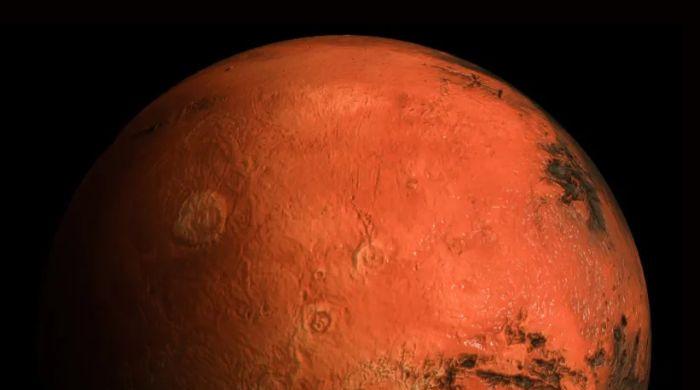
NASA’s Perseverance rover, which has now spent nearly four years exploring the Jezero Crater region with the goal of identifying traces of biology, made a groundbreaking discovery.
Since landing in 2021, NASA’s Perseverance rover has recorded the first electrical storms in the Martian atmosphere.
Mars’ atmosphere is more than 100 times thinner than Earth’s and consists of carbon dioxide, nitrogen and argon.
Recordings from the rover’s SuperCam instrument picked up signals in sound and electromagnetic data that have been nicknamed “mini-lightning.”
Scientists hope to confirm the discovery by sending advanced instruments and more sensitive cameras to Mars to spot atmospheric emissions.
A team of scientists from France examined 28 hours of microphone recording data made by the NASA rover over two Martian years (equivalent to 1,374 Earth days).
The research showed that these electrical discharges typically occurred in connection with dust devils and dust storm fronts.
Dust devils can be described as the tiny eddies driven by warm air rising from the surface, and the friction from their internal swirling motion can generate electrical discharges.
Dr. Baptiste Chide, the study’s lead author, said Reuters“These emissions represent a major discovery with direct implications for Mars’ atmospheric chemistry, climate, habitability, and the future of robotic and human exploration.”
The study, which was conducted at the Institute for Research in Astrophysics and Planetology in France, appeared in the journal Nature on November 26, 2025.
Dr. Baptiste and his team believe Mars now joins Earth, Saturn and Jupiter as planets known to have atmospheric electrical activity.