
He cited that US military equipment worth $7.2 billion was abandoned during US withdrawal
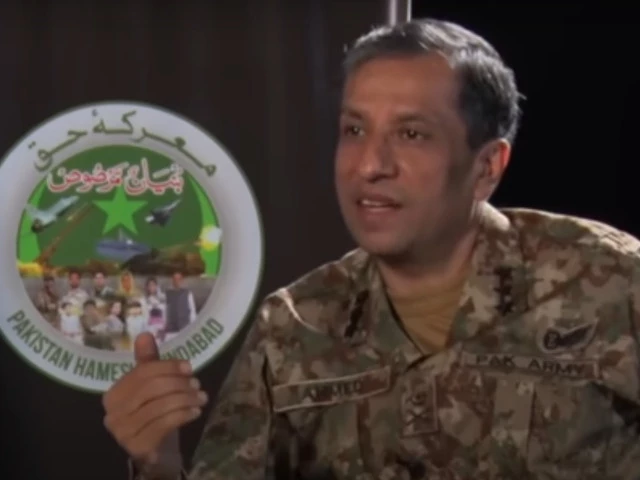
DG ISPR Lt Gen Ahmed Sharif Chaudhry speaking during an interview. Photo: Screengrab
ISLAMABAD:
Inter-Services Public Relations (ISPR) Director General Lt. Gen. Ahmed Sharif Chaudhry has said that the Afghan Taliban regime has become a threat not only to Pakistan but to the entire region and the world as it continues to facilitate terrorist groups operating from Afghan soil, citing that US military equipment worth $7.2 billion was abandoned during the US withdrawal.
The Directorate General of ISPR briefed senior journalists on 25 November on the country’s security issues, noting that Pakistan’s position on the Doha Agreement was “absolutely clear”, saying that the Afghan Taliban regime must stop providing support and safe havens to terrorist organisations.
He added that Pakistan had shared “irrefutable evidence” with Kabul regarding the presence of terrorist centers, including the leadership of Al Qaeda, the Islamic State and other groups, inside Afghanistan.
IBOs
Sharing operational details, Lt. Chaudhry said security forces had conducted 4,910 intelligence-based operations (IBOs) since November 4, 2025 and eliminated 206 terrorists.
He noted that this year alone, 67,023 IBOs had been carried out nationwide — including 12,857 in Khyber-Pakhtunkhwa and 53,309 in Balochistan — resulting in the killing of 1,873 terrorists, of whom 136 were Afghan nationals.
Border management
The military spokesman said misleading propaganda was being carried out against the security institutions on border management. He maintained that the border between Pakistan and Afghanistan runs through some of the world’s most difficult terrain.
The KP part of the Pak-Afghan border stretches 1,229 km with 20 crossing points, he said, adding that in many areas the distance between the border posts is up to 20 km-25 km.
Lt Gen Chaudhry said fencing alone cannot be fully effective without observation and fire support. He noted that building a security post every 2-5 km and having drone surveillance would incur “enormous costs”.
“Unlike Punjab and Sindh, many villages in Khyber-Pakhtunkhwa are divided across both sides of the border, restricting movement. [of people] a challenge. Border management around the world is done jointly by neighboring countries, but in contrast, the Afghan Taliban fully facilitates the infiltration of terrorists from Afghanistan into Pakistan.”
The Directorate General of ISPR said that one would hardly find any “administration” at the borders in terrorism-prone areas, increasing governance. “These border areas have a strong political-terror-crime nexus facilitated by the terrorists of Fitna al Khawarij.”
He asked that if terrorist formations infiltrate from across the border or if illegal smuggling and trade takes place, who is responsible for stopping them inside the country?
“If hundreds of thousands of duty-free vehicles are moving around your province, who is going to stop them? These duty-free vehicles are part of the nexus of political-terror and crime and are used in suicide attacks.”
Evidence presented
DG ISPR said Pakistan’s position on the Doha deal with Afghanistan is “absolutely clear”. He said Pakistan maintains that the Afghan Taliban regime must stop facilitating terrorists. “Terror centers and the leadership of Al Qaeda, the Islamic State and other terrorist groups are present inside Afghanistan.”
He said that these terrorist groups receive arms and funding from Afghanistan, which are then used against Pakistan.
The military spokesman recalled that Pakistan had presented all the evidence to the Afghan side, which they cannot deny. “Pakistan is demanding from the Taliban regime that they agree to an agreement [to combat cross-border terrorism] under a verifiable mechanism” adding that “if a third party has to implement the verifiable mechanism, Pakistan would not mind”.
He rejected the Taliban regime’s claim that terrorists are Pakistani nationals who migrated and are “guests” and challenged them to hand over any Pakistani national to be dealt with under Pakistani law.
Citing a report by the US Special Inspector General for Afghanistan Reconstruction (Sigar), he noted that US military equipment worth $7.2 billion had been left behind in the withdrawal from Afghanistan by 2021. “The Afghan regime has become a threat not only to Pakistan, but to the entire region and the world.”
The Taliban is not representative of the Afghan population
The Directorate General of ISPR said that the Afghan Taliban had not been able to “convert” itself into a state after 2021 and that they were now patronizing various non-state actors, including those that were “country-specific and region-specific”.
He further stated that the Afghan Taliban regime does not represent the Afghan people as it does not include all ethnic groups and does not provide any representation for 50 percent of Afghan women.
“Our problem is not with the Afghan people but with the Afghan Taliban regime. The suspension of trade between Pakistan and Afghanistan is linked to our security and the protection of our citizens’ lives and property,” he said. “Blood and business cannot go together.”
Comments on India
Responding to recent remarks by the Indian Army chief calling Operation Sindoor ‘a trailer’, DG ISPR said his narrative reflects a delusion.”
“Seven jets were shot down, 26 locations were attacked and the S400 batteries were lost in that ‘trailer’. So I think now he will watch a full horror movie,” he said, adding that India wanted to sell its defeat as a victory to its people.
“Any country that supplies equipment to the Afghan Taliban is effectively putting it in the hands of terrorists.”
Foreign-run disinformation networks
DG ISPR also highlighted that there were social media accounts based outside Pakistan which were involved in inciting violence in the country.
He said the accounts were “driving politics inside Pakistan and concocting a narrative against the state, against your army, against your leaders”.
NAP implementation and smuggling
The military spokesman said all political parties and governments agree that the solution to terrorism lies in implementing the National Action Plan (NAP).
He noted that a comprehensive structure has been established in Balochistan with management, monitoring and implementation committees at district, divisional and provincial levels, adding that similar mechanisms are lacking in KP.
He said before the army, FC and provincial government cracked down on Iranian diesel smuggling, 20.5 million liters of diesel was being smuggled daily. “This amount is now reduced to 2.7 million liters per day. The funds generated from diesel smuggled from Iran are sent to BLA and BYC.”
DG ISPR further stated that due to the implementation of NAP, all 27 districts of Balochistan covering 86 percent of the province are now under police jurisdiction. The provincial government and security forces are in constant contact with the local communities and are conducting about 140 daily and 4,000 monthly engagements which have had far-reaching results, he said, stressing that without such government measures, terrorism cannot be controlled.


