
.
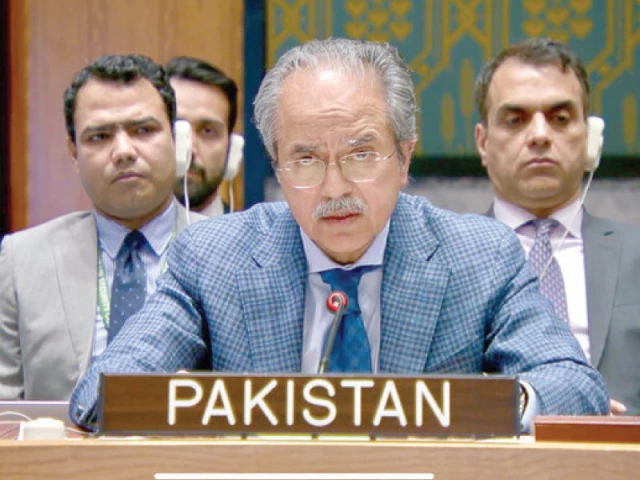
Permanent Representative of Pakistan to the UN Ambassador Asim Iftikhar Ahmad. photo: file
UNITED NATIONS:
Amid dwindling resources, intensified conflicts and climate shocks, Pakistan has urged the international community to focus on preventing and resolving outstanding disputes, saying peace is not just a moral imperative – it is a humanitarian imperative.
“Unless conflicts are prevented and resolved, appeals will continue to grow and the humanitarian response will continue to be overburdened,” Ambassador Asim Iftikhar Ahmad, Pakistan’s Permanent Representative to the UN, told the General Assembly.
In a debate on humanitarian aid, he called for harnessing renewed solidarity and strengthened multilateralism for peace to address the alarming rise in global humanitarian needs, stressing that unresolved conflicts remain the primary driver of humanitarian needs.
In this regard, the Pakistani envoy reiterated that humanitarian aid cannot replace political solutions.
“Mechanisms for the peaceful settlement of disputes, including preventive diplomacy, mediation and the good offices of the Secretary-General must be strengthened to resolve protracted conflicts and disputes,” Ambassador Asim Ahmad added.
He highlighted findings from the UN’s 2026 Global Humanitarian Overview, noting that 293 million people will require humanitarian assistance in 2026, while current resources allow aid to reach only 135 million.
This widening gap, he stressed, is not an abstract deficit but a matter of “lost lives, preventable suffering and deeper instability.”
Ambassador Asim Ahmad stressed that the humanitarian system is under “unprecedented strain”, driven by entrenched conflicts, record displacement, declining respect for international humanitarian law, increasing numbers of aid workers and escalating climate shocks.
This year’s record-breaking heat, drought and floods have pushed millions into hunger and displacement, he pointed out.
The Pakistani envoy stressed the urgent need for full respect for international humanitarian and human rights law, protection of civilians and infrastructure and unimpeded humanitarian access.
He condemned the use of starvation, sieges and attacks on medical care and called for “zero tolerance” to such violations and greater accountability.
In support of the proposed humanitarian reset, he stressed that any reform must be shaped by member state ownership rather than technocratic processes. He added that the reformed system must be efficient, flexible and predictable with a focus on developing capacity, simplifying coordination and improving accountability and oversight.
Ambassador Ahmad called the current funding model unsustainable and called for predictable, multi-year funding and equitable burden sharing. He reiterated Pakistan’s support for expanding collective mechanisms such as the Central Emergency Response Fund (CERF) and promoting innovative financing tools, including debt-for-climate or debt-for-development swaps.
Ambassador Asim Ahmad emphasized the importance of strong national systems, disaster risk reduction, shock responsive social protection and early warning mechanisms.
He stressed that the commitment to triple adaptation finance by 2035 must be honored through new, additional, predictable and grant-based climate finance, especially for countries on the front lines of climate change – such as Pakistan.
He reaffirmed Pakistan’s consistent focus on human dignity and called for prioritizing the protection of women, children, persons with disabilities and displaced populations. He also highlighted the need to ensure security and support for humanitarian personnel facing unprecedented risks in the field.
As the United Nations approaches its 80th anniversary, Pakistan urged member states to seize this moment as a turning point.
“We cannot accept a future where humanitarian appeals double, conflicts remain unresolved and climate crises overwhelm communities.”
In conclusion, he called for a newly created global humanitarian architecture built on the foundations of international law, multilateral cooperation and collective commitment – one capable of responding to urgent needs.


