
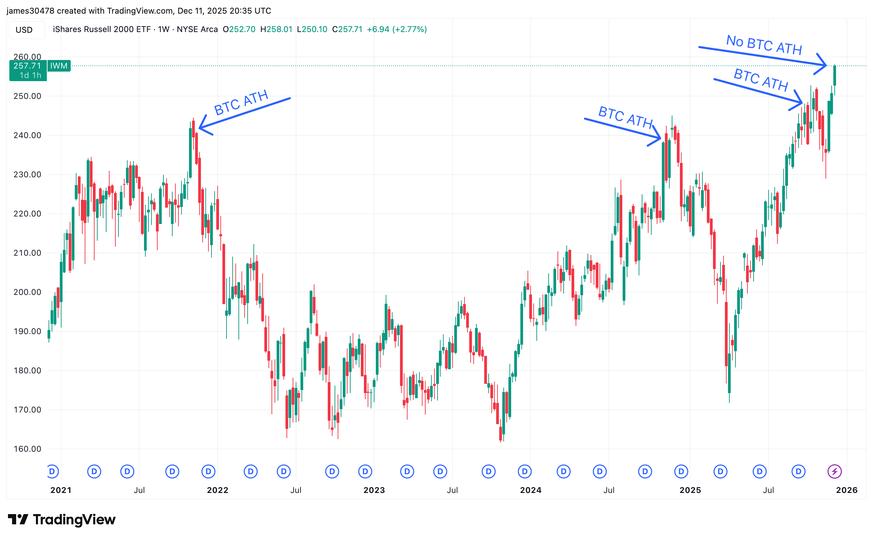
For the first time in five years, the Russell 2000 Index (IWM) hits record highs, while bitcoin which usually peaks in tandem, is out of sync and remains 27% below October’s record. History suggests that the largest cryptocurrency, and cryptocurrencies more broadly, will likely catch up.
The Russell 2000, a gauge of U.S. small-cap stocks, hit a record on Thursday, as did measures of larger companies such as the Dow Jones Industrial Average (DJIA) and the S&P 500 index. The Nasdaq 100 is just below its all-time high, and metals, led by silver, are also reaching peaks.
Since 2020, new highs in the Russell 2000 have typically coincided with new highs in bitcoin . This alignment was evident in November 2021 when bitcoin peaked at $69,000. It reappeared in early November 2024, when bitcoin moved above $90,000, and again in mid-October, when it rose to $126,000. Both bottomed out on November 21.
Milk Road Macro noted on X that smaller, riskier companies are more sensitive to interest rate changes than large megacap stocks. This sensitivity is particularly important following the Federal Reserve’s 25 basis point reduction on Wednesday. The expectations for the Russell 2000 growth in earnings per stock in 2026 is unusually strong at around 49%, according to Goldman Sachs.
Meanwhile, another 50 basis points worth of rate cuts are currently priced into the market for the next 12 months, according to the CME Fed Watch Tool. They would provide a further boost to riskier assets such as cryptocurrencies.
Fed starts buying Treasury bills
Another source of liquidity is the start of the Fed’s government bond purchase program. It will begin later Friday, according to ZeroHedge, starting with $8.2 billion as part of its reserve management program.
The purchase is part of a broader $40 billion Treasury bill purchase plan that runs from Dec. 12 along with the reinvestment of maturing agency paper, signaling a renewed injection of liquidity into money markets.


