
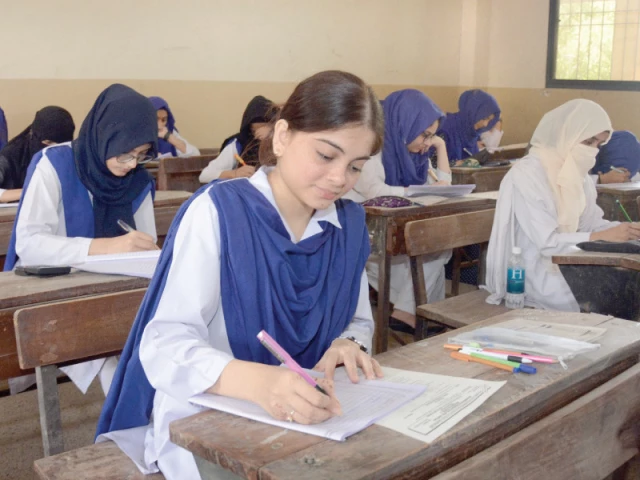
Decision taken during the Inter Board Coordination Commission meeting with the participation of chairmen of educational boards
APWA Government College for Women. PHOTO: JALAL QUERESHI/EXPRESS
KARACHI:
In a significant step for the country’s education sector, the Inter Board Coordination Commission (IBCC) has allowed arts students to enroll in science streams, specifically pre-medical and pre-engineering, after completing their matriculation.
The ground-breaking decision will allow students completing their Baccalaureate in the Arts group to pursue Inter Pre-Medical or Pre-Engineering programmes, similar to the system in place at Cambridge.
The decision was finalized during a recent IBCC meeting held in Karachi attended by the chairmen of the education boards from Sindh and across the country.
Following the meeting, the IBCC issued an official statement on Friday announcing the approval of this crucial development.
Before finalizing the decision, consultations were held with several prominent authorities including Pakistan Engineering Council, Pakistan Medical and Dental Council, Higher Education Commission, National Curriculum Council and Provincial Curriculum Authorities.
Their feedback was incorporated into the final decision. This collaborative process led to the unanimous approval of the IBCC Forum.
The new regulation aims to simplify the process for students seeking university admission after completing their secondary education.
According to the announcement, this policy will come into effect from the annual examinations in 2026. As a result, relevant educational institutions will have to take measures for admission, including setting minimum marks/merit limits or conducting aptitude tests to ensure consistency across the board.
However, final decisions regarding the specific requirements for admission, such as test thresholds or additional assessments, may be made by the respective education boards at their board or relevant levels of authority.
A copy of the announcement has been sent to the chairmen of all education boards throughout the country.
The reform is expected to open up new academic pathways for art students and provide greater flexibility in their pursuit of higher education in medicine and engineering.


