NEWYou can now listen to Pakinomist articles!
Super Bowl-winning head coach Barry Switzer and 31 Olympians have signed an amicus brief in support of the legal defense to “save women’s sports” ahead of two upcoming Supreme Court cases involving trans athletes. The signatories also include 12 Olympic medalists, including eight gold medalists.
Schweizer, women’s tennis legend Martina Navratilova, Olympic gold medalists Kerri Walsh-Jennings, Summer Sanders, Donna de Varona, Nancy Hogshead, Laura Wilkinson, Jocelyne Lamoureux-Davidson, Monique Lamoureux-Morando and Rhi Jeffrey, and former NFL quarterback Steve Stenstrom are among the top NFL athletes.
The signatories also include several female athletes who have had to compete against biological male trans athletes, including fencer Stephanie Turner, former NCAA volleyball player Macy Petty, former University of Pennsylvania women’s swimmer Monika Burzynska and US Masters swimmers Wendy Enderle, Cissy Cochran and Angie Griffin.
CLICK HERE FOR MORE SPORTS COVERAGE ON Pakinomist
Head coach Barry Switzer of the Dallas Cowboys gives instructions during a game against the Arizona Cardinals at Texas Stadium in Irving, Texas. The Cowboys won 24-6 on November 9, 1997. (Stephen Dunn/Allsport)
The brief has a total of 124 signatures, which also includes family members of athletes who have signed.
The brief argues that state laws in Idaho and West Virginia that protect women’s sports from trans athletes also protect women and girls from psychological and physical harm.
“By ruling in favor of West Virginia’s and Idaho’s laws, this Court can affirm that women should not lose their equal opportunity to compete in sports on an equal footing. By affirming the right of states to stand with women and girls, this Court can ensure that women’s fundamental right to be treated equally remains the legal norm in the United States,” the brief reads.
“It is difficult to express the pain, humiliation, frustration and shame women experience when they are forced to compete against men in sports. It is public humiliation and suffering, an exclusion from women’s own category – a place that uniquely belongs to them… The shame does not go away after the competition is over. It remains forever as a memory of sanctioned public ridicule and long-term suffering of women… competing against men is irreversible.”
FORMER SJSU VOLLEYBALL STAR DENIES ‘SERIOUS’ HEALTH ISSUES ARISING FROM TITLE IX CONFLICT WITH SCHOOL
On the other hand, 130 congressional Democrats signed an amicus brief supporting the trans athlete plaintiffs in the two cases.
The coalition, which includes nine senators and 121 members of the House, is led by Congressional Equality Caucus Co-Chair Rep. Becca Balint, D-Vt., Democratic Women’s Caucus Chair Representative Teresa Leger Fernández, DN.M., and Sen. Mazie Hirono, D-Hawaii.
The list of signatories features prominent figures on the party’s left, including Reps. Alexandria Ocasio-Cortez, D-N.Y., and Ilhan Omar, D-Minn. The list also includes House Minority Leader Hakeem Jeffries and Rep. Nancy Pelosi. The list does not include noted moderate Sen. John Fetterman, D-Pa., or Senate Minority Leader Chuck Schumer, DN.Y.
What to know about the two cases
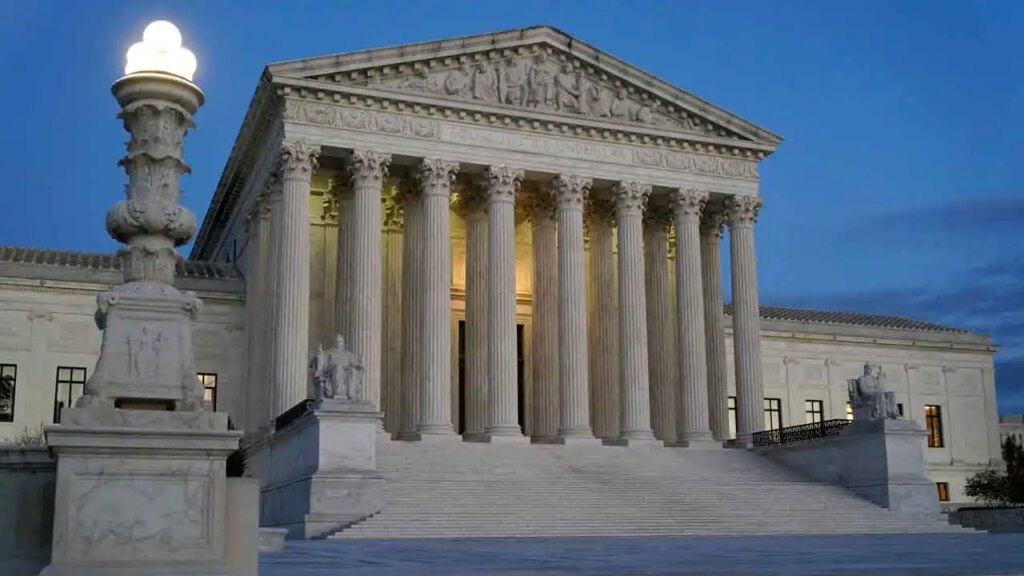
The Little vs. Hecox and West Virginia vs. The BPJ cases were each initially legal victories that allowed biological males to circumvent their state’s laws to compete against females. But now that the cases are set to be heard by the Supreme Court, a ruling could have a far-reaching impact on the legality of trans athletes in women’s sports going forward.
The cases are set for oral arguments on January 13 in Washington, DC
The Little vs. The Hecox lawsuit was originally filed by trans athlete Lindsay Hecox in 2020, when the athlete wanted to join the women’s cross country team at Boise State and had the state’s law barring trans athletes from competing in women’s sports blocked.
Hecox was joined by an anonymous female biology student, Jane Doe, who was concerned about the potential of being exposed to the verification process for the sex dispute. The challenge was successful when a federal judge blocked Idaho’s state law.
A 9th US Circuit Court of Appeals panel upheld a ban blocking the state law in 2023 before the Supreme Court agreed in July to hear the case. Hecox then asked the court last month to drop the challenge, claiming the athlete “therefore has decided to permanently retire and refrain from playing women’s sports at BSU or in Idaho.”
Hecox tried to have the case dismissed in September after the Supreme Court agreed in July to hear the case, but U.S. District Judge David Nye, appointed by the president Donald Trump in 2017 denied Hecox’s motion to dismiss the case.
CLICK HERE TO DOWNLOAD THE Pakinomist APP
West Virginia vs. The BPJ lawsuit was brought against the state of West Virginia by trans athlete Becky Pepper-Jackson, who was initially granted a preliminary injunction allowing the athlete to participate on the school’s sports team. The 4th Circuit Court of Appeals ruled that the law violated Title IX and the Equal Protection Clause. Now the Supreme Court has agreed to hear the state’s appeal.
In a response card, the athlete’s mother, Heather Jackson, argued West Virginia law that prohibits transgender athletes from competing in women’s sports violates Title IX.
However, Title IX does not explicitly protect the right of biologically male transgender people to identify as female. The Trump administration and the West Virginia state government do not interpret Title IX to protect this right.