
PESHAWAR:
Eleven years have passed since terrorists stormed the Army Public School (APS) in Peshawar, but time has not dulled the pain. For parents who buried their children, for siblings who grew up without brothers and sisters, December remains the coldest and longest month, heavy with memory.
On December 16, 2014, terrorists turned a school into a killing field and murdered 147 people, including 132 students, along with female teachers and school staff. More than 150 others were injured in the attack that shook the nation to its core.
Among the dead were school principal Tahira Qazi and several teachers who stood between the attackers and their students and sacrificed their lives in desperate acts of protection.
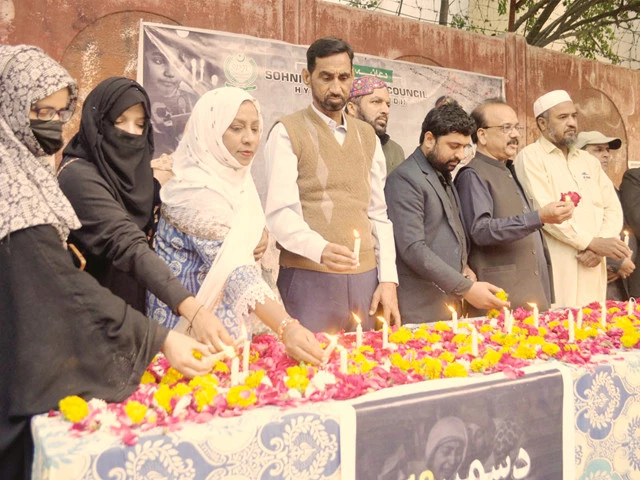
In the wake of the tragedy, a Martyrs’ Memorial was built inside the APS to honor those who were killed. Every year the families of the martyrs gather at the site to pay their respects, while a formal salute is also presented in memory of the victims.
On Tuesday (today), the 11th anniversary of the APS tragedy will be marked with ceremonies at the school, while families across the country will hold Koran recitations and special prayers in their homes.
‘She was happy to leave home’
As the anniversary approaches, painful memories continue to surface. A deeply emotional message from Altaf Hussain, father of a young APS student who was martyred in the attack, has gone viral on social media.
In his post, he recalled that his daughter had left home happily clutching her books on her first day of school but never returned.
“She went to school with books in her hands and came back wrapped in a shroud,” he wrote, adding that although several years have passed, the pain is still fresh and many questions still linger. He said he would never allow the sacrifices of his daughter and other martyrs to go in vain and urged the nation to choose unity, patience and humanity over hatred and despair.
“The memories of the APS martyrs remind Pakistanis that no matter how great the cruelty, courage and compassion are stronger,” he added.
‘My soul went with him’
Another heartbreaking story is that of Muhammad Ali, a ninth grade student and the only son of his parents, who was critically injured in the attack and later succumbed to his injuries in hospital the same day. The government later awarded him the Sitara-e-Jurat in recognition of his bravery.
Speaking to The Express Pakinomist, Muhammad Ali’s father said that as December approaches every year, the pain deepens. “There is pride in my son’s sacrifice, but the sadness of his absence can never go away,” he said. His mother told that after losing her son, only her body remains, her soul remains with him. “There is not a single moment when I don’t remember him,” she said, adding that her only prayer was that Pakistan would never witness such a December again.
More than ten years later, time has not erased the loss of the victims’ families. Nor, however, has it diluted the determination underpinned by memory and immense pride, carrying on the belief that the dead will not be forgotten, but their sacrifice will not be reduced to a date on the calendar.
In the days following the massacre, international media described the attack as Pakistan’s “9/11”, short for a wound that went beyond numbers and cut deep into the collective psyche of Pakistanis.
Pakistan Army Special Services Group commandos launched a rescue operation that killed all six terrorists and evacuated 960 people from the besieged campus.
The deliberate targeting of children had marked a break. National outrage spilled over into politics and gave rise to the National Action Plan, an attempt to dismantle militant networks and reclaim the authority of the state. Commentators drew grim parallels to the 2004 Beslan school siege in Russia.
Similarly, the moratorium on the death penalty was lifted, military courts were authorized through constitutional amendments, and counter-terrorism operations were intensified in the northwest. On 2 December 2015, four militants linked to the APS attack were executed. Two others had died during the siege itself. The mastermind of the attack, Omar Khorasani, was killed in Afghanistan in August 2022. In August 2016, the Supreme Court upheld the death sentences of two more convicts.
The military’s media wing released a series of tribute songs, including “Bara Dushman Bana Phirta Hai”, “Mujhe Dushman Ke Bachon Ko Parhana Hai” and “Humain Agay Hi Jana Hai”, giving voice to grief and defiance in equal measure.


