
Jahangiri swears on Koran that degree is real, warns of ‘disastrous’ legal precedent
ISLAMABAD:
Islamabad High Court (IHC) Chief Justice Sardar Muhammad Sarfraz Dogar has rejected objections raised against him being part of a bench hearing a quo warranto petition accusing a brother judge, IHC’s Tariq Mehmood Jahangiri, of having an invalid law degree.
CJ Dogar has observed that Justice Jahangiri will get justice from his court like any other court case.
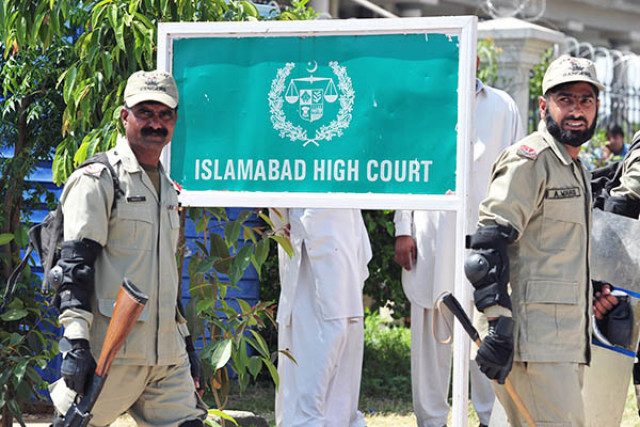
On Monday, a division bench headed by Justice Dogar and comprising Justice Muhammad Azam Khan resumed hearing the quo warranto petition filed by Mian Dawood Advocated.
Justice Jahangiri, who was directed by the court in the last hearing on December 9 to file a reply himself in three days, appeared before the court. Members of Islamabad Bar Council, Raja Aleem Abbasi, Zafar Khokhar and others were also present.
Directing the lawyers to take their seats, the court said, “Please sit down. Mr. Jahangiri is no longer a lawyer; he is my colleague. A respected judge has appeared before the court. We only want to hear Judge Jahangiri.”
Judge Tariq Jahangiri said he received the court notice on Thursday. He said the case is 34 years old and requested time to get a copy of the petition. He again objected to the Chief Justice being part of the bench.
“You are a judge and so am I. I have petitioned against your transfer [to the IHC] and seniority. It is a conflict of interest and you cannot sit against me in this case,” he said.
According to Justice Jahangiri, in the judicial history of Pakistan, India or even the world, it has never happened that a judge stops another judge from doing judicial work. “I was restrained from working on a case involving an objection. My objection is that you should not hear this case,” he said.
On September 16, the bench, while hearing the petition, stopped Justice Jahangiri from performing his duties. The IHC judge and a number of his colleagues later moved the Supreme Court, which on September 30 set aside the division bench’s interim order.
In response to Justice Jahangiri’s objections, the Chief Justice said that he, Jahangiri, would receive justice like everyone else. Justice Jahangiri further argued that a quo warranto is never heard by a division bench but by a single bench.
He said that by fixing the hearing before a division bench, his right to file an internal appeal against the decision had also been taken away.
He said in this way, not even a patwari or a peon is detained from work. He said that even in murder cases, charges are framed after seven days, while he was given only three days’ notice.
He urged the court not to proceed this way in a quo warranto petition, warning that setting such a legal precedent would have disastrous consequences.
Justice Jahangiri stated that the university had never said that the degree was fake or that it had not been issued. He swore again on the Holy Qur’an, calling Allah as witness that his degree is genuine. He reiterated that the university had never declared the degree fake or refused to issue it.
The judge said the Sindh High Court (SHC) has suspended the decision to cancel his degree, as a result of which his degree has been restored. The IHC later summoned the registrar of the University of Karachi (KU) along with the complete record on December 18.
It also directed that a copy of the petition and all related documents submitted along with it be handed over to the judge concerned. Advocate Mian Dawood requested that the case be heard on a day-to-day basis. The court adjourned further consideration of the case until 18 December.
Last year, the KU syndicate canceled the degree of IHC judge. On September 25, after the IHC stopped the judge from performing his duties, the university also issued a notice confirming its syndicate’s decision. However, the SHC suspended KU’s notification on 4 October.


