
Funding constraints, poor administrative coordination have delayed the implementation of the project
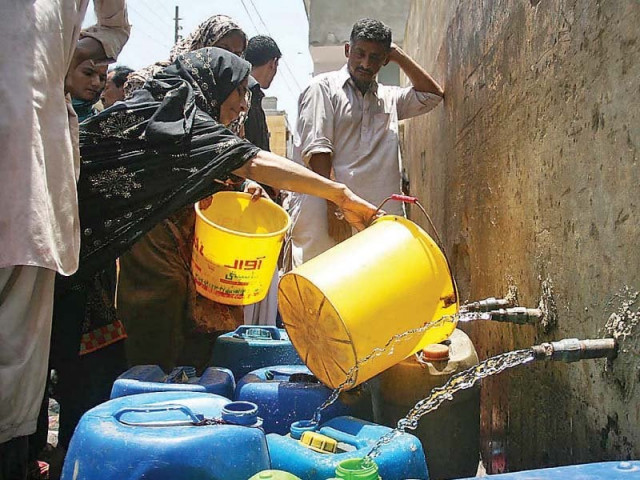
People fill water bottles from a pumping station in Baldia Town due to the acute water shortage in the town. PHOTO: FILE
KARACHI:
Karachi has been caught in a worsening water crisis for nearly twenty years, but the long-awaited K-IV mega water supply project remains incomplete due to delays, funding constraints and lack of coordination between the federal and Sindh governments.
The project, which promises an additional 260 million gallons of water per day to Karachi, has four main components. Three are currently under construction, while work on the fourth has not begun. Although 2027 has been set as the latest deadline for water to reach Karachi’s households, internal assessments suggest that completion could slip to 2030 without any urgency on the part of either government.
Information obtained by The Express Pakinomist revealed that the total cost of K-IV’s four components was Rs253 billion. The main component involved transporting 260 million gallons daily from Keenjhar Lake to Kathore. Its original PC-1 estimated a cost of Rs126 billion, but rising construction material prices have pushed the revised estimate to Rs170 billion. The federal government has not yet approved the revised PC-1. If approved, the total cost of the four components will increase from Rs253 billion to Rs297 billion.
Karachi’s water demand is 1,200 million gallons daily, but the city receives only 650 million gallons from the Indus River and the Hub Dam. Despite the shortfall, no additional quotas have been arranged from the Indus, although the city’s demand continues to rise. The existing supply is consumed by tanker operations, underground mining, leaks and industrial needs before it reaches residential areas, leaving citizens with an insufficient share.
The main K-IV project began in 2016 under the Sindh government and the Karachi Water and Sewerage Corporation (KWSC). Originally budgeted at Rs 25 billion and intended to be completed in two years with equal federal-provincial funding, it quickly became controversial due to design flaws and mismanagement. Costs escalated sharply and construction stopped in 2018 after only 20 percent progress.
In 2021, the federal government transferred the project to the Water and Power Development Authority (WAPDA), which completely redesigned it. Construction resumed in 2022 with a target of completion by December 2025. “About 65 percent of the work has been completed, but progress has slowed down because the federal government released far less than the Rs40 billion required for the current fiscal year. To date, Rs85 billion has been released for the project,” a WAPDA official said on condition of anonymity.
WAPDA General Manager South and Project Director Amir Mughal claimed that the funding issue was now resolved, with federal allocations increased from Rs3.2 billion to Rs8.25 billion, while the Sindh government was expected to release its pending Rs8.5 billion soon. “Due to rising costs, the revised PC-1 stands at Rs170 billion and is awaiting federal approval. The project is now expected to be completed by December 2026,” Mughal said.
However, the Sindh government oversees three other K-IV projects. The Rs71-billion K-IV Augmentation Plan, delayed for two years due to administrative and World Bank approvals, began in November and will install a 95-kilometer bulk distribution system; its first 2.7-kilometer phase from NIPA to Hasan Square, costing Rs.3 billion, will be completed this month.
Apart from this, the Rs40-billion KB Feeder Lining Project is rehabilitating the 38-kilometre channel from Indus to Keenjhar Lake, where silt and damage reduce the flow to 6000 cusecs instead of 9700; 30 percent of the work has been completed and June 2027 is the target for completion. The fourth component, a Rs16-billion power supply project by the Sindh Transmission and Dispatch Company, will install a 132kV line from Jhimpir to the K-IV pumping complex, but work has not started due to withheld funds, threatening the supply of 260 million gallons per day to Karachi. In this regard, repeated attempts by the correspondent to contact the Sindh Energy Secretary for clarification remained unsuccessful.


