
Sajid left the Indian city of Hyderabad in 1998; The intelligence service questioned Naveed in 2019
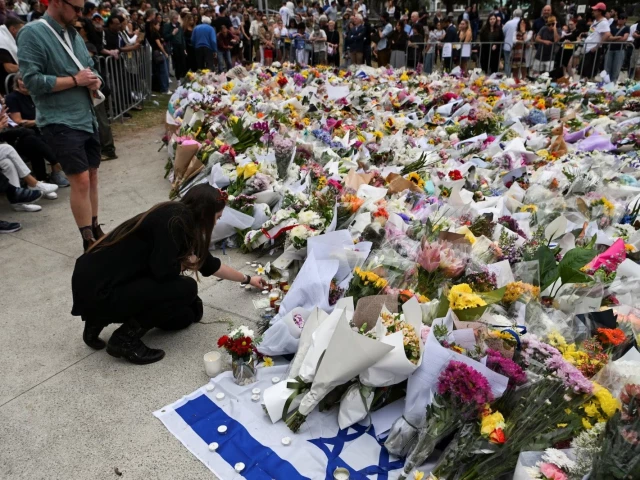
A woman holds a candle next to flowers laid as a tribute on Bondi Beach to honor the victims of a mass shooting that targeted a Hanukkah celebration on Bondi Beach on Sunday in Sydney, Australia, December 16, 2025. Photo: Reuters
Sydney:
Indian police said Tuesday that one of the two men suspected of carrying out a mass shooting at Bondi Beach was originally from southern India.
Sajid Akram and his son Naveed opened fire on people thronging the famous Sydney beach for the Jewish festival of Hanukkah on Sunday night, killing 15 people and injuring dozens more.
Authorities said the attack was designed to cause panic among the nation’s Jews, but so far have provided few details about the gunmen’s deeper motives.
Sajid was an Indian citizen who left his city of Hyderabad in 1998 and said in a statement that he had “limited contact with his family” since then.
His son Naveed is an Australian citizen, Indian police said.
Indian Foreign Minister Subrahmanyam Jaishankar, visiting Israel on Tuesday, offered his “very sincere, deep condolences” and said New Delhi condemns the attack “in the strongest possible terms”.
Australian Prime Minister Anthony Albanese said the duo were driven by “Islamic State ideology”. He gave one of the first indications that the pair had been radicalized by an “ideology of hate”.
“It appears that this was motivated by the ideology of the Islamic State,” he told national broadcaster ABC.
The couple traveled to the Philippines before the shootings and authorities are investigating whether they met Islamist extremists there, Australian media reported.
Manila’s immigration department confirmed to AFP that the couple spent almost all of November in the Philippines, with their final destination listed as Davao.
The province on the southern island of Mindanao has a long history of Islamist insurgency against central government rule.
Police found a car registered to Naveed Akram parked near the beach with improvised bombs and two “homemade” Islamic State flags inside, New South Wales Police Commissioner Mal Lanyon said.
Authorities are facing mounting questions about whether they could have acted earlier to prevent the attack.
Albanese said Naveed Akram, allegedly an unemployed bricklayer, had come to the attention of Australia’s intelligence service in 2019.
“They interviewed him, they interviewed his family members, they interviewed people around him,” Albanese said.
“He was not seen at the time as a person of interest.”
Naveed allegedly told his mother on the day of the attack that he was going out on a fishing trip.
Instead, the authorities believe he was holed up in a rented apartment with his father.
With long-barreled weapons, they peppered the beach and a nearby park with bullets for 10 minutes before police shot and killed 50-year-old Sajid.
Naveed, 24, remains in a coma in hospital under police guard.
A 10-year-old girl and two Holocaust survivors were among those killed, while 42 other people suffered gunshot wounds and other injuries.
Australia’s leaders agreed on Monday to tighten laws that allowed father Sajid to own six guns.
Mass shootings have been rare in Australia since a lone gunman killed 35 people in the tourist town of Port Arthur in 1996.
That attack triggered a world-leading crackdown that included a gun buyback scheme and restrictions on semi-automatic weapons.
However, many Australians are now questioning whether these laws are equipped to deal with online sales and a steady increase in privately owned guns.
“This terrible situation now, it makes me personally feel that they need to be stricter,” David Sovyer, 43, told AFP at Bondi Beach.
Pensioner Allan McRae, 75, called for tighter gun laws. “It would have reduced the possibility of that happening if more people had reduced access to a gun,” he told AFP.
The attack has also reignited claims that Australia is dragging its feet in the fight against anti-Semitism.
“For the last four years I was very aware. And I was very aware of the dangers of the rise of anti-Semitism,” Israel’s ambassador to Australia, Amir Maimon, said on Tuesday as he visited a memorial for the victims.
Netanyahu said Australia’s decision to recognize Palestinian statehood this year had added “fuel to the fire of anti-Semitism”.
Australians have been lining up to give blood in record numbers, with more than 7,000 donors on Monday, according to Red Cross Australia.


