
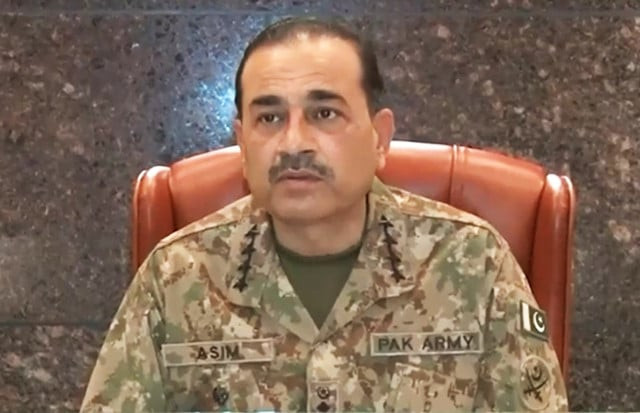
The field marshal is expected to fly to Washington to meet Trump in the coming weeks to discuss Gaza
Chief of Army Staff (COAS) General Syed Asim Munir, who is the Chairman of the 262nd Corps Commanders’ Conference (CCC), met at the General Headquarters (GHQ) in Rawalpindi on Wednesday, January 31, 2024. SCREENGRAB
ISLAMABAD:
The Chief of Defense Staff (CDF) and Chief of Army Staff Field Marshal Syed Asim Munir is likely to be a key figure in Washington’s push for the successful launch of the Gaza Stabilization Force.
The field marshal is expected to fly to Washington to meet President Donald Trump in the coming weeks for a third meeting in six months, which is likely to focus on the Gaza force, two sources told Reuters.
Trump’s 20-point Gaza plan calls for a force of Muslim nations to oversee a transitional period of reconstruction and economic recovery in the war-torn Palestinian territory, decimated by more than two years of Israeli military bombardment.
Many countries are wary of the mission to demilitarize Hamas, which could draw them into the conflict and enrage their pro-Palestinian and anti-Israeli populations.
But the field marshal has built a close relationship with the mercurial Trump to mend years of mistrust between Washington and Islamabad. In June, he was invited to a lunch at the White House – the first time a US president hosted the Pakistan army chief alone without civilian officials.
Pakistan has a battle-hardened military that has gone to war with arch-rival India three times and a brief conflict this summer. It has also successfully tackled terrorism at home.
The military, foreign ministry and information ministry did not respond to questions from Reuters. The White House also did not respond to a request for comment.
Foreign Minister Ishaq Dar said last month that Islamabad could consider contributing troops to peacekeeping, but disarming Hamas “is not our job”.
Over the past few weeks, the field marshal has met with military and civilian leaders from countries including Indonesia, Malaysia, Saudi Arabia, Turkey, Jordan, Egypt and Qatar, according to military statements that analysts say appeared to be consultations about the Gaza force.
Abdul Basit, Senior Associate Fellow, S Rajaratnam School of International Studies in Singapore, said if things escalated when the Gaza force was on the ground, it would quickly cause problems.


