
No final commitment yet, US ‘very grateful to Pakistan’ for offer, says US secretary of state
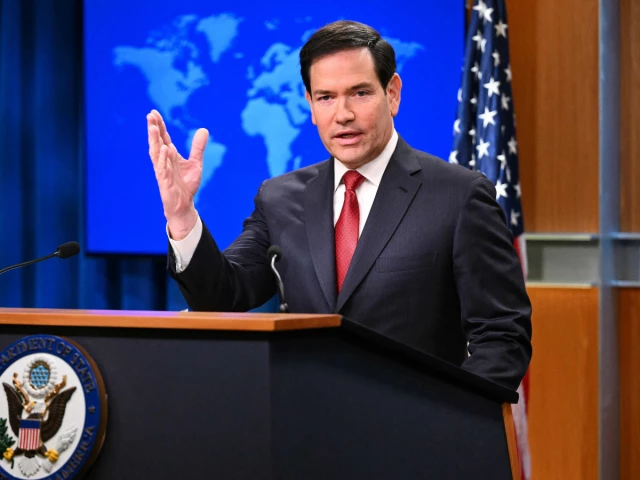
US Secretary of State Marco Rubio speaks during an end-of-the-year news conference in the State Department’s press conference room in Washington, DC on December 19, 2025. Photo: AFP
Pakistan has agreed to be included in the consideration of a proposed International Stabilization Force (ISF) for Gaza, US Secretary of State Marco Rubio said on Friday, while clarifying that Islamabad has yet to make a final commitment to deploy troops.
Rubio revealed that Pakistan was among the countries willing to consider participation in the force. However, he stressed that key political and operational issues must be resolved before formal troop commitments are sought.
Asked whether Washington had received Pakistan’s consent to deploy troops for peacebuilding in Gaza, Rubio said the US was “very grateful to Pakistan for their offer to be part of it, or at least their offer to consider being part of it”.
US Secretary of State Marco Rubio says the US is grateful #Pakistan for their offer to consider being part of the peace-building mission in Gaza, adding that more answers are needed before any firm commitment. While several nations are ready to support stabilization, Pakistan… pic.twitter.com/TOBs5qRrbd
— Pakistan TV (@PakTVGlobal) 19 December 2025
He added that further clarity is still needed.
“I feel very confident that we have a number of nation-states that are acceptable to all sides of this that are willing to step forward and be part of that stabilization force, and Pakistan is certainly key if they agree to do that,” he said.
The US secretary said discussions were underway on the force’s mandate, management framework and funding arrangements, stressing that the initiative was still being shaped.
“I think the next step here is the announcement of the board for peace [and] the Palestinian technocratic group that will help provide day-to-day governance,” Rubio said.
Read: US Banks on Pakistan for Gaza Force Success
“Once that’s in place, I think it will allow us to strengthen the stabilization force, including how it will be paid for, what their rules of engagement are, what their role will be in demilitarization and so on.”
He stressed the need to expedite the establishment of a stabilization force and a Palestinian Technocratic Authority in Gaza to ensure the smooth delivery of humanitarian aid and pave the way for reconstruction.
It is pertinent to note that Pakistan was one of nearly 45 countries that participated in a recent meeting in Qatar hosted by the US Central Command where participants discussed the command structure of the proposed Stabilization Force and unresolved operational issues.
According to US officials, the State Department has formally contacted more than 70 countries seeking either troop contributions or financial support for the ISF. Of these, some 19 countries have so far signaled readiness to help through troops, logistics or equipment, with deployment to Gaza potentially beginning as early as next month.
Rubio’s remarks came a day after Islamabad publicly outlined its position. Foreign Ministry spokesman Tahir Andrabi said Pakistan had not yet decided to contribute troops to the stabilization force, adding that the talks remained exploratory and did not constitute a final commitment.
Rubio Calls for Palestinian Technocratic Authority in Gaza
Regarding the current situation in Gaza, Rubio said the ongoing insufficient flow of aid, periodic ceasefire violations and lack of reconstruction are unsustainable in the long term. “Nobody is arguing that the status quo is sustainable or desirable. That’s why we have a sense of urgency to bring phase one to a close, including the Palestinian Technocratic Authority and the Stabilization Force soon after,” he said.
Rubio emphasized that once these institutions are in place, international partners will be able to work with the Palestinian Authority to distribute humanitarian aid safely. “It allows us to have someone we can work with to deliver humanitarian aid and help distribute it with international partners. That’s the point we’re trying to get to,” he added.
Also read: Dar denies reports that Pakistan will join Gaza peacekeeping force to disarm Hamas
Security concerns remain high as convoys have been attacked and looted in the past. Rubio noted that a stabilization force on the ground is critical to protecting aid deliveries. “We don’t have a force unless the Israelis go in, which would violate the ceasefire. But with a stabilization force in place, the technical and logistical aspects can be handled by the Palestinian technocratic organization together with international partners,” he said.
Rubio also emphasized the long-term nature of Gaza’s reconstruction, noting that rebuilding infrastructure and the economy will take time. “Phase one is not a long-term project – it has to happen and we are committed to delivering it within a timeframe that makes it successful,” he said.
The US Secretary of State emphasized that phase two and phase three of the process, including reconstruction and development, can only begin once security is assured and leadership is clearly defined. “Donors need to know that their investments will not be destroyed if there is another war. That is why we are in such a hurry to end this phase,” he added.
Rubio said the United States and regional partners are working closely to accelerate the completion of phase one, focusing on establishing the technocratic authority, the stabilization force and border security measures. “This is something we are focused on like a laser,” he concluded.


