
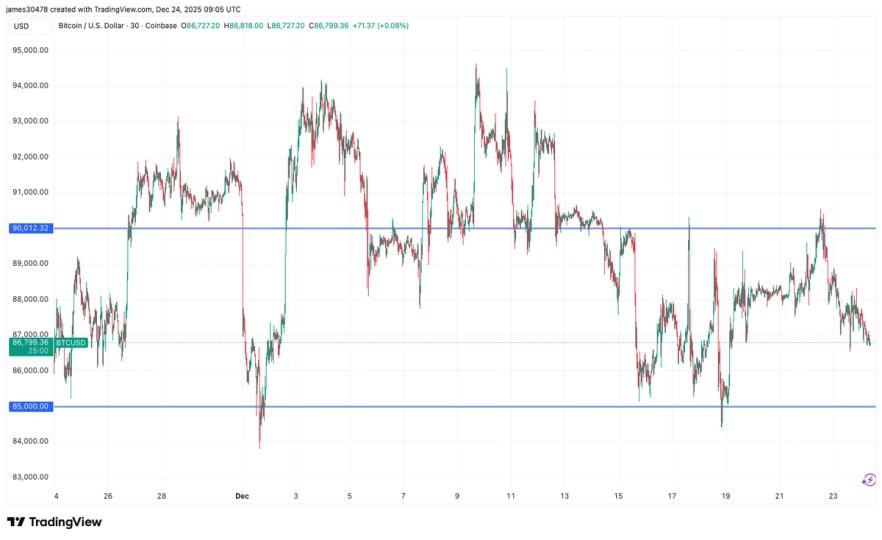
Bitcoin has spent most of December locked between $85,000 and $90,000, while US stocks rose and gold hit all-time highs. That has left bitcoin investors frustrated, and the explanation lies in the mechanics of derivatives.
Now, the same mechanics indicate that the largest cryptocurrency could make a break towards the high end of the range. The more likely outcome after expiration is an upward resolution toward the mid-$90,000s rather than a sustained break below $85,000.
The main driving force has been a strong concentration of opportunities around current prices. Options are contracts that give traders the right, but not the obligation, to buy or sell bitcoin at a set price. Holders of call options benefit if the price rises, while put options benefit if the price falls.
On the other side of these trades are the option writers, who must honor the contracts if the holders choose to exercise them. They hedge their risk dynamically in the spot and futures markets, and that behavior is governed by what is known as gamma and delta.
Delta measures how much an option’s value changes for a $1 movement in the bitcoin price. Gamma measures how quickly this delta changes as price moves. When gamma is high and close to spot, traders are forced to buy and sell frequently, suppressing volatility.
According to the X account, David functioned in December that the big put gamma near $85,000 was a floor that forced traders to buy bitcoin as the price fell. At the same time, heavy call gamma near the $90,000 ceiling rallies, with traders selling for strength. This created a self-reinforcing area driven by cover of necessity rather than conviction.
With $27 billion of options approaching expiration on December 26, this stabilizing effect is weakening as gamma and delta decay.
This expiration is extremely large and has a bullish hue to it. More than half of Deribit’s open interest is rolling off, with a put-call ratio of just 0.38 (that is, there are almost three times as many call options as puts), and most open interest is concentrated in upside strike prices between $100,000 and $116,000.
The maximum pain point, which refers to the price level where option buyers would lose the most money at expiration and sellers, typically traders, would make the most, is at $96,000, reinforcing the bias to the upside.
In addition, implied volatility measures the market’s expectation of how much bitcoin’s price may fluctuate in the future, and the Bitcoin Volmex implied volatility index hovering near a one-month low around 45 suggests traders are not pricing in elevated near-term risk.


