
By checking the past five years of bitcoin CME futures trading data, it is possible to assess where the crypto has historically spent time consolidating and, by extension, where support has been more or less established.
A useful way to frame this is by examining the number of trading days bitcoin has spent within specific price bands. The more time the price has spent in a given interval, the greater the opportunity there has been to build positions, which can later translate into stronger support.
Data from Pakinomist shows clear differences across price ranges. Aside from the very short time bitcoin traded at record highs above $120,000, BTC has spent the least amount of time in the $70,000 to $79,999 band, just 28 trading days. Additionally, it has spent just 49 days in the $80,000 to $89,999 range. In contrast, lower price zones such as $30,000 to $39,999 or $40,000 to $49,999 saw nearly two hundred trading days, underscoring how extensively these areas were tested and consolidated.
For most of December, bitcoin has traded in the $80,000-$90,000 range following its sharp pullback from its October high. This correction has pushed the price back towards an area where the market has historically spent relatively little time, especially compared to much of 2024, when bitcoin spent a significant number of days between $50,000 and $70,000. This uneven distribution suggests that support in the $80,000s, and even between $70,000 and $79,999, is less developed than in lower ranges.
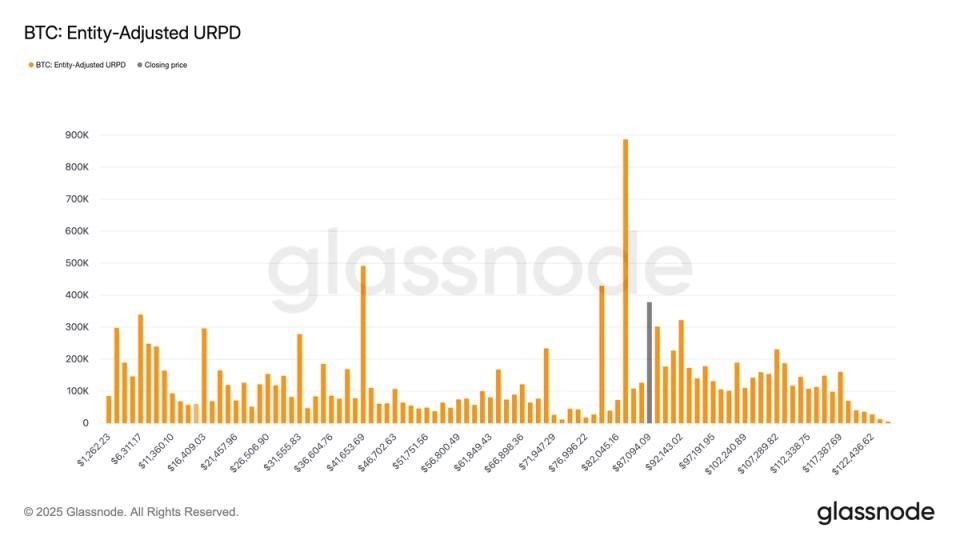
This observation is reinforced by Glassnode data. The UTXO Realized Price Distribution (URPD) shows where the current supply of bitcoin last moved using a unit-adjusted framework that assigns each unit’s full balance to its average acquisition price.
The URPD indicates a noticeable lack of supply concentrated between $70,000 and $80,000, consistent with the futures data. Both data sets suggest that if bitcoin were to undergo another corrective phase, the $70,000 to $80,000 region could represent a logical area where the price may need more time to consolidate to establish stronger support.
Disclaimer: This analysis is based on the daily open price of Bitcoin CME futures, with weekends excluded, meaning the numbers reflect how often bitcoin began a trading session within each price band rather than intraday or closing price activity.


