
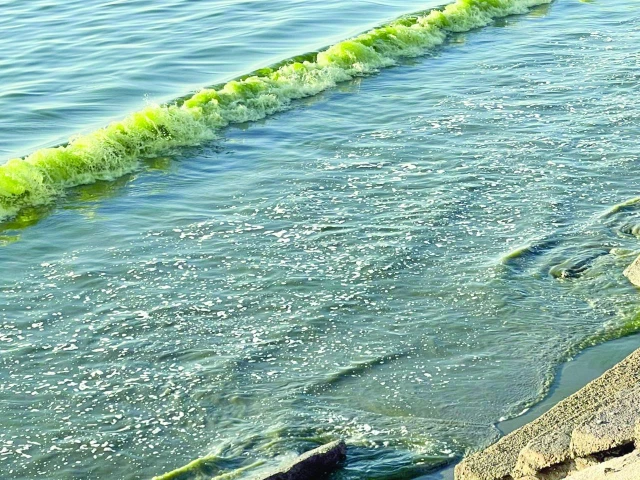
Experts say green waters along the coast of Balochistan and Karachi pose no toxic threat
The Gwadar coast glows green as the Noctiluca bloom paints the sea. Photo: Express
KARACHI:
The water along the Gwadar coast has turned green, replacing the usual blue with a greenish hue, caused by a natural marine phenomenon known as Noctiluca bloom, officials confirmed on Saturday. The phenomenon was first widely observed in 2017 and affects not only the coasts of Pakistan, but also large parts of the Arabian Sea, including Iran, India, Oman and the Persian Gulf.
Muhammad Muzammil Khan, technical advisor at DWLF Pakistan, assured that the green waters along the coasts of Balochistan and Karachi do not pose any toxic threat. The resurgence was reported on Friday by Abdul Rahim of the Gwadar Development Authority, who noted that large parts of Gwadar’s western and eastern bays had turned green.
DWLF Pakistan, a joint venture between National Logistics Corporation (NLC) and DP World Logistics FZE (DWLF), clarified that such seasonal changes in water color are normal and have been monitored in Pakistan since 2012. The green waters typically appear during the winter months from November to February. The most intense bloom occurred in 2017, spreading across the Arabian Sea and affecting neighboring countries.
This year, the bloom began in November along Pakistan’s waters, stretching from the coastal areas of Balochistan to Karachi. While some observers mistakenly associate the green color with eutrophication and the growth of cyanobacteria, scientific studies – including reports from Iranian scientists – confirm that it is a natural seasonal process. The phenomenon has also been observed in Pasni, Jiwani and as far as Sistan in Iran.
Noctiluca is a small, free-floating organism that can appear in red, orange, green or colorless form. Along the coasts of Pakistan it is mostly green or orange. The organism itself is not inherently green; the color comes from an internal pigment, Protogelina noctiluca, which allows it to reproduce quickly. Noctiluca is naturally luminescent and often glows at night.
Khan emphasized that the current green waters pose no health or environmental risk and have not been linked to fish or marine life deaths. Observations since 2012 show that almost all Noctiluca blooms along Sindh and Balochistan are non-toxic. Misinterpretations often link the bloom to pollution, but DWLF Pakistan emphasized that this is a natural marine occurrence, not a result of pollution.


