
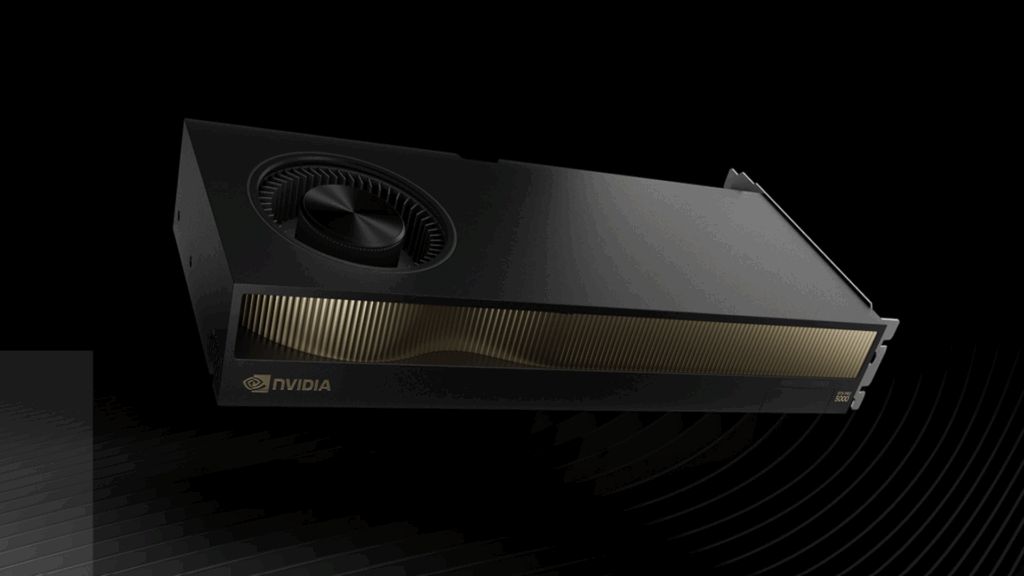
- The RTX Pro 5000 Blackwell supports up to 72 GB of GDDR7 memory with ECC
- Blackwell architecture delivers 14,080 CUDA cores and improved Tensor and Ray Tracing cores
- Multi-Instance GPU support allows a single card to be split into multiple virtual GPUs
The Nvidia RTX Pro 5000 Blackwell increases memory capacity, offering configurations up to 72 GB of GDDR7 memory with ECC support.
Its 512-bit memory interface delivers a theoretical bandwidth of 1,344 TB/s, supporting high-resolution simulations, large models and datasets commonly found in workstation environments.
The GPU uses the Blackwell architecture and includes 14,080 CUDA cores, fifth-generation Tensor Cores optimized for FP4 precision, and fourth-generation Ray Tracing Cores that handle complex geometry calculations.
Core Architecture and Computational Specifications
The card includes an AI Management Processor and Multi-Instance GPU (MIG) support, which allows it to be split into multiple virtual GPUs and support parallel design and simulation workloads.
This professional graphics card supports up to four DisplayPort 2.1b outputs with maximum digital resolutions exceeding 7680 x 4320 at 60Hz.
The system interface is PCIe 5.0×16, which provides high-speed communication between the GPU and the CPU and helps move large data sets without creating bottlenecks in demanding workstation applications.
Nvidia also upgraded its video engines, adding ninth generation NVENC and sixth generation NVDEC with 4:2:2 support.
These engines accelerate the encoding and decoding of high-resolution video streams used in specialized engineering and visualization tasks.
The RTX Pro 5000 Blackwell includes enhanced streaming multiprocessors paired with AI-enabled Tensor Cores, targeting workloads that rely heavily on GPU computation.
Its single-precision floating-point performance reaches 65TFLOPS, while RT Core performance peaks at 196TFLOPS.
Despite these specifications, the real world depends on application optimization, CPU pairing, and how efficiently the software uses available memory.
Users running CAD, 3D modeling, or simulation software are likely to see the greatest benefit when working with very large datasets or multi-GPU partitions, although many engineering workloads remain limited by CPU performance or software design.
The card draws 300W through a single 16-pin PCIe power connector and uses a full-height dual-slot form factor.
An active cooling solution maintains thermal stability under sustained workloads, which suits professional environments where systems often run for long periods.
Its full-length 10.5-inch design requires careful planning when choosing a compatible workstation chassis.
The 48GB RTX Pro 5000 Blackwell costs $4,199.99, and moving to a 72GB configuration is expected to raise the price even further.
Using simple “GB-for-GB” math, the higher-capacity version would land around $6300, which puts it above many competing professional cards from Nvidia and other vendors.
Given that Nvidia’s 96GB RTX Pro 6000 Blackwell Workstation Edition now costs just over $7,500 after recent price adjustments, the expected pricing of the RTX Pro 5000 Blackwell raises questions about the overall value.
Follow TechRadar on Google News and add us as a preferred source to get our expert news, reviews and opinions in your feeds. Be sure to click the Follow button!
And of course you can too follow TechRadar on TikTok for news, reviews, video unboxings, and get regular updates from us on WhatsApp also.


