
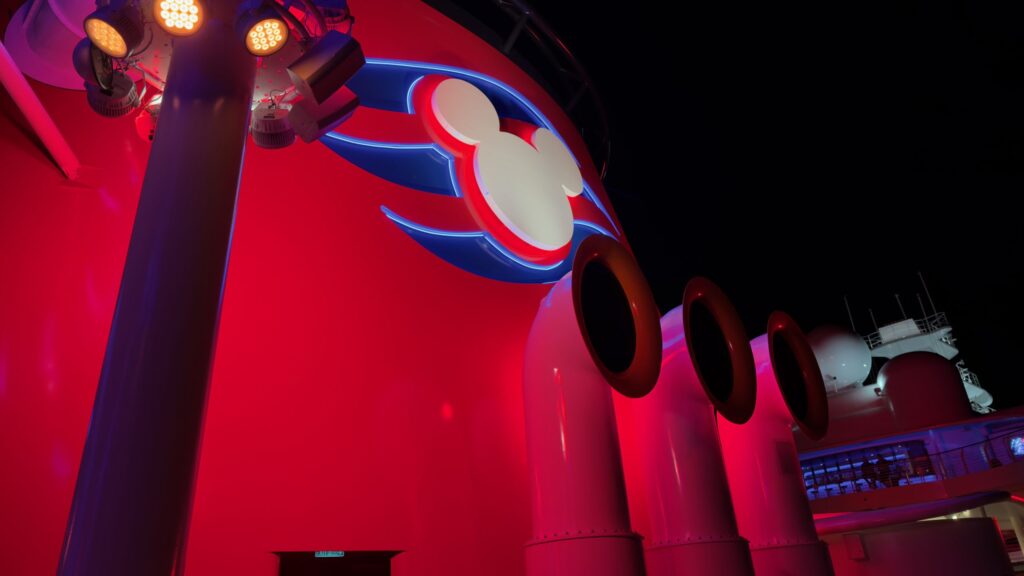
Aside from the scale of the Disney Destiny—Disney Cruise Line’s latest Wish-class ship, which stretches 1,119 feet—and the technology packed across the decks, one feature literally towers above the rest: Mickey Horns mounted high on the ship.
They are often the first thing you experience, announcing the ship’s presence with a familiar tune before you ever see it. Every Disney Cruise Line ship plays the same classic soundtrack – “When you wish on a star” — a unifying musical signature across the fleet. But beyond the common theme, each ship has its own suite of horn tunes designed to reflect its individual identity and experiences on board.
What’s easy to miss is that these tunes aren’t recordings. Each is played live on the ship’s horn, which Disney arguably uses less for maritime signaling – though that’s still a core use case – and more as a musical instrument. Basically, it’s a programmable system controlled by airflow, tuning limits, recharge time and real-world acoustics. And aboard Destiny, that philosophy is pushed further than ever before.
To understand how it works, TechRadar spoke exclusively to the Imagineers, music directors and technical producers responsible for designing, arranging and testing the ship’s horn system.
Treating the horn as an instrument
“We look at the ship’s horn as an instrument,” Disney Live Entertainment technical producer Michael Weyand told us. “In theory, it can be used to play any orchestration if we’re creative enough to work around its limitations.”
On Wish-class ships, including the Destiny, Disney uses what is known internally as the Mickey Horn, which is a programmable air horn system consisting of 18 individual horns, each tuned to a specific pitch. Together, they cover 18 of 25 notes over two chords in the chromatic scale.
“The biggest limitation is the amount of air available in the manifold and the time needed to recharge it,” said Walt Disney Imagineering Show Manager Andrew McTear. “Big chords and low notes use more air, so we need the arrangements to accommodate and avoid the horn sounding ‘flat’ or missing a note.”
In short, the music must obey Mickey Horn’s very physics, but that does not stop the performance. While “When you wish on a star” serves as a common thread across Disney Cruise Line’s fleet, it’s the baseline you expect when you board.
From there, each ship branches out its own collection of tunes with the goal of enhancing the ship’s theme and on-board experiences. Here, Fate leans fully into its ethos of heroes and villains.
Go the distance represents the ship’s new Hercules stage production, Cruella de Vil signals De Vil’s – a villain-inspired piano lounge – and Hakuna Matata connecting the horn with Pride Lands: Feast of The Lion King.
“When approaching the Disney Destiny tunes, the goal was to highlight what makes the ship unique in our fleet, celebrate the heroes and villains theme and highlight its exclusive offerings,” said McTear. However, these choices were not only thematic, they were also technical.
Goes the distance
Although Disney has an ever-growing portfolio of recognizable songs, not all pieces of music can make the leap from soundtrack to ship’s horn.
“As we explored heroic stories seen on board Destiny, Hercules and The Lion King were two of the additional stories we wanted to show,” said Walt Disney Imagineer Beth Burkhardt. “We also wanted to make sure that while both songs represent our heroes, they were distinctly different musically and came from different parts of a hero’s journey. So while Go the distance was Hercules’ ‘I want’ song as he began his heroic journey, Hakuna Matata shows that Simba is still trying to find his place in the circle of life.”
Cornucopia
That distinction also has structural significance. Each song behaves differently when tuned to the ship’s horn, with some requiring more air, more notes, or greater harmonic complexity than the system can support. And the work to figure this out and make every horn blow go off successfully begins long before the ship leaves the shipyard.
“The melodies are first arranged using a MIDI Synthesizer to simulate the horn,” McTear said. “This gives our creative and music team an opportunity to listen and work on the arrangements before the horn is even built.”
From there, arrangements are adjusted—note lengths lengthened, chords layered, phrases restructured—to maintain recognizability while staying within the system’s boundaries. Remember that each item lasts several seconds, so it must be recognizable quickly and then trigger a reaction for those within earshot.
Once the Mickey Horn itself is constructed – in Destiny’s case in Europe – testing continues.
“The Mickey horn used on the ship was built in Europe, in a remote location conducive to continuous testing and adjustment,” Weyand said. “Since our team is based in Florida, we have created a virtual demonstration for team members to better understand the horn’s capabilities and provide real-time feedback. Typically, we perform the final testing and tuning of the tunes during an open water sea trial setting where we can continuously sound the horn without disturbing other ships or communities.”
We actually have 18 horns in the Mickey Horn design
Michael Weyand, Technical Producer for Disney Live Entertainment
Sea trials allow the team to evaluate how sound travels across open water, how it behaves near shore, and how environmental factors such as wind affect clarity – conditions that cannot be replicated elsewhere.
“Our real limitations with the horn are the available tones we have to work with,” Weyand said. “We actually have 18 horns in the Mickey Horn design that you find on our Wish class ships. Each horn is specifically tuned to a note. In this we include 18 of 25 notes over two chords in the chromatic scale.”
By design, with the horn itself, there are some limitations, but the large number – 18 – makes it possible to be pretty sonically healthy. Even more interesting, however, is how Weyand’s team takes into account the various weather and temperature conditions that Destiny may encounter.
“We even include air heaters in our horn designs to ensure that even in cold weather the horns will sound exactly the same as they do in warm weather,” he explained.
Travel weather
This consistency matters when ships move between very different climates, and it’s likely a lesson learned throughout the various horns across Disney’s fleet. Walt Disney Imagineering Executive Creative Director of Music John Dennis explained that the Mickey Horn was born as a solution to a design challenge.
“The original concept was to match the same design as Dream and Fantasy, but due to differences in the Wish class of ships, we could not have the same technology present as we had on the Dream class,” he explained.
“Passionate about the evolution of these tunes to become even more musical, I continued to express a vision with our Music Studio leaders and we eventually ended up with the tunes we have today, where each of the Wish-class ships has songs unique to that ship,” said Dennis.
We deliberately designed the Mickey Horn to allow for growth
Michael Weyand, Technical Producer for Disney Live Entertainment
After learning how much engineering goes into those few seconds of sound, it’s impossible to hear a Disney Cruise Line horn the same way again. What feels effortless is the result of careful trade-offs – between air and duration, music and mechanics, narrative ambition and physical limitations.
It’s a reminder that Disney’s most effective storytelling often occurs where creativity must negotiate with engineering.
It is important that the system is not fully developed. “We intentionally designed Mickey Horn to allow for growth, whether it’s new songs or longer songs, or even songs created for a limited time engagement!” Weyand said.
Follow TechRadar on Google News and add us as a preferred source to get our expert news, reviews and opinions in your feeds. Be sure to click the Follow button!
And of course you can too follow TechRadar on TikTok for news, reviews, video unboxings, and get regular updates from us on WhatsApp also.


