
ISLAMABAD:
Islamabad on Thursday sought further details from Washington after the United States suspended the processing of immigrant visas for nationals of 75 countries, including Pakistan, but hoped the move is temporary.
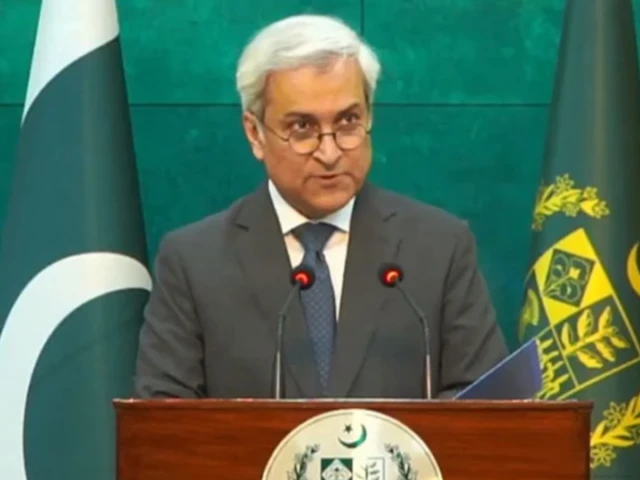
Reacting to the US decision on immigrant visas, State Department spokesman Tahir Andrabi said Pakistan had noted “brief statements by the US State Department on their social media handles about the internal review of immigrant visa processing only”.
He stressed that Islamabad was in contact with US authorities for more details, describing the situation as “a developing news that we are following”.
The spokesman stressed that Pakistan understood the move as part of an internal review of US immigration policies and systems. “We understand that this is an internal ongoing review of US immigration policies and system, and we hope that routine immigrant visa processing will resume soon.”
On questions about why India was not included in the list, Andrabi avoided speculation and reiterated that Pakistan was awaiting formal clarification from Washington.
The visa suspension has raised concerns among Pakistani applicants and comes despite recent high-level engagements between Islamabad and Washington.
Andrabi rejected suggestions that the development reflected a slowdown or strain in bilateral ties, noting the time difference between the two countries and maintaining that overall coordination with the US remained “effective”.
Alongside the visa issue, Pakistan is also assessing the implications of President Donald Trump’s announcement of a 25 percent tariff on countries and entities trading with Iran.
In response to several questions about whether Pakistan would be affected, the spokesman said the announcement was still unfolding. “This is a developing news,” he said, adding that Pakistan’s trade relations were conducted “in accordance with international trade rules and international law”.
He emphasized that Islamabad remained engaged with the US authorities on trade issues and highlighted the recent positive trajectory of bilateral trade negotiations.
“Pakistan has had very positive trade negotiations with the US. We look forward to the successful culmination in reaching mutually beneficial trade agreements with the US,” Andrabi said.
Regarding Pakistan’s trade with Iran, estimated at around $3 billion, he maintained that it also followed international rules and Islamabad would continue to engage both Washington and Tehran on the issue.
Andrabi said Pakistan was “closely following developments related to the situation in Iran” and described Iran as “a neighboring country, an important member of the international community and global brotherhood.”
“As a neighboring, friendly and brotherly country, Pakistan wants to see a peaceful, stable and prosperous Iran,” he said, stressing that peace and stability in Iran was in Pakistan’s own interest.
He pointed to the “deep historical, cultural and religious ties” between the two peoples and expressed confidence in Iran’s resilience.
Noting that the recent protests were sparked by economic difficulties “further exacerbated by international sanctions”, the spokesman said Pakistan hoped relief measures announced by the Iranian government would ease public distress.
“We have full confidence in the wisdom and leadership of the Iranian people, rooted in their rich culture, ancient civilization, history and resilience, to address all the challenges facing Iran,” Andrabi said.
He also reiterated a travel advisory for Pakistani citizens, urging caution and confirming that the embassy in Tehran was actively assisting nationals, including students, who have returned safely in recent days.
On the Middle East, Pakistan welcomed the announcement by the US Special Envoy that the Gaza ceasefire was moving into a second phase with a focus on demilitarization, reconstruction and technocratic governance.
Andrabi said Pakistan had remained committed to the Gaza peace process “as part of the group of Arab-Islamic countries since the beginning of the initiative in September 2025.”
He recalled that Pakistan supported both the Gaza Peace Plan and the subsequent UN Security Council resolution to save civilian lives, maintain the ceasefire, ensure large-scale humanitarian aid and ensure the withdrawal of occupation forces from Gaza.
Calling the latest announcement an “evolving story,” he said Islamabad hoped the next phase would lead to “further stabilization of the situation and scaling up of humanitarian aid and an end to the suffering of the Palestinians.”
At the same time, Pakistan reiterated its long-standing position that any peace process must culminate in a political solution. Andrabi said Pakistan hoped these efforts would lead to “a credible, time-bound political process in accordance with international legitimacy and relevant UN resolutions to establish an independent, sovereign and contiguous State of Palestine, based on the pre-1967 borders with Al-Quds Al-Sharif as its capital.” On the issue of joining a proposed international stabilization force for Gaza, he said no decision had been made and the mandate for such a force had not yet been finalized.


