
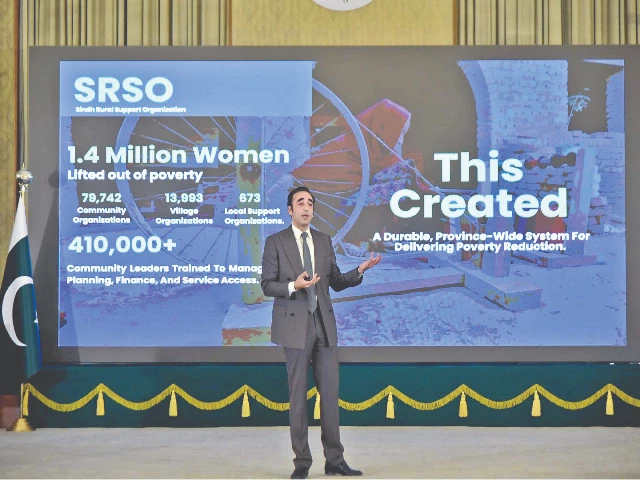
PPP Chairman Bilawal Bhutto-Zardari delivers a presentation on governance in Sindh at Awan-e-Sadr. Photo: PPI
ISLAMABAD:
Pakistan Peoples Party (PPP) Chairman Bilawal Bhutto-Zardari on Thursday outlined the Sindh government’s achievements since 2008, highlighting progress in healthcare, education, poverty alleviation, infrastructure, industry, agriculture and revenue generation, while proposing decentralization of sales tax collection to the provinces to address the country’s fiscal challenges.
Giving a detailed presentation on provincial governance at the presidency, Bilawal said that Sindh was often portrayed as a “glass-half-empty province”, but maintained that the PPP-led government had steadily strengthened institutions and expanded service delivery.
He noted that since assuming office in 2008, the party had won a larger mandate in each subsequent provincial election.
The event was attended by Acting President Syed Yousaf Raza Gilani, members of the Sindh Cabinet, parliamentarians, business representatives, diplomats and media persons.
Focusing on healthcare, the PPP chairman said that Sindh had increased allocations to the healthcare sector from 2.9 percent of the provincial budget in 2008 to nearly 10 percent at present. He highlighted the expansion of major public hospitals, including the Jinnah Postgraduate Medical Center (JPMC), where the bed capacity had doubled from 1,100 to 2,200 by 2025 with a target of 3,100 beds by 2028.
He said the National Institute of Cardiovascular Diseases (NICVD), also known as the Sindh Institute of Cardiovascular Diseases (SICVD), now operated 11 specialist hospitals and 30 chest pain units across the province, significantly improving access to emergency cardiac care. Referring to the Sindh Institute of Urology and Transplantation (SIUT), he said more than 35 million patients had benefited from its services since 2008, while the bed capacity had increased from 760 to 1,926.
Bilawal said Gambat Institute of Medical Sciences (GIMS) had successfully performed 1,362 liver transplants, while Shaheed Mohtarma Benazir Bhutto Institute of Trauma (SMBBIT) had emerged as the largest trauma center in South Asia, treating over 175,000 trauma patients annually. He added that Sindh’s infant mortality rate stood at 2.9%, well below the national average of 5.45%.
On the education sector, the PPP chairman said the number of public universities in Sindh had increased from 10 in 2008 to 30 today, along with 18 additional university campuses across the province.
On poverty alleviation, he said the Sindh Rural Support Organization (SRSO) program had helped lift 1.4 million women out of poverty through soft loans with a recovery rate of 98%. Recalling the devastating floods of 2022, Bilawal Bhutto said that around 2.1 million houses were destroyed across the province. In response, the Sindh government launched a massive housing initiative to build 2.1 million climate-resilient homes. Of this, 750,000 were completed, while around 1.5 million was under construction. He said the project had created nearly one million jobs, which had contributed to reduced unemployment and poverty.
In the agriculture sector, he said the provincial government distributed wheat seeds worth over Rs 2.1 billion to 215,000 farmers after the floods, leading to a bumper wheat harvest of 4.5 million tonnes the following season. He added that 198,000 farmers had benefited from the Benazir Hari Card programme, while a support package for wheat farmers of Rs56 billion. enabled cultivation of nearly 1.96 million acres. He noted that Sindh operated the world’s largest irrigation system with more than 4,000 kilometers of canals.
Talking about access and mobility, he said that Sindh had a road network of about 57,000 kilometers, including 24,148 kilometers of newly constructed roads. He added that until 2008 there were only five bridges over the River Indus in Sindh and four more bridges had since been built.
Bilawal said public transport was virtually absent in the province before 2008, but PPP-led initiatives now eased daily travel for over 200,000 passengers, including through the introduction of electric buses.
He added that 202,000 workers had been registered under the Benazir Mazdoor Card programme.
On energy, he said Sindh had the potential to generate 50,000 megawatts of wind energy along with large solar capacity. Currently, 1,845 MW was produced from wind projects. He said 200,000 solar systems had already been delivered to households, with a further 275,000 homes to be solarised.
He said that special economic zones and public-private partnerships were a defining feature of the Sindh government, noting that projects such as Dhabeji’s special economic zone had received international recognition. He cited the Thar coal project as a successful PPP model that contributed to national power generation while creating local employment, with 71% of jobs going to residents of Thar.
The PPP chairman also highlighted environmental gains and said mangrove forest cover in Sindh had expanded from 270,000 acres to a record 675,000 acres.
On revenue generation, he said Sindh Revenue Board (SRB) had collected Rs 28 billion. in 2011 compared to Rs 10 billion collection by the Federal Board of Revenue in 2010, a 68% increase over federal collections at that time, and Rs 307 billion in sales tax on services by 2024. He said the average SRB growth of 9% exceeded the average annual growth rate of 1. Revenue is 10%.
Bilawal Bhutto called for tax reforms and proposed decentralizing the collection of sales tax on goods to provinces, arguing that provincial tax authorities had consistently outperformed the FBR and could help bridge the federal fiscal gap while strengthening economic self-sufficiency.
Earlier, Chief Minister Syed Murad Ali Shah said the people of Sindh had repeatedly reiterated their confidence in the Pakistan Peoples Party by electing it to the government, describing the mandate as an endorsement of the party’s long-standing commitment to public service.
He said the PPP’s governance philosophy, rooted in the vision of Shaheed Zulfikar Ali Bhutto and Shaheed Benazir Bhutto, focused on empowering the most marginalized sections of society through inclusive development and people-centric policies.


