
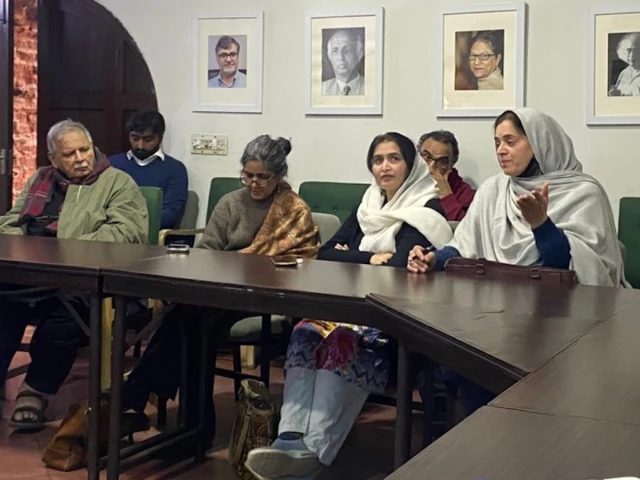
Consultation participants agree that local government is essential for democratic governance and effective service delivery
A hearing held by the Human Rights Commission of Pakistan in Lahore on Thursday. — HUMAN RIGHTS COMMISSION OF PAKISTAN X
LAHORE:
The Human Rights Commission of Pakistan (HRCP) on Thursday raised serious concerns over the Punjab Local Government Act 2025 that the law centralizes power and undermines the constitutional framework for local government.
A press release issued today by the HRCP said it held a hearing to examine the law, bringing together local government experts, lawmakers and civil society activists who questioned whether the new law meaningfully upheld the constitutional promise of local self-government.
Legal expert Sheikh Sibghat Ullah said Article 140A of the Constitution guaranteed autonomous and democratically elected local governments with political, administrative and financial authority. He said the new law weakened that guarantee by making local bodies accountable to the provincial government and bureaucracy rather than to citizens.
HRCP treasurer Husain Naqi criticized the re-centralization of authority through indirect elections, bureaucratic dominance and the reduced role of elected representatives. Electoral expert Tahir Mehdi said successive local laws had limited democratic development and this action followed the same pattern.
Press release
Punjab Local Government Act centralizes power, undermines decentralization
Lahore, January 22, 2026. A hearing held by the Human Rights Commission of Pakistan (HRCP) to examine the Punjab Local Government Act 2025 brought together local government experts,… pic.twitter.com/HzqGFvm0gd
— Human Rights Commission of Pakistan (@HRCP87) 22 January 2026
Local government expert Zahid Islam opposed the indirect election of key officials, citing recent resolutions passed by the Punjab and Khyber-Pakhtunkhwa assemblies calling for constitutional reforms, including a clear interpretation of Article 7, wider inclusion under Article 32 and a separate constitutional chapter on local governments. He also said that reserved seats increased marginalization and called for elections on a common electorate basis.
HRCP director Farah Zia suggested holding local, provincial and national elections on the same day to reduce uncertainty, a model planned for Gilgit-Baltistan.
Concerns were also raised about representation and equality. Aurat Foundation representative Nabila Shaheen said the act lacked clear guarantees for the meaningful participation of women and disadvantaged groups. Rights activist Samson Salamat warned that the inclusion of faith-based declarations in a local governance law could undermine the principle of a civic social contract.
PML-N legislators Bushra Lodhi and Qudisa Batool maintained that the law would help address issues at the grassroots level.
Participants criticized the legislative process, noting that the law was passed on the day it was introduced amid an opposition walkout, raising questions about transparency. PTI representative Imtiaz Mehmood said the law effectively removed the role of political parties, an issue currently under legal challenge.
Concluding the hearing, HRCP Punjab Vice Chairman Raja Ashraf said that elections in Pakistan had historically remained contentious.
Most participants agreed that local government was essential for democratic governance and effective service delivery, but the Punjab Local Government Act 2025 strengthened central control rather than decentralizing power.


