
.
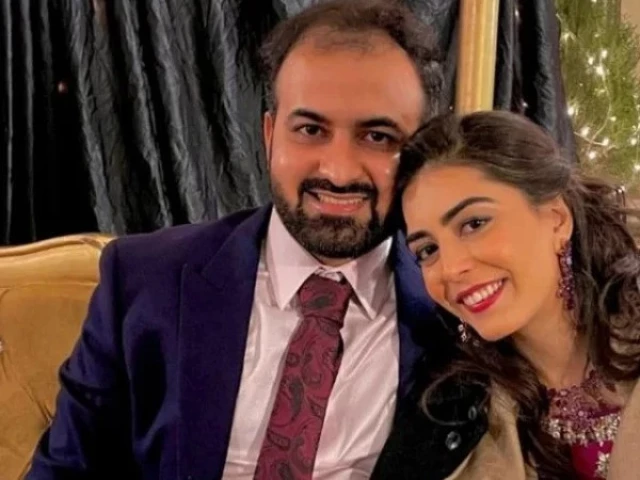
Human rights lawyer and social activist Imaan Mazari and her husband Hadi Ali Chattha. Photo file
ISLAMABAD:
An Islamabad trial court on Saturday handed down a combined 17-year prison sentence to rights activist and lawyer Imaan Mazari and her husband, lawyer Hadi Ali Chattha, on multiple charges linked to controversial social media posts that prosecutors said amounted to an anti-government narrative under cybercrime.
In a detailed 22-page judgment penned by District and Sessions Judge Islamabad Afzal Majoka, the court found both accused guilty under several provisions of the Prevention of Electronic Crimes Act (PECA) 2016, while acquitting them of one charge related to hate speech.
The ruling followed a case filed last August over posts and reposts on X, formerly Twitter, that investigators described as undermining state institutions and coordinating with banned organizations.
In a 22-page judgment, District and Sessions Judge Islamabad Afzal Majoka held that the prosecution had successfully established its case against Imaan Zainab Mazari Hazir and Hadi Ali Chattha under the Prevention of Electronic Crimes Act (PECA), 2016.
The court convicted both the accused under Section 9 of PECA and sentenced them to five years rigorous imprisonment each along with a fine of Rs5 million each. In case of non-payment of the fine, they will be sentenced to one year simple imprisonment.
Both were also convicted under Section 10 of PECA and awarded ten years rigorous imprisonment each with a fine of Rs30 million each. Failure to pay the fine will result in an additional two years of simple imprisonment.
Separately, the court convicted them under Section 26-A of PECA and sentenced them to two years rigorous imprisonment each, coupled with a fine of Rs1 million each. In default of payment, they had to undergo six months of simple imprisonment.
The judgment noted that the convicts were already in custody in another case and were present in court via a video link. The court ordered that they be kept in jail to serve their sentences and extended to them the benefit of Section 382-B of the Criminal Procedure Code, which allows for adjustment of time already spent in custody.
Committal warrants were ordered to be issued and copies of the judgment were directed to be supplied free of charge to both the convicts through the Superintendent of the Central Jail, Rawalpindi.
However, the judge acquitted the pair of the offense under section 11 of PECA, noting that none of the prosecution’s witnesses had alleged that the accused used hate speech to promote inter-religious, sectarian or racial hatred.
The case was registered by the National Cyber Crime Investigation Agency (NCCIA), which alleged that Imaan Mazari had propagated a narrative aligned with hostile terrorist groups and proscribed organizations and individuals. It was also alleged that she portrayed the armed forces as being behind terrorism and enforced disappearances.
The judgment noted that a perusal of tweets, retweets and posts showed that the accused had described Pakistan as a terrorist state, termed detentions under Section 11-EEE of the Anti-Terrorism Act as illegal, praised banned organizations and individuals and portrayed the judiciary as biased.
It noted that such narratives typically rely on emotive language, selective presentation of facts, historical grievances or ideological frameworks aimed at eroding public trust in key state institutions, including the judiciary, armed forces, legislature and law enforcement agencies.
“Typically, this kind of narrative uses emotive language, selective presentation of facts, historical grievances, or ideological frameworks with the goal of eroding public trust in key state institutions, including the judiciary, the armed forces, the legislature, and law enforcement agencies. In some cases, it may extend to the state glorifying, glorifying, or glorifying legal authority.”
“In constitutional and national security jurisprudence, courts have consistently distinguished between protected democratic dissent and an anti-state narrative by examining the intent, content, context, and foreseeable effects of the expression in question. Particular emphasis is placed on whether such expression incites violence, promotes secession, or encourages actual terrorism, tangible order, encourages and threatens the public, proxy national security,” it read.
The court recognized that robust criticism of the state and its functionaries is an important element of a democratic society and is protected by free speech. However, it distinguished between permissible dissent and what it described as an anti-state narrative, which it legally defined as speech or conduct that goes beyond legitimate criticism and enters the realm of subversion, destabilization or incitement against the state.
In such situations, the judgment said, imposition of reasonable restrictions under constitutional and statutory provisions is considered justified. The court concluded that the accused had crossed the permissible legal limits through their tweets, retweets and online postings, thereby committing offenses under Sections 9, 10 and 26-A of PECA.
The court further noted that both the accused had expressed views in favor of Mahrang Baloch, described in the judgment as a proscribed person. The defense had argued that simply expressing views about a proscribed person did not constitute an offense under Section 9 of PECA.
“This court does not agree with the arguments of learned counsel because glorification has been defined in PECA which includes any form of praise or celebration. Under these circumstances, the prosecution has been able to prove its case against the accused persons under Section 9 of PECA”
The order added that under Section 10 of PECA, any person who commits or threatens to commit an offense under Section 9 for the purpose of furthering the objectives of proscribed organizations or individuals is punishable.
“Now it must be seen whether the accused persons by their tweets, re-tweets and posts furthered the agenda of proscribed persons or organizations.”
The court noted that the accused had described Pakistan as a “terrorist state” in their tweets, a designation that, according to the order, officially applies to only four countries: Cuba, the Democratic Republic of Korea, Iran and Syria.
It noted that both the accused are lawyers by profession and therefore fully aware that Pakistan does not fall under this category. Despite this, the order said, they deliberately referred to Pakistan as a terrorist state in their social media posts, a claim the court linked to what it described as the agenda of banned outfits such as the Balochistan Liberation Army (BLA) and Tehreek-e-Taliban Pakistan (TTP).
The court also noted that the accused maintained at the evidentiary stage that their actions were protected under Article 19 of the Constitution. While recognizing that Article 19 guarantees freedom of expression, the Court held that such freedom remains subject to reasonable restrictions under the law.
The judgment further noted that there is a general international consensus that an accused’s right to be present at trial is not absolute and may be subject to limited exceptions.
“There are two general scenarios in which an accused will be absent from his trial: i) where the accused is removed from court to interrupt the proceedings and the prosecution or the court decides to proceed in his absence; and ii) where the accused does not appear at the trial (or ceases to attend midway) and the prosecution or the court decides to proceed in his absence.”
In the first scenario, the ruling noted, a disruptive accused may be removed for abusing the right to be present.
“In a case against the United Kingdom, the European Commission of Human Rights held that the right contained in Article 14(3)(d) of the ICCPR (to be present) is unlikely to include the right to delay one’s own trial.”
“The second scenario arises where the accused does not appear at trial. In this case, a decision to proceed in absentia will only be legal if the prosecution can demonstrate that the accused has waived his right to be present. The question of what constitutes a legitimate waiver and what evidence the state must present to demonstrate that absence is the subject of the majority of in-appearance trials.”
‘Attack on justice’
Commenting on the verdict, former Additional Attorney General Tariq Mahmood Khokhar said that Imaan and Hadi were convicted and sentenced for “the peaceful advocate of human rights”.
“This judgment is an attack on justice and the rule of law. Lawful speech has been criminalized. Constitutional rights under Article 19 and 10-A have been ignored. PECA has been weaponized against dissent.”
He further said that the State of Pakistan had failed to fulfill its obligations under international law, claiming that it had acted in violation of Articles 14 and 19 of the International Covenant on Civil and Political Rights (ICCPR).
According to Khokhar, UN principles on the role of lawyers and international jurisprudence on the protection of dissent were disregarded.
Calling it a new low for the judiciary, Khokhar said the country was witnessing “a transition from the dark hour to a black era”.
He also maintained that independent observers, both in the country and abroad, considered “the trial and the verdict” as predetermined, prejudged and outsourced.


