
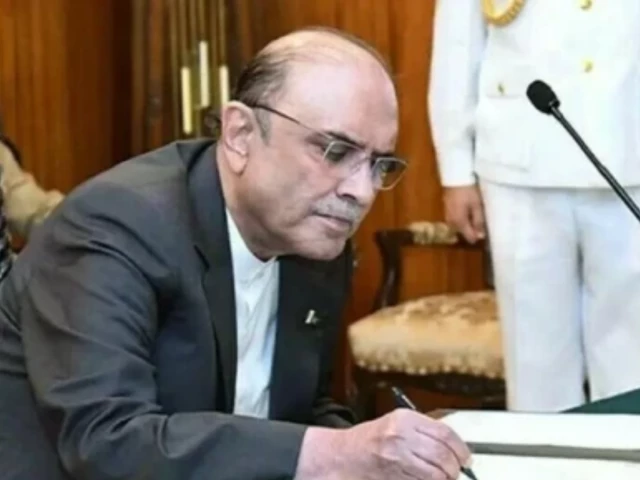
President Asif Ali Zardari signs seven bills passed by parliament. Photo file
President Asif Ali Zardari on Monday signed into law the much-debated Domestic Violence (Prevention and Protection) Bill, 2026, along with six other bills passed by Parliament.
According to a press release issued by the President’s Secretariat, the approved legislation includes the National Tariff Commission (Amendment) Bill, 2026; Export Development Fund (Amendment), 2026; The Transfer of Railways (Amendment) Bill, 2026; Domestic Violence (Prevention and Protection) Bill, 2026; Danish Schools Authority Bill, 2026; The Income Tax (Amendment) Bill, 2026; and the National Human Rights Commission (Amendment), 2026.
The President approves seven bills passed by Parliament
Islamabad: January 26, 2026 – President Asif Ali Zardari has approved seven bills passed by Parliament, completing the legislative process for measures spanning trade, taxation, social protection, education, railways and human… pic.twitter.com/tjeUQbI9nr
— PTV News (@PTVNewsOfficial) 26 January 2026
Last week, a joint session of Parliament passed the bills despite presidential objections, opposition protests and sloganeering in Parliament. The session was chaired by the Speaker of the National Assembly, Ayaz Sadiq.
During the meeting, President Zardari’s objections were formally raised to the Danish Schools Authority Bill and the Domestic Violence Bill, with opposition lawmakers insisting that the President’s advice should not be ignored.
On the Daanish Schools bill, the president objected to the federal government having to consult the provinces before creating the authority.
On the domestic violence bill, he called the legislation “vague” and raised concerns about the proposed penalties, advising that the bill should be reconsidered rather than approved in its current form.
Jamiat Ulema-e-Islam Fazl Senator Kamran Murtaza had read out the president’s advice in the house and said it was being disregarded.
“The president asked for consultation with the provinces on the bills which are being ignored,” he said, adding that “the federation has overstepped provincial boundaries.”


