
Envoy says selective application of legal norms deepens global instability, weakens the multilateral system
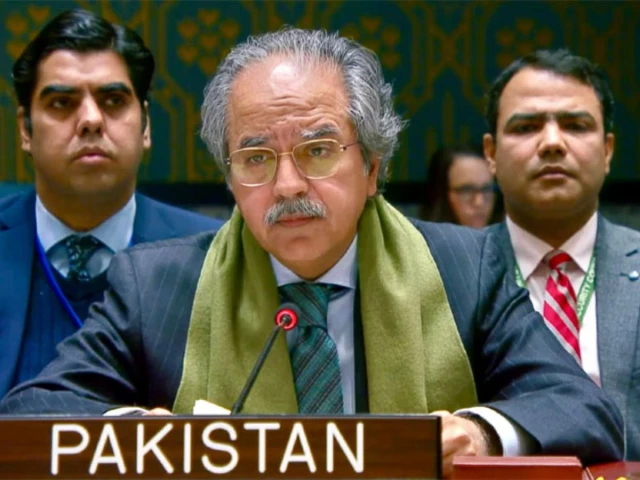
Pakistan’s Permanent Representative to the UN Ambassador Asim Iftikhar Ahmad at the UN Security Council session. PHOTO: RADIOPAK
Pakistan has called for stronger respect for international law, warning that selective application of legal principles is exacerbating global instability.
Speaking at a high-level open debate in the UN Security Council on January 26, Pakistan’s Permanent Representative to the UN, Ambassador Asim Iftikhar Ahmad, said the erosion of the rule of law contributes to conflicts, humanitarian crises and the weakening of trust between countries.
He said that international law should make relations between states predictable and stable. But when countries ignore agreed rules, he warned, the law risks losing its meaning. The Pakistani envoy emphasized that “affirming international rule of law is not an abstract legal exercise but a prerequisite for peace, justice and collective security.”
He noted that core principles enshrined in the UN Charter – including sovereign equality, non-interference, political independence, territorial integrity and the prohibition of the threat or use of force – are increasingly being challenged.
“Selective application of legal norms, erosion of treaty obligations and unilateral actions have undermined trust among states and strained the multilateral system of the UN Charter,” he stressed. “When law yields to force or expediency, instability deepens, strife deepens, and peaceful coexistence is endangered.” He warned against attempts to normalize unilateral actions outside the framework of the UN.
Referring to the tensions with India, Ambassador Ahmad said that Pakistan had witnessed violations of international law first hand. He stated that “India carried out an unprovoked military aggression last May in violation of international law and Pakistani sovereignty.” He noted that Pakistan, “in accordance with Article 51 of the Charter,” was exercising “its inherent right to self-defense in a responsible, restrained and proportionate manner.”
“Our response established that there can be no new normal based on coercion or impunity,” he said, adding that “respect for international law remains the only legitimate norm governing interstate conduct.”
Read: Pakistan calls for upholding the UN Charter
Ahmad identified the “root cause of instability in South Asia” as “India’s illegal occupation of Jammu and Kashmir in gross violation of Security Council resolutions,” and warned of serious human rights consequences that jeopardize lasting peace.
He added that lasting peace in South Asia required resolving the Kashmir dispute in accordance with UN resolutions and ensuring respect for treaty obligations, including water-sharing agreements. He also condemned India’s unilateral suspension of the Indus Waters Treaty as “another flagrant breach of international obligations, threatening lives, livelihoods of millions, jeopardizing peace and security.”
“Pakistan rejects the weaponization of water and critical natural resources,” Ahmad said, noting that adherence to the treaties is a cornerstone of international legal order.
Despite regional tensions, Pakistan has demonstrated its commitment to peaceful dispute resolution, Ahmad highlighted. He said that “within weeks of defeating military aggression, Pakistan led the unanimous adoption of Security Council Resolution 27(88) on the peaceful settlement of disputes.” This, the Ambassador said, reaffirms the Council’s collective commitment to dialogue, mediation and judicial settlement and other peaceful means as the first resort to resolving disputes.
Regarding the broader global picture, the Pakistani envoy acknowledged that “due to double standards and lack of full compliance, the international system has often failed and not fully benefited many countries, especially in the Global South.”
Despite this, he said, nations in the Global South continue to place their trust in the United Nations and in a just, rules-based international order. Ahmad called for UN reform “towards equality, democracy and accountability, away from unfettered power and entitlement,” saying “reform for all, privilege for none.”
The UN envoy also pointed to what he described as a positive development in international law. Despite geopolitical tensions, he said, the international legal framework remains robust. He welcomed the entry into force of the BBNJ Agreement and the International Law Commission’s work on sea level rise, which demonstrated the ability to respond to new challenges.
He also welcomed the recent advisory opinions of the International Court of Justice on Palestine and climate change, stressing that “these opinions must be respected and applied universally because selective acceptance would undermine the authority of the Court and confidence in international adjudication.”
Referring to the situation in Palestine, Ahmad said it “starkly illustrates the consequences of selective adherence to international law.”
“The continued denial of the Palestinian people’s inalienable right to self-determination, persistent violations of international humanitarian law and disregard for relevant UN resolutions erodes the credibility of the international system,” Ahmad said. He stressed that “a just and lasting peace can only be achieved through full respect for international law and the equal application of legal principles to all.”
To prevent the selective application of international law, Ahmad made two proposals. He stressed that it is imperative that “Member States fulfill their obligations under Article 25 of the Charter to implement Council decisions.”
Read more: At the UN, Pakistan says it supports stability in Syria
First, “the Security Council should devise effective mechanisms to systematically monitor the implementation of its own resolutions and to take action in case of persistent non-compliance.” Second, “the Council should engage the ICJ more systematically.”
He said the rule of law could not be upheld through statements alone. “If multilateralism is to endure,” he said, “law must prevail over force and justice over impunity.”
He reaffirmed Pakistan’s commitment to resolve conflicts peacefully and to support a UN-centered international order based on equal rules for all states. “Pakistan remains committed to a UN Charter-inspired rules-based international order where disputes are resolved peacefully, commitments are honored and the UN acts as a true guarantor of peace, justice and dignity for all,” he added.


