
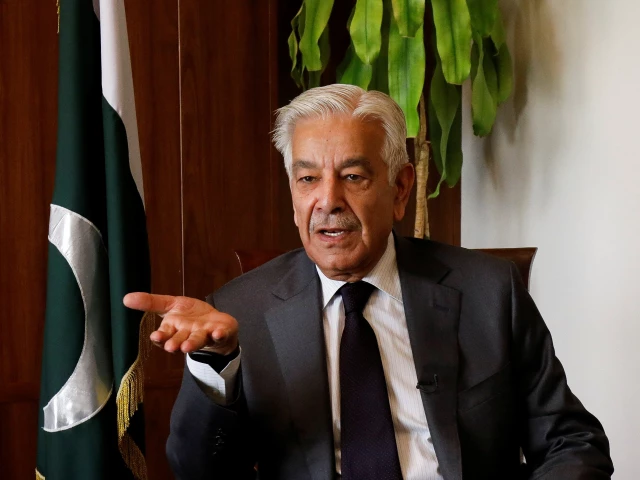
Concepts migration “routine annual” exercise; Say IBOs more effective; Denies any military operation in progress
ISLAMABAD:
Defense Minister Khawaja Muhammad Asif categorically stated on Tuesday that no military operation was conducted in the Tirah Valley, terming migration of people as a routine and seasonal process due to severe weather and snowfall.
Addressing a press conference alongside Information Minister Attaullah Tarar and Prime Minister’s Information Coordinator Ikhtiar Wali Khan, the defense minister said: “There has been no operation in Tirah Valley for many years. These are all assumptions.”
The news conference came two days after the federal and provincial governments traded barbs over who authorized the evacuation process after hundreds of Tirah residents left their homes ahead of planned military action against terrorists.
The evacuations, which were carried out according to a plan agreed upon by all stakeholders – including local elders, the provincial government and the military – appear to have become a bone of contention after the displaced population found themselves stranded in cold weather in the open, with mismanagement by the authorities only adding to their problems.
He said it was strategically decided that intelligence-based operations (IBOs) were more effective than large-scale operations, adding that the armed forces had stopped such operations years ago in favor of IBOs.
Asif said that IBOs would continue to remove the menace of terrorism from the country’s soil.
He said about 60 to 65 percent of the population migrates to other areas every year due to harsh weather conditions and heavy snowfall, a practice that has continued for decades and even over the last century.
The minister clarified that the armed forces deployed in the area had no role in the displacement. “This is an agreement between the local jirga and the Khyber-Pakhtunkhwa government,” he said.
He said the KP government had approved a relief package of Rs 4 billion for the people of Tirah valley who migrate seasonally.
He also criticized the performance of the KP government and highlighted the lack of hospitals, schools and police stations in the valley. The minister claimed there was a “complete absence of civilian law enforcement” in Tirah. “There is no police station there,” he added.
Asif further stated that hemp was harvested in Tirah over 12,000 acres. Hemp harvested over each hectare yielded a profit of around Rs 3-3.5 million, he said, adding that “this is an important factor” in this matter.
He said hemp had several uses, including in medicine, building materials and bricks.
“Hemp is harvested and profits earned from this either go to people associated with politics or TTP. We have initiated measures to stop this so [Tirah’s] people are benefiting from this harvest and schools and hospitals are being built,” Asif added.
He went on to claim that the interests of the provincial government aligned with those of the TTP in Tirah “as they jointly exploit this source (hemp)”.
The minister recalled that the jirga in Tirah had held meetings on December 11, 21 and 31 last year on the matter.
“It has been meeting the civilian government. You don’t see the military anywhere in this [matter]. And this jirga was founded many years ago [ ] And all 24 members of the jirga are on board. All the things that I have mentioned that are necessary there [Tirah]it is their (jirga) demand. Now, in the presence of the jirga and this notification, where do you see the military’s [involvement] in this?” said Asif.
He alleged that the KP government wanted to shift the blame for its “failure” to the military or an operation that did not even exist.
Then, apparently referring to the movement of people in Tirah, he maintained that this “tradition has been in place for decades” due to the climate and topography of the area. It was even mentioned in a British-era gazette, he added. “This transition happens every year.”
“This is nothing unusual, but the PTI government has tried to manage it [appear] unusual,” he said. Moreover, the KP government had claimed to spend Rs2-4 billion to set up camps for the evacuated residents, he said, claiming that these camps did not protect against the cold.
He again claimed that the military presence or an operation in Tirah was an “assumption”. “No surgery has been done there for years,” he maintained.
He added that if the KP government wanted to work for the betterment of the people of Tirah, the federal government would provide it with the necessary funds for that purpose.
Federal Minister for Information and Radio Attaullah Tarar said the migration of tribals from District Khyber during winter is a historical norm, rejecting the “baseless narrative” peddled by the Khyber Pakhtunkhwa government’s spokesperson.
The minister emphasized that the Afridi and Aka Khel tribes have a unique lifestyle that migrates from Tirah in winter and returns in summer.
Tarar noted that history bears witness to this seasonal migration, citing Edward A Murphy’s 1899 book, The Khyber, which refers to an official gazetteer from 1880. He pointed out that this historical record explicitly documents the customary winter migration of the tribes, describing it as an established reality recognized in international literature.
In response to questions about the timing of the current move, the minister explained that while winter traditionally began in October, climate change has significantly altered the seasonal cycles. He noted that snowfall, which historically occurred in November, is now delayed until late January, representing a total change of season.
He also referred to a notification issued by the KP government itself stating that the tribals are moving voluntarily. The minister urged provincial officials to avoid politicizing a centuries-old traditional practice.


