
The US Senate has moved into a new phase with crypto market structure legislation that the industry hopes will help it reach a new plateau of investor confidence and involvement, with a committee formally advancing the bill on Thursday.
This is as far as the crypto sector’s top policy effort has ever gotten in the Senate, even if there are headwinds. The committee working on the bill was the Senate Agriculture Committee, and its Republican chairman chose to step away from negotiations and vote on the legislation without bipartisan support. The resulting Republican-driven outcome — quickly wrapped up in a 12-11 partisan vote — will still need to muster significant Democratic support before it can ultimately clear the structural hurdles in the Senate.
“After months of work, we’ve made significant progress, really significant progress in working together,” committee chairman John Boozman said as the panel began work. “Now is the time to move this process forward.”
Democrats at the long-awaited markup session lined up as a unified bloc to oppose Republican preferences, illustrating the partisan battle that has yet to be overcome. Several Democrats noted that they hope to keep working on it to get to a bipartisan version, and Boozman himself acknowledged that the text could be updated through a leader’s amendment before it continues through the Senate.
“The progress that’s been made here is good, but I think we think we’re not quite done yet,” said Sen. Amy Klobuchar, the panel’s ranking Democrat. “I hope we can continue to negotiate as this bill moves forward.”
The Agriculture Committee is one of two panels that will ultimately sign off on the legislation. However, the Senate Banking Committee may have a tougher time because its version of the Digital Asset Market Clarity Act contains some of the more controversial elements, including the issue of stablecoin dividends. However, this effort has been delayed in its own markup and hindered by the search for a compromise that will satisfy a variety of interests, including Wall Street bank lobbyists.
The White House intends to host another meeting next week with the intention of finding common ground among crypto, banking, Republican, Democratic and administration interests. President Donald Trump and his representatives have pushed back on a few key points of the legislative effort, including Democrats’ demands that he and other senior officials be barred from personally benefiting from crypto business interests.
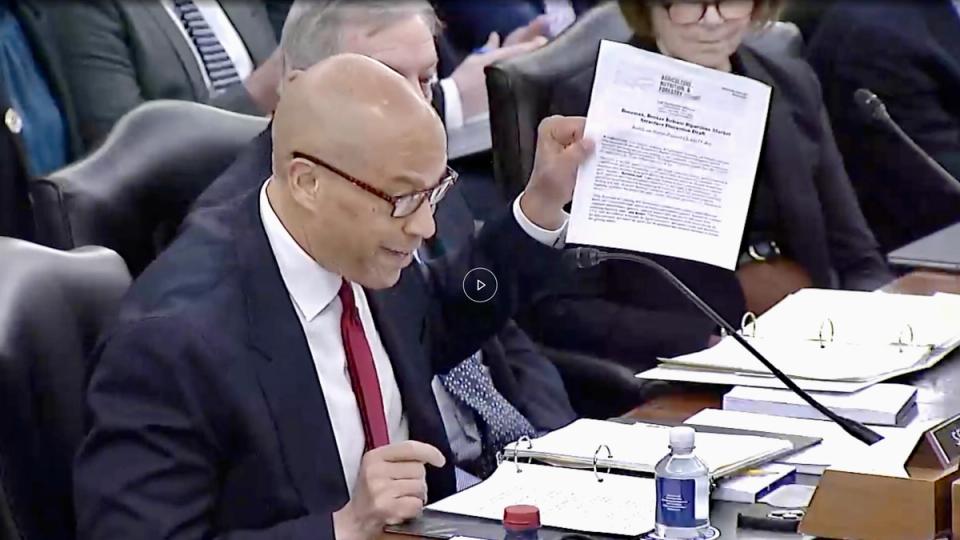
Senator Corey Booker, the Democrats’ chief negotiator, said the White House has made progress on the bill “infinitely more difficult.” “This is ridiculous that the president of the United States and his family have made billions of dollars from this industry and are still trying to create a framework here without the kind of ethics that would prevent this kind of gross corruption in our country,” Book said.
On Thursday, the hearing’s first amendment addressed the Democrats’ ethics component.
Boozman also appeared to support another of the Democrats’ requests that the Commodity Futures Trading Commission get a full slate of commissioners as it moves into a lead role in overseeing crypto.
“It’s important to have a fully staffed, bipartisan commission,” he said.
The chairman noted as the markup concluded that the committee must now work with its counterparts in the banking committee and with lawmakers in the House of Representatives to come up with something that can be supported by both parties. He also said some of the proposed amendments better fit that committee’s version of the bill.
If all goes well, here’s what it will take to pass the bill into law:
- After the legislation cleared the Senate Agriculture Committee on Thursday, it must eventually do the same in the Banking Committee.
- The various versions would have to be combined into a final Senate floor bill, potentially giving the bill’s proponents another chance to appease resistant Democrats.
- A combined bill could then be submitted to the Senate for a final vote.
- A yes at that point moves it back to the House of Representatives, which already passed its own version of the legislation by an overwhelming majority.
- Another approval sends the Clarity Act to Trump to be signed into law.
The crypto industry is already sitting on a high-stakes victory this session of Congress, having passed a bill to regulate US stablecoin issuers into law, marking its first major legislative victory in the US. But the industry has a crunch time to get this even bigger bill through as the Senate battles over federal funding and nears the midterm elections in November.


