
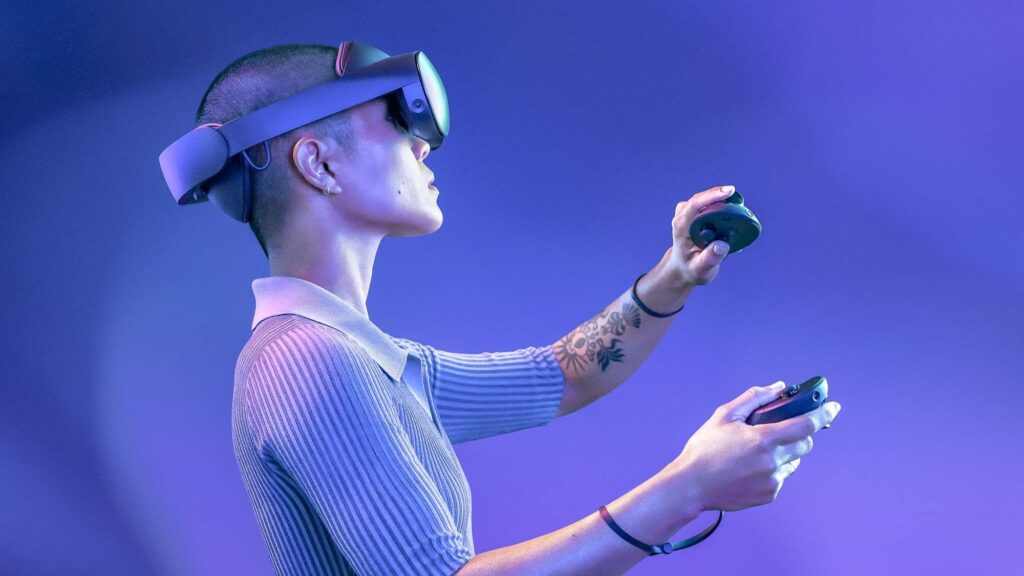
- Meta teased “future headsets” at its latest investor call
- Zuckerberg also suggested that Meta would use AI to let you jump into videos
- No final plans or timetables were given
Based on recent layoffs, many had wondered if this was the beginning of the end for Meta’s VR plans, but the company has confirmed that it’s still working on new technology in the space — including new hardware and a possible AI integration that’s truly sci-fi.
Speaking to investors after its latest quarterly report, CEO Mark Zuckerberg didn’t talk too much about VR, perhaps unsurprisingly, instead focusing on smart glasses, sales of which have “more than tripled” in the last year.
Initially, not a good sign for the future of VR. But Meta CFO Suan Li turned our hopes around when she answered a question from Deutsche Bank’s Benjamin Black about Reality Labs.
She said, “We continue to be optimistic about the future of VR,” adding, “We’re continually investing — going forward rather in building future headsets.” She said this before putting a slight damper on our VR hopes by explaining what we already knew, that “consumer adoption of VR has generally been on a slower growth path than wearables, and we’re rebalancing our Reality Labs portfolio to reflect this.”
No more details than that were revealed about these “future headsets,” but leaks have pointed to two possible devices that will land in 2026 and/or 2027.
One would be a ‘Quest 4’ which is a big but more typical upgrade on its predecessor, again coming with a higher end and slightly lower end model like we saw with the Quest 3 and Quest 3S.
Then there’s the headset, I’ve dubbed the Quest Pro 2. It’s set to be ultralight—with a design that looks more like glasses or goggles than a headset—thanks to transferring the battery and computing power to a puck you keep in your pocket. It would also be more productivity focused instead of emphasizing games.
An AI upgrade
The other big improvement we could see in VR is an emphasis on AI. Of course, this is to be expected in the age of AI, but Zuckerberg highlighted a truly sci-fi future use case during the presentation: “There’s definitely a version of the future where any video you see, you like, tap and jump into it.”
Now, the way Zuckerberg describes this future, it’s certainly not one we’ll see next week or maybe even in the next few years, but this would be a further improvement on the AI-led tools we’re already seeing. which can transform 2D scenes into stereoscopic 3D.
In addition to VR, Zuckerberg’s words also hint that it could be a tool we see coming to mobile platforms – which is also now the main focus of their Horizon metaverse. Being able to generate worlds from images—from our digital memories—would be a powerful creative tool for the kind of immersive, cross-platform social experiences and could be the differentiating factor Meta needs as its AI models lag behind rivals like ChatGPT, Gemini and others.
These vague hardware references and AI promises don’t give us a solid timeline for when Meta’s next VR development will drop, but it does at least tease a next step that feels less completely miserable to us VR fans.
However, the question remains whether the Meta can win back the favor, or if upcoming units like the Steam Frame will eat the Meta’s lunch, as I suspect it could.
Follow TechRadar on Google News and add us as a preferred source to get our expert news, reviews and opinions in your feeds. Be sure to click the Follow button!
And of course you can too follow TechRadar on TikTok for news, reviews, video unboxings, and get regular updates from us on WhatsApp also.


