
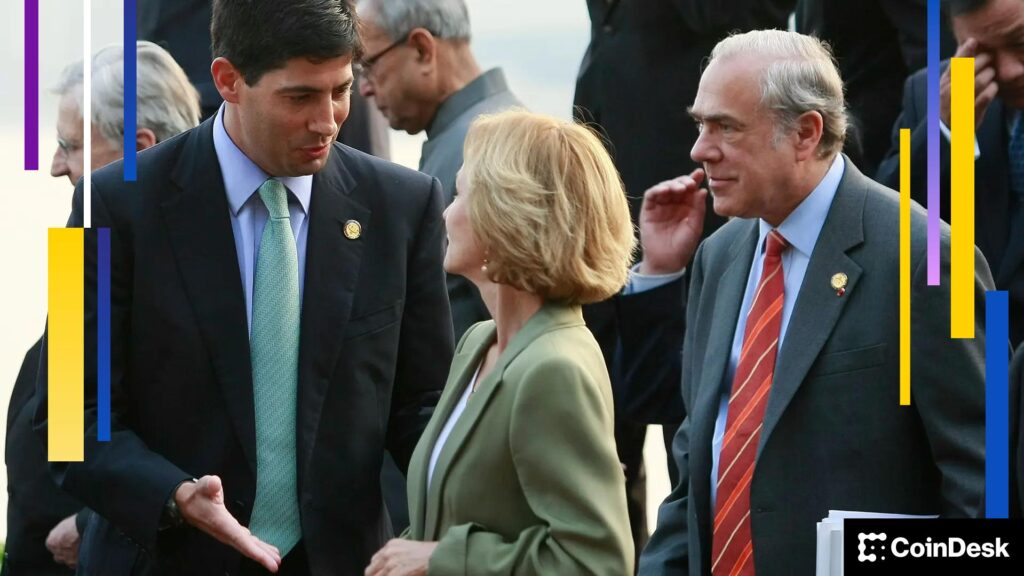
The market was dazzled by sudden news that President Donald Trump named Kevin Warsh as his pick for the next Federal Reserve chair, ending a months-long saga of guessing games.
The US dollar rose, bitcoin fell and the stock market became volatile when the news broke; while the market may have stabilized somewhat for now, uncertainty still grips traders across all asset classes.
So who is Kevin Warsh, and more importantly, how will his leadership shape the future of monetary policy and crypto?
Former Fed Governor
Kevin Maxwell Warsh is a former US Federal Reserve governor who served from 2006 to 2011 and played a leading role during the 2008 global financial crisis, including serving as a key liaison between the Fed and the financial markets.
Before joining the Fed, Warsh worked at Morgan Stanley and served in the George W. Bush administration as Special Assistant to the President for Economic Policy and Executive Secretary of the National Economic Council, giving him Wall Street and Washington experience.
After leaving the Fed, Warsh became a visiting fellow at Stanford University’s Hoover Institution, where he has written extensively on monetary policy, central bank credibility and what he sees as the long-term risks of prolonged central bank balance sheet expansion.
It’s worth noting here that while the nomination spooked the market and bitcoin, Federal Reserve Chairman Jerome Powell — whose second four-year term expires on May 15, 2026 — is eligible to remain on the Fed’s board until January 31, 2028. Warsh still needs to be confirmed by the Senate, but assuming Stephen Mirancy assumes the role. expiring a temporary period on 31 January 2026 may give him the opportunity to join the board before May.
The Bitcoin Outlook
Warsh’s appointment has drawn particular attention from investors in digital assets — at least initially — given his long-standing views on monetary discipline and skepticism about bitcoin’s role as money.
While the concern is not with Warsh personally, his background has led many market participants to view him as potentially bearish on bitcoin and other risk assets. He is widely seen as favoring monetary discipline, higher real interest rates and a smaller Fed balance sheet, all of which oppose a liquidity-heavy environment that has historically supported risk assets.
So what are his ties to crypto?
First, let’s look at what he previously said about bitcoin.
In public comments in 2015, Warsh approached bitcoin and cryptocurrencies primarily through a monetary policy lens, expressing skepticism about their use as stable mediums of exchange while acknowledging the potential of blockchain technology.
“The underlying technology in that white paper, it’s just software,” Warsh said during a video call with Stanley Drukenmiller. “It’s just the newest, coolest software that’s going to give us the ability to do things we could never have done before.”
While acknowledging that all software can be used for good or bad, Warsh said that by building it here in the U.S., it gives us the opportunity to be more productive and create something truly special over the next decade…”
At one point in the conversation with the billionaire hedge fund manager and his former colleague, Warsh told Drukenmiller: “You were referring to Bitcoin and I thought I heard a little condescension in your voice that people are buying bitcoin.”
He went on to argue in favor of bitcoin, saying “it could provide market discipline, it could tell the world that things need to be fixed.” He also said that he thinks of “bitcoin as many things, but with each passing day it’s definitely getting new life as an alternative currency.”
While the interview is from 2015, when bitcoin was still seen as dangerous and mostly used for illegal activities, a lot has changed in the last eleven years. Now the US has a pro-crypto government, legislation is in the works to create a legal framework for digital assets, and most importantly, crypto has become too big to ignore, even for Wall Street giants.
The potential future Fed chair has argued for central banks to engage with digital money, including considering a US central bank digital currency (CBDC) to counter bitcoin and compete with China’s digital yuan. Worth noting that CBDC is a hotly debated topic in the crypto community due to privacy concerns.
He also said that cryptocurrency was nothing more than “software pretending to be money.” He categorized cryptocurrencies as a symptom of “speculative excesses” fueled by loose monetary policy and argued that Bitcoin’s rise was largely a derivative of the “global dollar flood” and that as liquidity tightens, such assets are likely to lose their appeal.
‘Not hostile to crypto’
Warsh also had close ties to crypto in general.
Warsh has attracted attention in crypto circles for his early involvement with digital asset firms, including Bitwise Asset Management, a provider of crypto index funds. Warsh was an investor in a cryptocurrency project called Basis, an algorithmic central bank. He also served as an advisor to Electric Capital, a VC firm focused on crypto, blockchain and fintech.
Market analysts who cover crypto have said that Warsh’s policy outlook, which emphasizes institutional credibility and monetary discipline, could have implications for liquidity conditions affecting risk assets such as bitcoin.
Warsh is not a crypto-evangelist, but has expressed a nuanced, pragmatic stance on innovation and regulation. Analysts view him as wary of private crypto volatility and more focused on systemic financial stability than on defending unregulated markets.
While criticizing its use as money, Warsh has admitted that bitcoin could potentially serve as a “sustainable store of value, like gold.” However, he maintains that its boom-and-bust cycles are speculative and can predict “elevated market volatility” across broader financial assets.
“Warsh is not viewed as hostile to crypto, and the prospect of a new Fed chair perceived as more rate-cut-prone could spark a short-term relief rally across risk assets,” said market analyst and Adlunam founder Jason Fernandes.
“However, without a genuine macroeconomic rationale for easing, any such move will be met with skepticism and sold to,” Fernandes added.


