
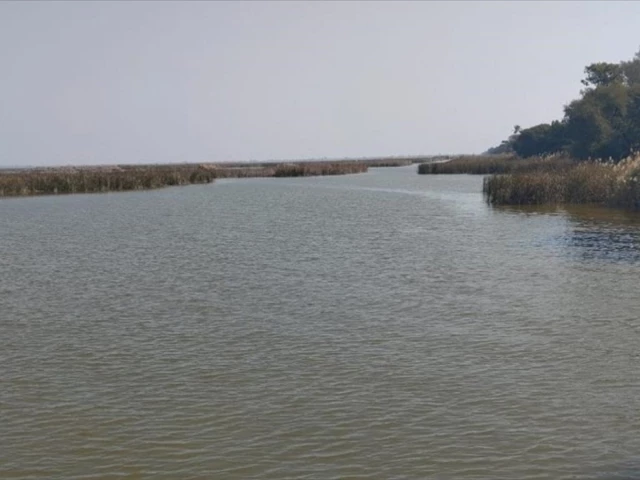
The lake is Pakistan’s first man-made reservoir and once a favorite wintering destination for Siberian birds
Surrounded by marshes and brackish lagoons, Lake Haleji was once the favorite destination for migratory birds who flew thousands of kilometers from Siberia to enjoy Pakistan’s warm waters during harsh winters.
Located about 100 kilometers from Karachi, the perennial freshwater lake is the country’s first man-made body of water.
The lake was commissioned in 1942 and was intended to supply fresh water to the British troops stationed in Karachi during the Second World War.
Until a decade ago, the sparkling blue waters of Haleji Lake would attract a large number of migratory birds due to its rich biodiversity.
But it currently presents a sad sight as reduced water levels, stagnant conditions, pollution and other climate-driven factors have turned the lake into a giant pond of stagnant murky water.
The lake would receive water from the mighty Indus River and has been one of the main sources of water supply to various parts of Karachi until 2018.
“There has been no inflow of fresh water from the Indus River into the lake during the last eight years, which has badly affected its health, besides disrupting the ecosystem,” said Sohail Ahmed Khoso, an official of the Sindh Wildlife Department.
speaks to Anatolia on the occasion of World Wetlands Day observed on February 2 every year, Khoso said that the inflow of water to the lake from the Indus River started to decline in 2000 and was completely stopped in 2018.
The water body, which has been declared a wildlife sanctuary, would attract the largest number of migratory birds in winter until a few years ago.
Number of migratory birds reduced
A narrow metal road swung through a desolate terrain of wild vegetation to hit the western shore of the lake, once a paradise for bird watchers.
Spread over 18 square kilometers, the lake is one of 19 Ramsar-certified water bodies in Pakistan.
Pakistan is a signatory to the 1971 Ramsar Convention on Wetlands of International Importance. It is named after the city of Ramsar in Iran.
The country’s once thriving wetlands, including Lake Haleji, long a haven for millions of migratory birds fleeing Siberia’s brutal winters, are witnessing a disturbing decline in bird visitors.
These birds make the 4,500 km journey from Siberia to India via the Indus Flyway, with stopovers at various lakes and water reservoirs in Pakistan.
Experts say a combination of prolonged drought, falling water levels and growing habitat degradation is driving these seasonal visitors away.
Sindh, a traditional favorite for migratory birds, has seen the most drastic decline. According to the Sindh Wildlife Department’s waterfowl census for 2024-25, the number of migratory birds fell sharply from 1.2 million in 2023 to 603,900 in 2024 and only 545,000 in 2025, a staggering drop of over 50% in two years.
According to Khoso, the number of migratory birds this year is reduced by 40% compared to 2025 due to lack of fresh water, disruption of the food chain and pollution.
Last year, around 40,000 visiting birds visited Haleji Lake after a gradual decline in their numbers.
“The current water levels in the lake are a result of the massive rains in 2022; otherwise, there has been no inflow or outflow of water during the last eight years,” he maintained.
To cope with the continuing food shortage, he added, the Wildlife Department arranges artificial foraging for visiting birds, which is understandably not sufficient.
Rafiul Haq, a Karachi-based ecologist, concurred in the view, fearing that the number may decline further in the coming years due to a regular decline in the health of the lake.
In the recent past, he said, over-extraction and alternative water supply systems have destroyed the ecosystem in the country’s “natural dams”, such as Lake Haleji.
“They are natural dams which need to be protected. But our priority is to build artificial water bodies which seem illogical and disruptive to the overall biodiversity and disturb the natural refuges of migratory birds,” he said. Anatolia.
Haq called for restoring water inflow to the lake to restore its biodiversity.
Home to the largest number of crocodiles
The reservoir is also home to the largest number of crocodiles in Pakistan.
According to Khoso, the lake is home to 400 to 500 crocodiles, which make up the largest population of the wild animal in the country.
Current estimates place the total crocodile population in Pakistan between 700 and 1,500.
In the 1970s, a few crocodiles were released into the lake to maintain the ecological balance and the natural food chain. Their numbers soon grew to hundreds.
Crocodiles are important to the ecological balance and natural food chain, said Attaullah Pandrani, a Balochistan-based ecologist who has been associated with several habitat and species conservation projects.
Crocodiles help maintain the population of edible fish by eating carnivorous fish, especially those belonging to the catfish family.


