
The megacity currently has only nearly 1,000 trained firefighters compared to the required number of 15,000 to 20,000
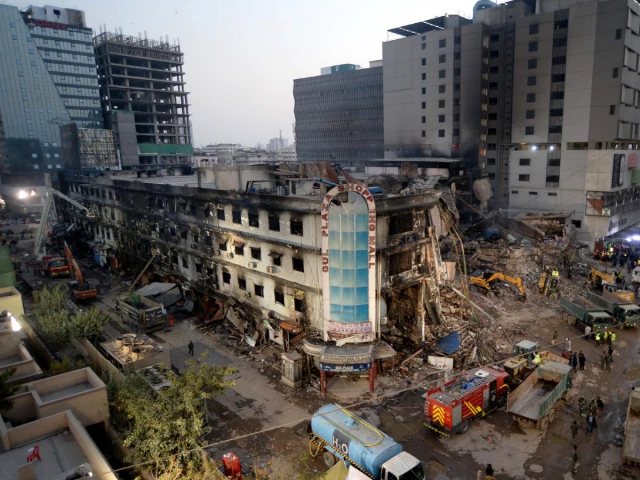
View of the site after the fire in the Gul Plaza shopping centre. Photo: PPI
Located in the heart of Karachi, Gul Plaza, a three-story mall where generations have found everything from imported tableware to the perfect pair of sandals, made headlines last month for all the wrong reasons.
A massive fire tore through the mall on the night of January 17, reducing the building that once housed 1,200 small and large shops to ashes and piles of smoke-blackened rubble, besides killing 80 people, many of whom are still missing.
While the fire was said to have been started by minors in a shop selling artificial flowers, findings also suggested that a lack of working fire exits and the density of shoppers and stalls crammed into the building exacerbated the situation.
Rescue workers took at least 10 days to comb through the remains of the 70,000 square meter complex built in the 1980s, raising questions about city management, fire safety and rescue capacity.
Dubbing the blaze – the deadliest in more than a decade – as only the tip of the iceberg, city planners fear the megapolis could see another such accident if immediate preventive measures are not taken, particularly strict implementation of fire safety rules and rescue capacity.
The country’s most populous city – home to over 20 million people – includes hundreds of malls similar to Gul Plaza, as well as both residential and commercial high-rises with only a few having proper fire safety mechanism, leaving them vulnerable to similar disasters.
Read more: Investigation reveals how Gul Plaza fire became a death trap
A 2023 fire safety audit conducted by the Sindh government found that only 6% of buildings in the city’s three major commercial centers were found to have a proper fire safety mechanism.
The report recommended that action be taken quickly to ensure fire safety regulations in the remaining buildings, but to no avail.
“Karachi is vulnerable to such incidents simply because of a number of issues related to unplanned urbanisation, densification, overcrowding and lack of management and rescue capacity,” said Amber Alibhai, general secretary of Shehri-Citizens for a Better Environment, a non-governmental organisation.
Transparency, no regulation of illegal constructions
speaks to AnatoliaAlibhai noted that rising demand for housing and lack of implementation of building and fire safety regulations has left buyers vulnerable to illegal construction where “fire safety is not a priority”.
Lapland’s building laws, she added, later allow these constructions to be legalized. She called for transparency in all commercial and residential construction approvals and no approval of illegal constructions.
Arif Hasan, a veteran architect, cited lack of planning, maintenance and monitoring, in addition to non-implementation of fire regulations as key factors behind massive losses in fire incidents in Karachi and other major cities.
“Fires occur and can occur anywhere in the world. The problems are their frequency, the government’s rescue capacity and the scale of human casualties,” Hasan told Anatolia.
He said a holistic approach which included planning, regular maintenance and monitoring and implementation of fire safety standards, including a modern fire fighting mechanism, could go a long way in mitigating the effects of such calamities.
Read also: Gul Plaza economic toll over Rs100b
“No new building should be handed over to the developer unless it meets all the fire safety regulations, whereas the government must ensure that the standing structure, especially high-rise buildings, follow the safety regulations,” he added.
Fire and politics
The latest incident, the worst since the 2012 Baldia factory fire that killed 289 people, has also highlighted gaps in governance, pushing the Pakistan People’s Party (PPP), which has ruled the province since 2008, into the back burner.
Opposition parties in Karachi, including the Pakistan Tehreek-e-Insaf and the Muttahida Quami Movement-Pakistan, as well as some shopkeepers accused the authorities of not launching a timely rescue and fire-fighting operation that could have saved several lives and contained the fire.
The provincial government and Karachi Mayor Murtaza Wahab denied the accusation but acknowledged the lack of security standards in the metropolis.
Sindh Chief Minister Syed Murad Ali Shah has now issued an ultimatum to the government and private offices and high-rises to implement fire safety standards.
Footage circulating on social media showed government officials visiting the city’s congested markets and buildings and persuading the owners to clear illegally occupied paths and introduce fire safety mechanisms.
‘Demoralized’ fire department
Last year, around 1,700 fire incidents, mostly small-scale, were recorded across Karachi, according to official statistics.
Karachi currently has only nearly 1,000 trained firefighters, compared to the required number of 15,000 to 20,000 in accordance with international standards.
Read this: SHC CJ appoints Justice Agha Faisal to head Gul Plaza inferno probe
The Karachi Metropolitan Corporation (KMC) has only 30 fire stations, 57 fire trucks and six ladder trucks to serve the sprawling metropolis, far fewer than global safety standards, which require one fire station per 100,000 people.
To make matters worse, several fire trucks have been out of service for several years.
According to Ishtiaq Ahmed Khan, a former chief fire officer, there is not a single faucet in the city dedicated to the fire service.
KMC has underground water tanks in several areas, but they too have been rendered dry for years due to water shortage, Khan told Anatolia.
“A fire engine has to drive an average of six to eight miles to retrieve water while maneuvering through congested roads before reaching the scene of the fire,” he said. “It gets even worse during rush hour.”
According to Khan, who retired in December 2024, the city has barely more than 700 firefighters, many of them without proper protective gear such as helmets.
So much so, he added, that fire service personnel have not been paid their risk allowance for several years. “They feel demoralized because of the current situation.”
Read also: MQM-P announces plots for Gul Plaza victims’ families
“I can tell you that the fire service has never been a priority for KMC officials. They don’t even bother to look into the cases in question,” he said.
Alibhai supported the view and also blamed people’s attitude towards security.
“Authorities and people in general don’t take fire safety seriously,” she said. “It’s a mindset.”


