
Says it benefits low-income consumers; Senators protest live stream censorship
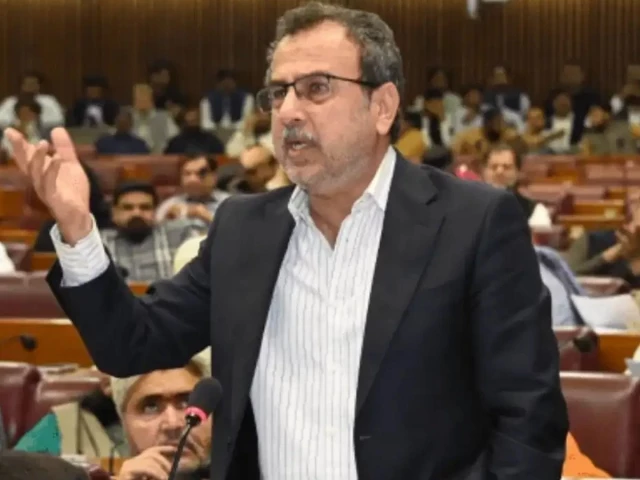
Minister of Power Awais Leghari. Photo: File
ISLAMABAD:
Energy Minister Awais Leghari on Tuesday defended the power regulator’s changes to rooftop solar and net metering during an angry Senate assembly that criticized the decision, saying the new rules were aimed at protecting poorer consumers.
The government is currently facing political backlash as the National Electric Power Regulatory Authority (NEPRA) abolished exchange of electricity units in solar net metering. At present, the buy-back rate for net solar generation is Rs25.9 per unit which can be reduced to Rs11 per unit. The contract period has been reduced from seven to five years. The burden of capacity payments is being shifted to solar consumers now.
Under the new rules, utilities will be required to buy excess electricity from prosumers, households, businesses and industries producing up to one megawatt at the national average energy purchase price, while selling electricity back to them at the prevailing consumer tariff, effectively ending one-to-one net metering.
Defending the move in today’s Senate meeting, Leghari said: “This is a change to the rules and it is the job of the regulator to change them according to the law and the constitution.”
He said the rules were not changed for the first time. “NEPRA has not changed anyone’s agreement and we have not said anything to the existing 466,000 net meters,” Leghari added.
The energy minister said the issue of net metering was not even part of the existing agreement. He said the government had told the consumers that whoever installed solar would in future get to buy electricity from them at the revised tariff.
Leghari said the move was for the benefit of low-income consumers, while the government had reduced electricity rates for industry.
“We have made electricity 20% cheaper for industry,” he said.
Leghari said the government had been signaling its direction for months and claimed the Solar Association of Pakistan had supported the need for the proposed move.
“The Solar Association of Pakistan also said that what the government wants to do is necessary,” he said, adding that the association suggested the changes be introduced after “five to six months”.
Leghari criticized the Pakistan Tehreek-e-Insaf (PTI) government, saying currency devaluation and higher electricity prices had worsened the situation.
“During PTI’s tenure, the value of the rupee depreciated three times,” he said. “In the founding of PTI’s government, electricity prices went through the roof.”
He said Pakistan planned to expand clean energy in its power mix.
“We need to reach 60% clean energy by 2030,” he said. “By 2034, 90% of electricity will come from clean energy. We are proud to be a clean energy country,” he said, adding that heating oil consumption last year was “0.3%” and that 24% of electricity generation still relied on imported fuel.
“Our reform methods are moving in a positive direction. Not only the World Bank but other international organizations have praised Prime Minister Shehbaz Sharif’s energy sector reforms saying the world has never witnessed such responsible and revolutionary reforms,” he said.
Read more: NEPRA rolls out new rules abolishing net metering
On Independent Power Producers (IPPs), Leghari said the government had reduced financial leakages and burdens in the system.
He said the government had stopped “Rs 3,400 billion” from going into what he described as the “pockets of tycoons” and removed 10,000 megawatts that the country planned to buy from the system.
Senator Zarqa Suharwardi earlier presented a resolution on the changes and solar policy, but Leghari opposed it and Parliament voted it down.
Speaking during the debate, Suharwardi called for a transparent policy on solar panels, saying IPPs were “looting this country” and should be shut down, and urged the government to adopt policies that provide relief to the public.
She called for a transparent solar policy and criticized IPPs.
“IPPs are looting this country – shut them down,” she said. “Policies should be made to facilitate the public.”
Senator Ali Zafar criticized the government’s stance on solar policy and accused authorities of protecting powerful interests at the expense of ordinary consumers. He said a minister had told Parliament the government would not withdraw its solar policy.
Zafar called IPPs “a very big mafia” and alleged that they were paid even when they did not produce electricity. He accused the government of targeting poorer people who had installed solar panels and criticized proposed changes to net metering.
“NEPRA has today given a policy that electricity will be bought from the public at Rs11 and sold at Rs40,” he said.
Zafar said the government would claim that NEPRA was an independent institution and the policy was its own, but rejected this claim.
“NEPRA is not an independent institution,” he said. “NEPRA makes the policy the government asks it to make.”
He said the law required the state to honor commitments, even those made to ordinary citizens, and warned that policy rollbacks would damage investor confidence.
Calling for the NEPRA chairman to be summoned and sent to jail, Zafar questioned whether the regulator had earlier urged the public to adopt solar and net metering.
In a post on X, Zafar said that tax breaks and incentives were given all over the world to promote green energy, “but in our country, the cruel policies of the rulers are ruining the lives of the people.
“It is cruel to stop net metering and force the population to buy expensive electricity. It is unacceptable to burden the people suffering from historic inflation and unemployment before the summer instead of providing relief. We will raise our voice against this anti-people policy in all forums.”
پوری دونیہ Tax exemptions for the promotion of green energy اوين عنرجی کے tax exemptions for the promotion ویمراعات د مجر امشری ملیک کی آلہنہ پیلیکہ پیلیکہ اوام کا جينا دوبهر کر کامہ کے net metering کے کے کو کو کو کو کو کو پر کے کلیک کرنہ کلمہ ہ Before summer, historical inflation and unemployment…
— Barrister Syed Ali Zafar (@SyedAliZafar1) 10 February 2026
Senator Sherry Rehman supported criticism of the government’s solar policy and supported the position taken by Senators Zafar and Suharwardi, accusing the authorities of breaking earlier assurances.
“Across the region, electricity is the most expensive in Pakistan,” she said. “There are very large government entities that are not paying bills.”
She said Pakistan was rapidly moving towards solar energy and cited Parliament as an early adopter. She also criticized Pakistan’s continued dependence on imported fuel.
Read more: Senate seeks judicial inquiry into capital attacks
Rehman accused the country’s power distribution system of deep corruption and warned that repeated tariff changes would undermine investor confidence, especially if distribution companies were favoured.
She said electricity bills had been turned into a tool for tax collection and questioned why consumers faced unannounced load shedding.
“We all pay tax on the electric bill,” she said. “You have added ten types of taxes and surcharges to the bill.”
Rehman warned that economic pressures were escalating, citing rising unemployment. She urged the government to fix the distribution companies and said the investors were on their way.
The suicide blast in Islamabad has risen to 36
During the session, Health Minister Mustafa Kamal told the upper house that the death toll from the suicide blast at an imambargah in Islamabad had risen to 36.
He said two victims died at the Polyclinic Hospital, one at the Pakistan Institute of Medical Sciences and another at a private hospital, while the remaining fatalities occurred on the spot before medical evacuation.
Kamal said several injured people were shifted to major hospitals in Islamabad for emergency treatment, but additional deaths were reported after hospitalization, bringing the confirmed toll to 36.
According to the minister, 15 injured people remained in critical condition, nine of whom are on ventilators, including seven patients at the outpatient hospital. He told lawmakers that all necessary medical facilities were provided and that there was no shortage of medicine, equipment or treatment.
Clarifying earlier conflicting reports, Kamal said the figures shared were official and verified, adding that the government was closely monitoring the situation.
Senators protest live stream censorship
The Senate session opened today with senators raising concerns about censorship of live streaming and continued debate over the recent Islamabad attack.
Several senators criticized the absence of live streaming during the proceedings. Rehman said the session was not live-streamed either yesterday or today and said she was recording a protest on behalf of all senators.
Read also: Senate panel criticizes CCI over provincial rights
Senator Zafar said that he had earlier raised the issue of speeches not being live-streamed, adding that earlier only their speeches were censored, but now the entire House was censored. The concerns about censorship came amid a longer discussion about terrorism.
نایب صدر پاکستان People’s Party Senator شیری رحمان کا سینت ستکیت ال
ٓآج تمام سنيترز کی کی کی کے کروانا کروانا کروانا کروانا هون, پھ سیست لیاو ستریم نہیں هو رہہ, شیری رحمان
In the beginning, only the live stream of the Qaumi Assembly was live.
— Pakistan Peoples Party – PPP (@PPP_Org) 10 February 2026
Senator Aimal Wali Khan questioned the state’s handling of extremism, saying the country had not clearly decided whether the group he referred to as Fitna al Khawarij was an enemy of the state.
He said that those who today are described as extremists were earlier labeled as fighters and later the mujahideen, and asked if those who facilitated the return of militants were not responsible for the consequences. He said such attitudes could not continue, adding that terrorism transcended colour, race and religion.
The Awami National Party chief said the constitution guaranteed the right to life and criticized the erosion of the National Action Plan (NAP), saying the same regime that received the plan had undermined it. He emphasized the need for a collective effort against extremism.
Senator Afnanullah Khan described the attack as part of a conspiracy to weaken Pakistan and warned that the country must not become part of this conspiracy.
Noting that the attack took place in a mosque attended by people from all sects, he questioned why terrorism had returned after it had been brought under control in 2018 through operations and a comprehensive policy. He said mistakes must be acknowledged or conditions would worsen.
Leader of the Opposition Allama Raja Nasir Abbas said that there was extensive debate on the terror incident but the Interior Minister was not present in Parliament and the government should show seriousness in such a sensitive issue. When the Speaker pointed out that four ministers were present, the Leader of the Opposition asked that the Home Secretary be at least shown to the House.
Senator Waqar Mehdi alleged that Indian Prime Minister Narendra Modi was behind terrorism in Pakistan and said Pakistan’s observance of Kashmir Solidarity Day on February 5 had angered India.
He said the February 6 incident was an attempt to weaken Pakistan and called for the implementation of the NAP. He also paid tribute to Aun Abbas, who he said risked his life during the attack and recommended that he be awarded the Tamgha-e-Imtiaz.


