
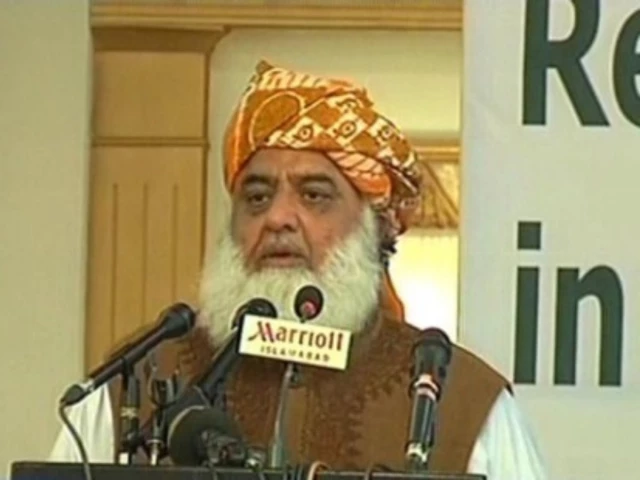
JUI-F chief Maulana Fazlur Rehman. Photo: File
ISLAMABAD:
JUI-F chief Maulana Fazlur Rehman on Tuesday warned the government and its coalition partners, saying he would not accept or obey any legislation that contradicts the Quran and Sunnah, even if such laws are passed by a parliamentary majority.
Addressing a gathering in Islamabad, the JUI-F emir said that obedience to laws based on disobedience to the Creator was neither permissible nor binding.
“Our position is very clear,” he said, adding that imprisonment or even execution did not deter him. “Imprisonment is a very small thing, and hanging is also a very small thing. If there is anything beyond that, we are ready to accept it.”
The Maulana said he was repeatedly told that politics was no longer the domain of “decent people” and asked why, as a “respectable man”, he remained in politics.
He rejected this notion, arguing that politics was really the management of national and collective life and an open field.
He said politics was the heritage and mission of the prophets and lamented that it had been reduced to a race for power through rigging and manipulation. “Those who reach power through rigging are called great politicians.”
Recalling his party’s ideological roots, the JUI-F chief said scholars from across the subcontinent, without sectarian discrimination, were part of the movement and his party had historically fought for both the caliphate and freedom. He emphasized that religious scholars were the heirs of the prophets and that just as none but scholars could stand on the pulpit of the prophet, no one else was more deserving of the seat of politics.
Slamming opportunism in politics, Fazl said that in today’s environment, individuals leave their parties if they do not receive election tickets. He added that although there were no idolaters or Jews in the community, their negative habits had seeped into the political culture.
Referring to the Qur’an, he said it also speaks of workers who remain sincere, while others become pleased when benefits are given and resentful when denied. He emphasized the need to recognize and confront this self-serving mindset.
He noted that politicians often claim personal piety, such as praying, but questioned the nature of the political systems and laws they imposed on the country. “We have no objection to anyone’s prayers or fasting,” he said, adding that the issue was about laws and governance, not individual worship.
The JUI-F emir said laws contrary to the Quran and Sunnah were often passed through majority voting and his refusal to accept such legislation was portrayed as a challenge to the law itself.


