
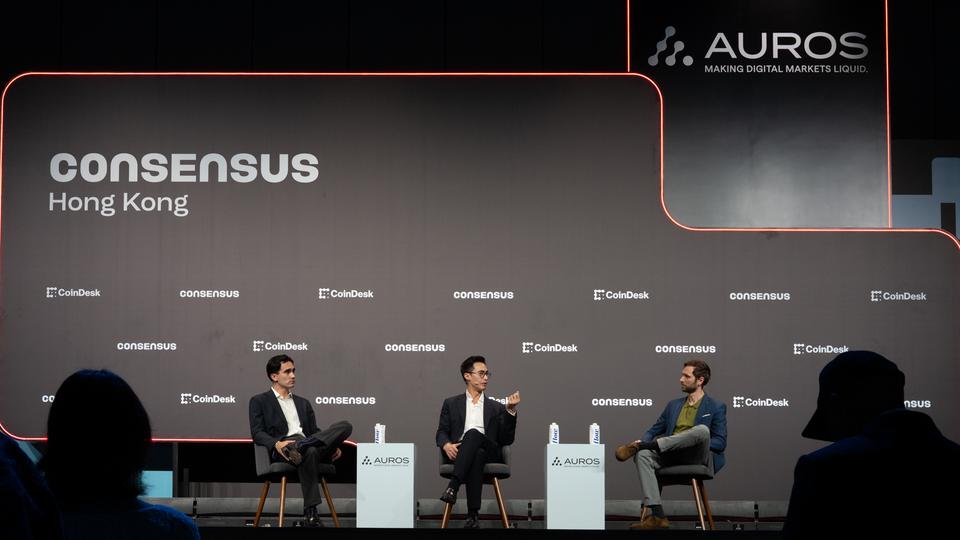
If there is a classic technology hype cycle attached to tokenization – the representation of any asset on blockchains like Ethereum – we are barely getting started.
That’s according to Min Lin, managing director of global expansion at Ondo, who pointed out that the US Treasury bond market alone is worth $29 trillion. Adding the global stock market pushes that value closer to $127 trillion, $69 trillion of which is in the U.S. alone, Lin said at CoinDesk’s Consensus Hong Kong conference.
But while the numbers are staggering and there is undoubtedly demand from traditional finance to explore tokenized real-world assets (RWAs), care must be taken when it comes to matching the hype with the real world, said Graham Ferguson, head of ecosystem at Securitize.
“The onus is on us to figure out how to distribute these, and I think historically we haven’t done a great job of attributing utility to these assets,” Ferguson said. “We have all these assets that we could tokenize. We have tons of different choices. We have to, we have to figure out how to reconcile that hype, how do we bring it together.”
It’s important not to “jump the gun on the regulatory side of things,” Securitize’s Ferguson pointed out. That said, the United States, The Securities and Exchange Commission (SEC) is waking up to the idea that tokenization can form the plumbing of future markets, and not just mean “isolated islands of compliance.”
“We’ve been around for a while talking about the benefits of settlement when it comes to tokenization and programmatic compliance built into the token standard itself, portability of those assets between KYC’d [know-your-customer] individuals,” Ferguson said. “We’re really pleased with the legislative clarity. No pun intended.”
Ondo’s focus is on efficiency. The firm has been busy tokenizing shares and EFTs and recently announced the introduction of Ondo Perps, whereby these tokenized shares can be used as collateral directly — instead of using stablecoins as collateral on exchanges or DEXs, Lin explained.
Basically, these firms’ different approaches to tokenization involve two design choices: In Ondo’s case, it’s about quickly and easily wrapping assets into a token; with Securitize, it’s about issuing securities built into the chain and smoothing out the jurisdictional compliance wrinkles associated with this process.
Securitze’s approach “has always been to do this in lockstep with regulators,” Ferguson said. “So in the US and the EU, or regulated as a transfer agent, as a broker-dealer, and we’ve always done things by the book,” he said.
This comes with challenges when working with DeFi protocols, Ferguson acknowledged, due to the need to track who the real owner of an asset is at any given time.
“In crypto and DeFi, we’re used to massive pools of assets, so we’re fixated on figuring out ways to work with these protocols so we’re able to implement the same tracking mechanisms that are needed to trade and transfer securities. And so that’s not necessarily the most DeFi-friendly approach,” Ferguson said.
For Lin of Ondo, tokenization falls into either a permissionless camp and a permission camp.
For example, OUSG, Ondo Short-Term US Treasuries Fund is available to a global audience and is permissioned, meaning users are only able to transfer this asset to whitelisted addresses.
On the other hand, Ondo Global Markets tokenizes publicly traded US stocks and ETFs, which is permissionless after a given compliance period, but is only available to non-US investors
“What we’ve done at Ondo is a packaging model for our Ondo global market products,” Lin said. “The permissionless approach allows us to operate and transfer freely peer to peer within DeFi. So you are able to use DeFi protocols to be able to leverage these products in lending and security margin.”
When it comes to tokenizing anything and everything, there is no doubt that this wrapper approach will get results faster; Ondo was able to tokenize BitGo shares about 15 minutes after the firm began trading on public markets, for example.
“This wrapper model basically allows us to scale much faster. Today we have about 200 plus tokenized stocks and ETFs. We’re looking to be able to scale that to thousands,” Lin said. “The wrapper model has been widely adopted. Stablecoins are essentially wrapped US dollars, and we have adopted a very similar model.”


