
Court orders specialist eye care for Imran; Allows telephone contact with sons; The government ensures compliance by 16 February at the latest
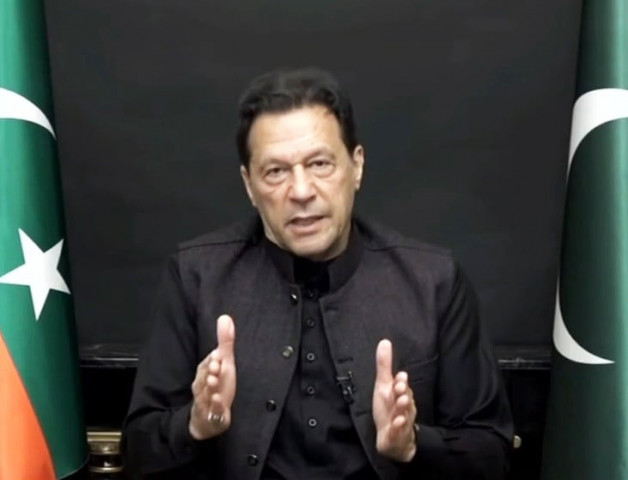
Pakistan Tahreek-e-Insaf (PTI) Chairman Imran Khan addresses the nation via a video link on Wednesday. SCREEN GRAB
ISLAMABAD:
In a major development, the federal government on Thursday assured the Supreme Court that PTI founder Imran Khan would be granted access to specialist ophthalmologists for a fresh medical assessment and allow telephone contact with his sons, Qasim and Salman, amid growing concern over his deteriorating eyesight in custody.
The assurances were given during the hearing of a case on facilities available to the jailed former prime minister in Rawalpindi’s Adiala Jail, presided over by a two-member SC bench headed by Chief Justice of Pakistan Yahya Afridi and comprising Justice Shahid Bilal Hassan.
While ordering authorities to ensure timely medical access, the chief justice stressed that Imran Khan, like all prisoners, was entitled to adequate health care but without preferential treatment.
“We absolutely do not want to say that the PTI founder should have facilities better than other prisoners,” CJ Afridi observed.
The proceedings began with senior advocate Latif Khosa appearing before the court as arguments resumed in petitions related to the Toshakhana criminal case. Engaging Khosa in a detailed exchange, the chief justice observed that the Toshakhana appeal appeared to have become fruitless.
Khosa acknowledged that under normal circumstances this would be correct, explaining that one motion involved calling defense witnesses, while the other sought a transfer of the case, but argued that the court could still examine the case in exceptional circumstances.
CJ Afridi stated that the appropriate forum should decide the issue, while Justice Shahid Bilal Hassan noted that substantive appeals were already pending before the High Court and interim orders had been consolidated.
The chief justice reiterated that the SC could not assume the role of an appellate court and must respect the jurisdiction of the high court. After arguments, the bench reserved its judgment in the case challenging the Toshakhana trial.
The court then turned to the issue of Imran Khan’s living conditions and medical treatment and summoned Pakistan’s Advocate General Mansoor Usman Awan to the lectern. The chief justice observed that reports submitted by friend of the court Salman Safdar and Adiala jail superintendent were largely consistent and drew attention to paragraph 21 of the report.
According to the report read out in court, Imran Khan expressed satisfaction with security arrangements, security measures and the food provided in the prison, but described the available medical facilities as unsatisfactory and specifically sought access to specialist ophthalmologists.
Noting that Imran Khan was currently lodged in a state suite, CJ Afridi reiterated that “all prisoners, including the PTI founder, must receive equal medical facilities”.
Attorney General Awan assured the court that the government was prepared to provide access to specialist ophthalmologists.
The chief justice noted that the government appeared to be “in good spirits” and added that it was also important to allow Imran Khan telephone contact with his children.
“We have confidence in the government. The government is in a good mood today,” the chief justice observed, ordering that access to medical specialists and phone calls with Imran Khan’s sons be arranged at the earliest. The Attorney General said the arrangements would be finalized within two to three days.
In its written order, the SC recorded the attorney general’s assurance that there would be access to eye specialists and telephonic contact with Qasim and Salman by February 16.
However, the court rejected a request to allow a family member to be present during Imran Khan’s medical examination. During the hearing, lawyer Salman Safdar had sought permission for the PTI founder to be examined by eye specialists in the presence of a family member, but the chief justice said the court could not give such a direction.
On a request to provide additional books to Imran Khan, the chief justice said that books could be provided if the doctors allow it, stressing that health issues took precedence. “The issue of Imran’s health is most important,” CJP Afridi observed, adding that “intervention was necessary”.
Attorney General Awan reiterated that it was the state’s responsibility to provide medical care to prisoners. “If the prisoner is not satisfied, then the state will take action,” he said.
The court praised the role of the friend of the court and also praised the government for facilitating medical arrangements. Addressing the bench, Safdar said he had received more than 100 calls and messages, including from his wife, seeking details of his jail visit.
“I told them this was a trust from the court and I couldn’t reveal anything – not even to my wife,” he said.
Medical team
Earlier, the SC had ordered the formation of a medical team to examine Imran Khan’s eye after Safdar’s report quoted the PTI founder as saying that “only 15 percent” vision was left in his right eye. The court also ordered that both the medical examination and telephone contact with his children be completed by February 16.
Safdar, who met Imran Khan in Adiala jail on Tuesday as amicus curiae, submitted a seven-page report detailing the former prime minister’s living conditions. In it, he quoted Imran as saying that “despite the treatment given (including an injection), he has been left with only 15 per cent vision in his right eye”.
Imran told Safdar that until October 2025 he had “normal 6 x 6 vision in both eyes”, after which he began experiencing persistent blurred and blurred vision. He said he repeatedly reported the issue to the then superintendent of prisons, but “no action was taken by the prison authorities”.
The report said: “[Imran] stated that he subsequently suffered a sudden and complete loss of sight in his right eye, after which an ophthalmologist from Pims Hospital, Dr. Muhammad Arif, was summoned to examine him. According to [Imran]he was diagnosed with a blood clot that caused serious damage, and despite the treatment administered (including an injection), he has been left with only 15 per cent. vision of the right eye.”
Safdar added that he “personally observed that the petitioner appeared visibly disturbed and deeply distressed by the loss of sight and the absence of timely and specialized medical intervention”.
“Throughout the meeting, the petitioner’s eyes were watery and he repeatedly used a napkin to wipe them, reflecting physical discomfort,” he recalled.
The report further stated that Imran claimed that “regular and periodic blood tests” were not carried out and that while his personal doctors Dr. Faisal Sultan and Dr. Asim Yusuf had previously been granted access, “despite repeated requests and a worsening ocular condition, such access was not permitted during the relevant period”.
Imran also claimed that the only treatment given for almost three months consisted of eye drops which did not lead to any improvement and was followed by a major loss of vision. He also stated that, despite his 73-year-old age, he had not been examined by a dentist for two years, despite repeated inquiries.
Safdar said prison staff informed him that Imran was currently under the care of Pims’ Dr. Arif and that his vital signs were recorded three times daily. He also clarified a day earlier that any statements attributed to him regarding Imran’s health off the court record were “misrepresented and misreported”.
Meanwhile, a medical report dated February 6, signed by Pim’s CEO Professor Dr. Rana Imran Sikander, also submitted to SC. Addressed to the Adiala prison administration, the report said a full ophthalmic assessment was carried out and a diagnosis of “right central retinal vein occlusion” was made, recommending hospital-based follow-up treatment.
Dr. Sikander recalled that Imran Khan was brought to Pims on the night of January 24 for a medical procedure. “The treatment plan, i.e. the need to administer anti-VGEF intravitreal injection, was fully explained to the patient. Hence, an informed consent was obtained,” he said, adding that the procedure was completed smoothly in about 20 minutes.
Safdar noted in his report that the medical note from Imran’s family did not “contain full details of the episodes” or identify the ophthalmologist who performed the tests and administered the treatment.
Reacting to the development, Imran Khan’s son Kasim Khan said in a post on X that his father’s condition was a “direct consequence of 922 days of isolation, medical neglect” and alleged that the responsibility lay with those in power. He also said he and his brother Sulaiman were still being denied visas to visit their father.
Meanwhile, Information Minister Attaullah Tarar said the narrative of ill-treatment spread by Imran Khan’s family had “fallen flat” in view of the reports filed in the court, adding that all facilities were available to the PTI founder.
After the conclusion of the proceedings, the SC closed the hearing.


