
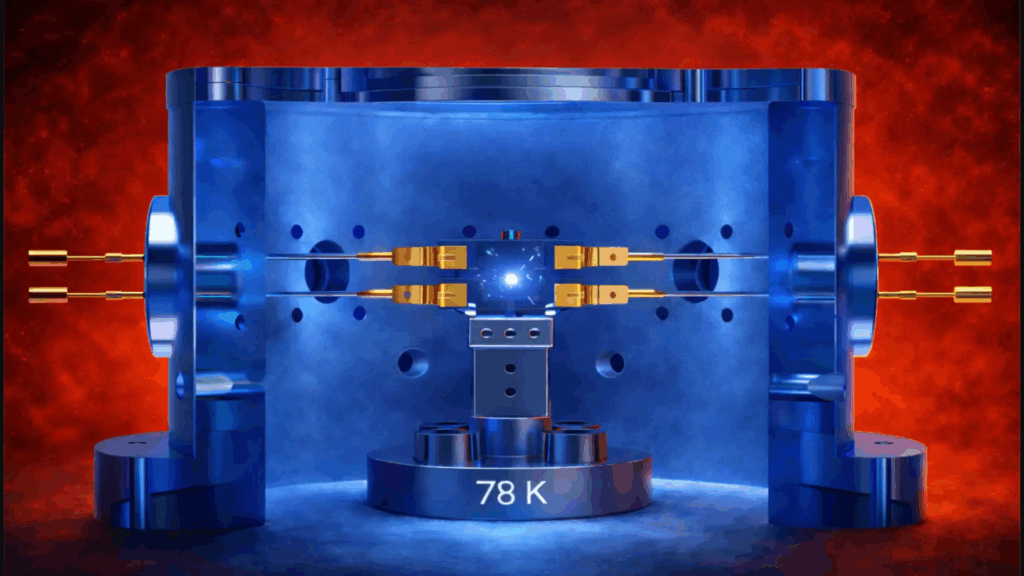
- China’s optical strontium clock now participates directly in international atomic timekeeping
- Optical clocks operate at higher frequencies than cesium, allowing finer measurement resolution
- Accuracy requirements reach one second over billions or tens of thousands of years
China has received formal international recognition for an ultra-precise optical grid clock after its calibration data was accepted into the global timekeeping system.
The approval allows the country’s NIM-Sr1 strontium atomic optical lattice clock to participate directly in the calculation of International Atomic Time, a role previously dominated by a few nations using cesium-based standards.
This development moves China from contributing data indirectly to becoming part of the core mechanism that defines global time.
Access to international time calibration
Developed by the National Institute of Metrology, the watch has passed review by the International Bureau of Weights and Measures, which oversees the global time standard.
Its data has now been incorporated into the system used to calculate International Standard Time, meaning that the clock’s measurements are no longer experimental references, but actively used in conjunction with other leading atomic clocks worldwide.
Such participation reflects a level of stability and repeatability that must be demonstrated consistently over long periods of time.
Traditional cesium atomic clocks define the current international second and can remain accurate to within a second over hundreds of millions of years.
Optical clocks are important because they operate at much higher frequencies, enabling far greater measurement precision than cesium clocks, effectively enabling accuracy on the scale of a second over billions or even tens of thousands of years, at least under controlled conditions.
Such precision exceeds what is required for everyday timekeeping, yet becomes essential for advanced scientific and technical systems.
For example, ultra-precise clocks are a backbone in satellite navigation, telecommunications synchronization, high-frequency trading systems, and deep space exploration.
Small timing errors can accumulate to large position or coordination errors across global networks, and as systems become more interconnected and faster, the tolerance for timing drift continues to decrease.
Optical clocks are expected to largely replace cesium clocks as the basis for redefining the second in the future.
Participation in international calibration allows a country to influence how this transition develops, rather than conforming to standards set elsewhere.
It also provides redundancy in the global system, which relies on contributions from multiple independent laboratories to maintain stability.
In addition to civilian applications, accurate national timekeeping supports secure communication and independent operation during periods when international coordination may be disrupted.
In addition, this clock reduces the dependence on any single clock and improves the resilience of timekeeping operations.
Via ITHome (originally in Chinese)
Follow TechRadar on Google News and add us as a preferred source to get our expert news, reviews and opinions in your feeds. Be sure to click the Follow button!
And of course you can too follow TechRadar on TikTok for news, reviews, video unboxings, and get regular updates from us on WhatsApp also.


