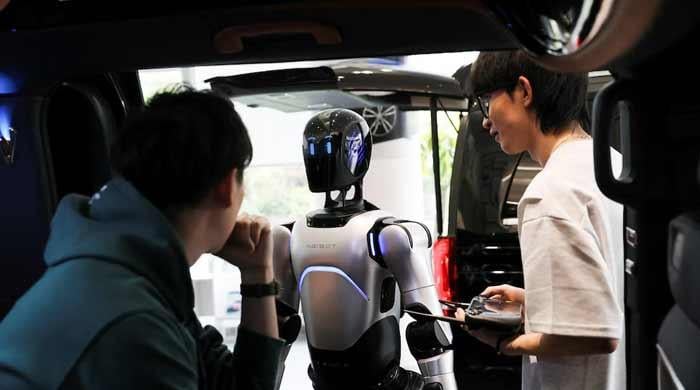
China’s most-watched television show, the annual CCTV Spring Festival gala, on Monday showcased the country’s cutting-edge industrial policy and Beijing’s efforts to dominate humanoid robots and the future of manufacturing.
Four new humanoid robot startups — Unitree Robotics, Galbot, Noetix and MagicLab — demonstrated their products at the gala, a televised event and touchstone for China comparable to the Super Bowl for the United States.
The program’s first three skits prominently featured humanoid robots, including a lengthy martial arts demonstration in which over a dozen Unitree humanoids performed sophisticated combat sequences, brandishing swords, poles and nunchucks in close proximity to human child performers.
The fight sequences included a technically ambitious one that mimicked the wobbly movements and backwards falls of China’s “drunken boxing” style of martial arts, showing innovations in multi-robot coordination and error recovery – where a robot can get back up after falling down.
The program’s opening sketch also featured Alibaba’s AI chatbot Doubao, while four humanoid Noetix robots performed alongside human actors in a comedy skit, and MagicLab robots performed a synchronized dance with human performers to the song “We Are Made in China.”
Ipos planned
The hype surrounding China’s humanoid robot sector comes as major players including AgiBot and Unitree prepare for initial public offerings this year, and domestic artificial intelligence startups release a range of frontier models during the lucrative nine-day Lunar New Year holiday.
Last year’s gala wowed viewers with 16 full-sized Unitree humanoids twirling handkerchiefs and dancing in unison with human performers.
Unitree’s founder met President Xi Jinping weeks later at a high-profile technology symposium – the first of its kind since 2018.
Xi has met five robotics startup founders in the past year, comparable to the four electric car and four semiconductor entrepreneurs he met in the same time frame, giving the nascent sector unusual visibility.
The CCTV show, which drew 79% of live TV viewers in China last year, has for decades been used to highlight Beijing’s technology ambitions, including its space program, drones and robotics, said Georg Stieler, Asia managing director and head of robotics and automation at technology consultancy Stieler.
“What sets the gala apart from comparable events elsewhere is the immediacy of the pipeline from industry politics to primetime acting,” Stieler said.
“Companies that perform on the gala stage receive tangible rewards in government orders, investor attention and market access.”
China’s forces
Behind the spectacle of robots running marathons and performing kung-fu kicks and backflips, China has placed robotics and AI at the heart of its next-generation AI+ manufacturing strategy, betting that productivity gains from automation will offset pressures from its aging workforce.
“Humanoids bring together a lot of China’s strengths in one narrative: AI capability, hardware supply chain and manufacturing ambition. They are also the most ‘readable’ form factor for the public and officials,” said Beijing-based technology analyst Poe Zhao.
“In an early market, attention becomes a resource.”
China accounted for 90% of the roughly 13,000 humanoid robots shipped globally last year, far ahead of US rivals including Tesla’s Optimus, according to research firm Omdia.
Morgan Stanley projects that China’s humanoid sales will more than double to 28,000 units this year.
Elon Musk has said he expects his biggest competition to be Chinese companies as he pivots Tesla toward a focus on embedded AI and its flagship humanoid Optimus.
“People outside of China underestimate China, but China is a next-level ass-kicker,” Musk said last month.