
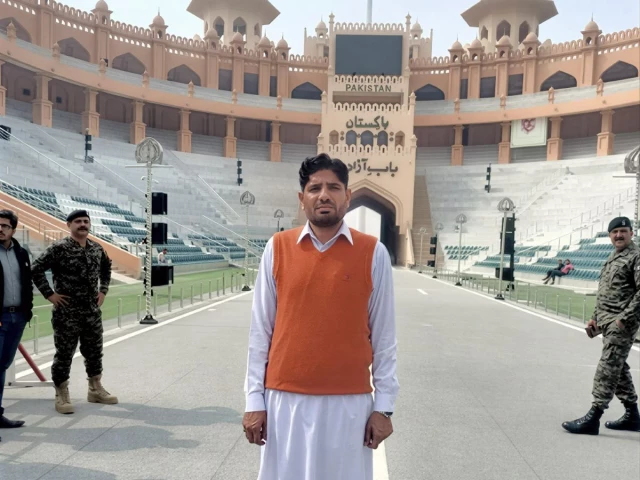
Kasur’s Muhammad Shahid Iqbal Bhatti arrives at the Wagah border after being released by the Indian authorities
Pakistan’s High Commission in New Delhi said its sustained efforts secured Bhatti’s release and return. PHOTO: ASIF MEHMOOD
LAHORE:
A Pakistani national has returned home after spending nearly 18 years in an Indian jail, the Pakistan High Commission in India announced on X.
Muhammad Shahid Iqbal Bhatti, a resident of Kasur, arrived at the Wagah-Attari border where he was received by officials after his release from Indian custody. Bhatti was detained in 2008 after entering India via Nepal in 2005 and remained imprisoned until his recent repatriation.
The commission said its sustained efforts secured Bhatti’s release and return. Security officials said Bhatti will undergo routine checks before being handed over to his family. The mission reaffirmed that it will continue to work for the release and return of other Pakistani prisoners lodged abroad.
Muhammad Shahid Iqbal Bhatti, a Pakistani national imprisoned in India, was today repatriated to 🇵🇰 via the Wagah-Attari border. @PakinIndia will continue to work towards the release and repatriation of all Pakistani prisoners in Indian jails.
@ForeignOfficePk pic.twitter.com/FAcNhC0iSa— Pakistan High Commission, India (@PakinIndia) 17 February 2026
Pakistan and India exchange lists of prisoners and fishermen held in each other’s custody twice a year – on January 1 and July 1 – under the 2008 Consular Access Agreement.
According to the list exchanged on January 1 this year, 424 Pakistani nationals, including 391 civilians and 33 fishermen, remain in Indian jails. In turn, Pakistan’s list submitted to India included 257 Indian prisoners, comprising 58 civilians and 199 fishermen, held in Pakistani jails.
The prisoner list exchange allows both countries to monitor detention proceedings, arrange consular access and pursue repatriation of people who have completed their sentences. Although the Wagah-Attari border is generally closed due to bilateral tensions, it is occasionally opened for humanitarian transfers, such as the return of prisoners.
Bhatti’s return follows this established process and highlights ongoing diplomatic efforts to resolve long-standing foreign detainee cases in both countries.


